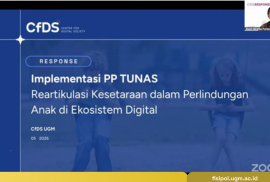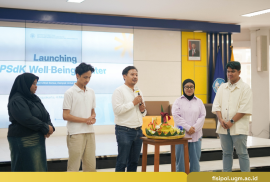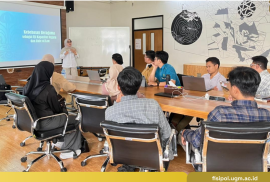
Yogyakarta, May 2nd 2025─The Department of Social Development and Welfare (PSdK) of FISIPOL UGM held the May edition of Social Development Talks entitled “The Future of Children’s Online Interaction: Protection and Freedom in PP Tunas” on Friday (2/5). Held online through the Zoom platform and attended by more than 100 participants, the May edition of Social Development Talks presented two speakers who have expertise in child protection issues, namely Tata Sudrajat (Save the Children Indonesia and PSdK Doctoral Program Student) and Chairani, S.Psi., M.Dist.St (Associate Expert Social Counselor, Policy and Institutional Working Group Coordinator, Directorate of Child Social Rehabilitation, Ministry of Social Affairs of the Republic of Indonesia).
News
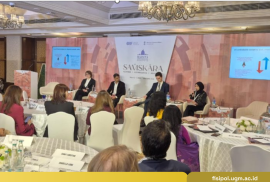
Yogyakarta, 30 April 2025–Concerns about the return of the role of the military and police in the civilian space have surfaced again. Located at the 4th Floor Auditorium of the Faculty of Social and Political Sciences UGM, the Department of Sociology UGM, together with the Department of Sociology UI and Social Research Center (SOREC) UGM held a public discussion entitled “The Return of Uniformed History: Challenging the Military and Police State of the Republic of Indonesia”. The discussion was presented by Dr. Arie Sujito (Department of Sociology UGM), Dr. Joash Elisha Tapiheru (Department of Politics and Government UGM), Dra. Jaleswari P., M.Hum. (LAB 45), Prof. Dr. Iwan Gardono S. (Department of Sociology, University of Indonesia), Najib Azca, Ph.D. (Department of Sociology, UGM) and Nurul Aini, M.Phil. as moderator.
Yogyakarta, April 30th 2025─Department of Communication Studies of FISIPOL UGM, held a book review event Social Media and Politics in Southeast Asia. The event invited the speaker and author of the book, Prof. Merlyna Lim (Canada Research Chairs in Digital Media & Global Community Network); the discussant, Prof. Dr. Phil. Hermin Indah Wahyuni, S.I.P., M.Si. (Lecturer of Communication Studies of UGM and Professor of Communication Systems); and moderated by Mashita Pitaloka Fandia Purwaningtyas S.I.P., M.A. (Lecturer of Communication Studies of UGM). This event was held offline at the Seminar Timur Room and broadcast live on the YouTube channel of the Department of Communication Studies UGM.
“Countries which are reliant on the coal industry have more difficulties in reaching the decarbonization target,” Indri mentioned in a public lecture titled “Unlocking the Climate Future: What Keeps Us from Climate Action” on Monday (28/4) at the Fisipol UGM Auditorium. This public lecture was organized by UGM’s Department of Public Policy and Management in collaboration with the Deutsche Gesellschaft für Internationale Zusammenarbeit (GIZ).
Yogyakarta, 21st of March, 2025—UGM’s Faculty of Social and Political Science supports the government efforts at carrying out a nation-wide energy transition scheme towards clean energy. Through intense cooperation with the Ministry of Energy and Mineral Resources of the Republic of Indonesia and the British Embassy in Jakarta, the MENTARI Initiation was organized on Friday (21/3) at Fisipol UGM.
Indonesia has strengthened its commitment towards Zero Emission by updating its National Energy Policy. It is stated that in 2023, as much as 23 percent of the total primary energy supply comes from sustainable energy.In the year 2050, it is targeted to be as high as 31 percent. Unfortunately, the progress towards the development of clean energy for Indonesia’s primary energy supply is stagnant, stuck at somewhere around 12 percent. This urgency requires various parties to collaborate with each other and create breakthrough innovations, so that it can endorse the utilization of clean renewable energy that is both stable and capable to accommodate the energy needs of the people.
Nurhadi, S.Sos., M.Si., Ph.D., as Vice Dean of Finance, Asset, and Human Resources Affairs of Fisipol UGM, mentioned that climate change has become one of the research umbrella for the faculty that oversees various important agendas. “Everywhere we go we can feel clean rooms, or clean air. However, where does it all come from? As a country, our energy still relies on coal. Fulfilling clean energy becomes a challenge towards resource exploitation to be controlled,” Nurhadi mentioned.
Yogyakarta, 21 March 2025–The FISIPIT Charity Fun Ride is a sharing program by the Faculty of Social and Political Sciences (Fisipol) cycling community, Universitas Gadjah Mada. This time, FISIPIT held various actions with the disability group “Paguyuban Bangkit Bersama” on Friday (21/3). The event was held through a gathering and breakfasting with several education staff and lecturers at Resto Numani, Parangtritis, Yogyakarta.
Paguyuban Bangkit Bersama is a Yogyakarta disability group whose members are mostly earthquake victims. When it was initiated in 2012, the first 30 members joined to raise the spirit and empowerment as a disability. Paguyuban representatives expressed gratitude to the FISIPIT Charity Run for providing meaningful support for the association’s sustainability.
Melbourne, 20 March 2025–The Faculty of Social and Political Sciences, Universitas Gadjah Mada (FISIPOL UGM), participated in a discussion organized by the Global Humanities Alliance (GHA) entitled “What Does Decolonizing Knowledge Mean from Different Geographical and Disciplinary Perspectives?”. FISIPOL UGM is one part of GHA, which is a forum for cooperation between 8 universities in the world to contribute to global discourse in the field of social humanities that focuses on responding to international issues.
Yogyakarta, March 19th 2025─The Department of Sociology, Faculty of Social and Political Sciences (Fisipol) held a Public Discussion and Book Review on “Political Sociology: Contemporary Perspectives and Approaches Reflecting on Young People’s Political Practices” on Wednesday (19/3). Together with a number of political and sociology experts of Fisipol UGM, the discussion raised the urgency in political perspectives apart from political actors and media.
Delivered by lecturer of the Department of Sociology, Dr. Lambang Trijono, the writing of the book was motivated by unrest over political discourse that pays less attention to social perspectives. “There is a desire to develop where politics is. I noticed that political discussions do not see the reality in our society,” he said. So far, political discussions have been closely related to the narrative of power and authority of the government as a political actor. However, the community as a group that has sovereignty in a democratic system is neglected.
Dr. Atalia Oniliu, a lecturer from the West University of Timisoara explained that the efforts in recognizing non-formal education in Europe began in 2001. The people realized that the presence of non-formal education does not only function as a complement to formal education, but it can also help hone self competencies and character. “We see non-formal education as something that is important. It can help hone character, culture, and soft skills that you would not typically experience in formal education,” Atalia mentioned.
Through cooperation and teamwork between the European Commision and the European Education Council for Non-Formal Education, the International Standard Classification of Education (ISCE) was created. This regulation gives several classifications and requirements so that non-formal education could be recognized according to its categories. These steps can help improve awareness of the importance of non-formal education to Romanian citizens, as well as achieve recognition in career paths.
“We emphasize that non-formal education is a part of long-life learning and honing soft skills. With that, it should be ensured that while non-formal education does not hand out diplomas like formal education does, there are still levels and special recognition,” Atalia added. The Romanian government currently has two main objectives in ISCE. First is to provide materials that formal education does not provide. The second is to reach all levels of society and achieve social inclusivity.
Yogyakarta, 11 March 2025–In commemorating International Women Day 2025, Fisipol Crisis Center (FCC) held a live Instagram event titled “Setara Bukan Sekadar Kata” (Equal is not just a word). The event, which was hosted by Nurul Amaliah (Master Student of DPP UGM), also presented speakers who enriched each other’s perspectives, namely Maygsi Aldian Suwandi, S.Sos., M.A (Lecturer of PSDK UGM) and Valenidha Sulafi (Peer Counselor CDC Fisipol UGM). This multi-perspective discussion aims to raise the issue of gender equality, challenges that are still faced, and concrete efforts that can be made to realize inclusive and sustainable equality.