Arsip:

Publication

Rethinking Indonesia’s Electric Vehicle Transition: FISIPOL UGM Scholar Highlights Industrial and Social Justice Dilemmas

Prof. Suharko, a lecturer in the Department of Sociology at the Faculty of Social and Political Sciences, Universitas Gadjah Mada, has published a study examining the challenges of Indonesia’s electric vehicle (EV) transition. The work highlights tensions between industrial downstreaming strategies and emerging risks of delocalization within the broader energy transformation agenda. 

Adopting a sociological perspective, the study critically assesses EV policies framed as part of green development and industrial modernization. It argues that downstreaming—while aimed at increasing resource value—may generate new inequalities if local communities and workers across the supply chain are not adequately protected.  read more
Unpacking Conflict, Shaping Policy: DMKP FISIPOL UGM Publishes National Anthology

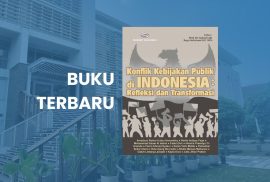
Lecturers and students from the Department of Public Policy and Management, Faculty of Social and Political Sciences, Universitas Gadjah Mada, have published a national anthology titled “Public Policy Conflicts in Indonesia: Reflection and Transformation.” The book is co-authored by Gabriel Lele, Bagus Sulistiono, and students as part of a collaborative academic initiative. 

The anthology examines a wide range of public policy conflicts in Indonesia—from agrarian and environmental issues to socio-cultural tensions. Using a conflict transformation approach, it not only maps the roots and dynamics of conflict but also proposes more inclusive, participatory, and equitable policy alternatives.  read more

Bringing Peace to the Classroom: FISIPOL UGM Lecturer Publishes Innovative Peace Pedagogy in an International Journal

A lecturer from the Department of International Relations, Faculty of Social and Political Sciences, Universitas Gadjah Mada (FISIPOL UGM), Suci Lestari Yuana, S.I.P., M.I.A., together with Teresa Gaia Sebayang, has recently published an international scholarly article titled “Acting Out Peace: The Role of Dramaturgy in Peace Studies in Higher Education.” The article appears in the reputable journal Teaching in Higher Education (Taylor & Francis), one of the leading global references in critical education studies. read more

The Impact of the Pandemic and Governance Challenges: New Research by a FISIPOL UGM Lecturer on Local Government Finance

Bevaola Kusumasari, Ph.D., a lecturer from the Department of Management and Public Policy (DMKP), Faculty of Social and Political Sciences (FISIPOL) UGM, has once again demonstrated her contribution to the international academic arena. She recently published a scholarly article entitled “Local Government Financial Performance and Decentralization in Indonesia.”

This publication examines the financial performance of local governments in the context of decentralization in Indonesia. Drawing on data analysis from 66 cities and in-depth interviews in 4 cities, the study highlights how financial performance measures—such as degrees of decentralization, independence, direct spending, and local revenue growth—are used to evaluate local financial governance. read more

Driving Just Transitions: Latest Publication by an HI FISIPOL UGM Lecturer in the Annual Review of Environment and Resources

One of the lecturers from the Department of International Relations (DIHI), Faculty of Social and Political Sciences (FISIPOL) UGM, Suci Lestari Yuana, Ph.D., has once again achieved international academic recognition. Together with her collaborators, she has recently published a scholarly article in the prestigious journal Annual Review of Environment and Resources, titled “Transformative Innovation Policy: An Analytical Review of Key Methods and Challenges.”

The article discusses Transformative Innovation Policy (TIP), a new generation of innovation policy designed to address increasingly complex social and environmental challenges—from energy and food crises to mobility systems that remain entrenched in unsustainable modes of production and consumption. The authors emphasize that merely improving technologies or financial instruments is no longer sufficient. Systemic innovations and transformative policies are needed to enable just transitions, ensuring both social justice and planetary health. read more

WhatsApp Workflow: When a Message Can Save National Food Production

New Release: Megashift FISIPOL UGM Article
“Digital Orchestration for Indonesian Agriculture: From WhatsApp Workflow to Food Security”
By: Setiawan Guntoro

Megashift FISIPOL UGM has once again published an article that sparks discussion on the future of agriculture and food security in Indonesia. This piece highlights a simple yet revolutionary idea: how an everyday app like WhatsApp can become the backbone of agricultural digitalization.

The article sheds light on a long-standing issue in agriculture, particularly in broiler farming: the slow flow of field data from farms to management, which often leads to delayed and risky decision-making. Many agritech startups have failed because their applications did not match farmers’ habits. However, WhatsApp—used by 9 out of 10 Indonesians—emerges as an alternative solution. read more

Political Satire in the Digital Age: From Jokes to Democracy

New Release: Megashift FISIPOL UGM Article

“Satirical Comedy in the Digital Public Sphere: A Contemporary Form of Political Participation”
By: Ardi Muhammad Rifqi
____________________

Megashift FISIPOL UGM has published a fresh article exploring how satirical comedy on social media has become a creative and powerful form of political participation in today’s digital era. Written by Ardi Muhammad Rifqi, the article dissects how humor, memes, and stand-up comedy content are reshaping political discourse in Indonesia.

The article highlights three main drivers behind the rise of satire: the accessibility of social media platforms, the growing popularity of stand-up comedy, and restrictions on free expression under regulations like the ITE Law. Within this context, satire emerges as a safe yet sharp tool for citizens to voice criticism and hold political actors accountable. read more

FISIPOL UGM Scholars Address Youth and Inequality in The Palgrave Handbook of Global Social Problems

Two Sociology lecturers from the Faculty of Social and Political Sciences, Universitas Gadjah Mada (FISIPOL UGM), Oki Rahadianto Sutopo and Fuji Riang Prastowo, have contributed their latest academic work to an internationally renowned reference book, The Palgrave Handbook of Global Social Problems.

In their chapter entitled “Young People and Inequality in Indonesia”, they examine how social inequalities in Indonesia generate a series of social, economic, and political challenges for the younger generation. Despite Indonesia’s high universal literacy and numeracy rates, social mobility remains limited, and youth wages are still low—particularly since more than half of the domestic economy operates in the informal sector. read more

FISIPOL UGM Lecturer Highlights Impact of Indonesia’s New Capital Development on Indigenous Communities in Latest Publication

Vandy Yoga Swara, lecturer at the Department of Social Development and Welfare (PSdK), Faculty of Social and Political Sciences (FISIPOL) Universitas Gadjah Mada, has recently published his latest scholarly work in the international journal Habitat International (Elsevier). The article, titled “River’s End: The Violence of Indigenous Riverine Urbanization in the Making of Indonesia’s New Capital,” was co-authored with Kei Otsuki and Femke van Noorloos (Utrecht University, Netherlands) as well as Michelle Kooy (IHE-Delft Institute for Water Education, Netherlands). read more

From Fields to Power: When Farmers Become Clean Energy Producers

Latest article from Megashift FISIPOL UGM
“Energy Transition from the Fields: Agrivoltaics Meets Agroforestry”
By: Fikri Danang Himawan

This article explores the concept of agrivoltaics — the integration of solar panels and agriculture on the same land — and how this system can be combined with agroforestry, a land management practice that integrates trees, food crops, and/or livestock. The combination of these two approaches offers a solution to address the challenges of renewable energy, food sustainability, land-use efficiency, and climate change adaptation. read more