
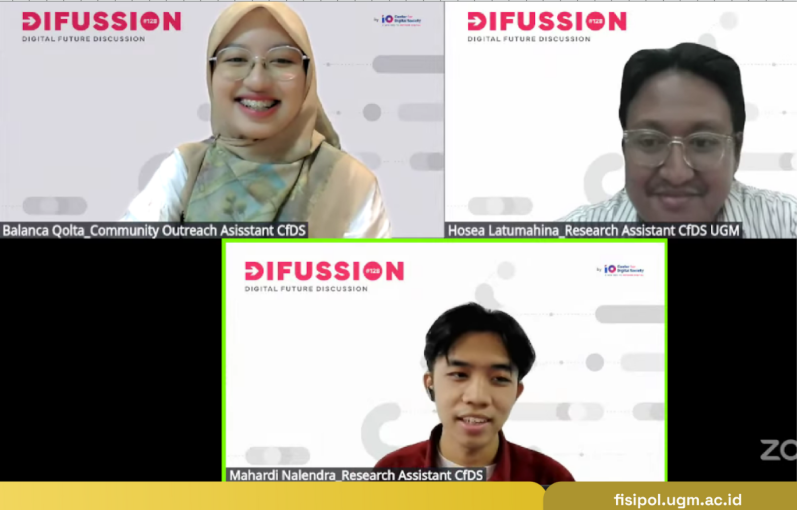
Yogyakarta, October 15th 2025─Artificial Intelligence (AI) is now a hot topic that is not only discussed in academic circles, but also in industry and public policy. Through DIFUSSION (Digital Future Discussion) #128 entitled “Indonesia’s AI Trajectory: From Hype to Investment Challenges,” the Center for Digital Society (CfDS) UGM traces the journey of AI in Indonesia, from technological euphoria to the real challenges in building a sustainable ecosystem that is in line with national interests.
This discussion featured two young speakers from CfDS, Hosea Immanuel and Mahardi Nalendra Syafa, with Balanca Qolta as the moderator. The three of them analyzed the phenomenon of AI in Indonesia, which poses real challenges related to investment in its development so that it can be carried out in a sovereign, inclusive, and sustainable manner.
In his presentation, Hosea Immanuel highlighted the Indonesian government’s plan to establish a Sovereign AI Fund, a national financing instrument designed to support the development of artificial intelligence and accelerate the growth of the digital market in the region. According to him, this initiative has the potential to be a major driving force in building a sovereign and competitive AI ecosystem. However, Hosea also warned that the plan still faces a number of fundamental challenges.
“Based on the results of the CfDS analysis, there are two main issues that need attention. First, the absence of a legal regulatory framework that can accommodate the plan. Second, the lack of clarity in conceptual and operational planning,” said Hosea.
To date, Indonesia does not yet have specific legal regulations governing the establishment and governance of sovereign funds for the digital technology and AI sectors. Without a legally binding framework, the Sovereign AI Fund risks lacking strong legal legitimacy, making its governance practices vulnerable or weak.
Another challenge lies in the lack of thorough planning, ranging from funding sources and financing schemes to mechanisms and investment return projections. The absence of a clear roadmap could potentially make the Sovereign AI Fund a less robust instrument in terms of financing resilience and sustainability.
Hosea emphasized that without a strong regulatory and planning framework, the Sovereign AI Fund initiative could lose its direction. “We need to ensure that the policy and governance foundations are solid so that AI investments are not merely symbolic, but truly impactful for Indonesia’s digital independence,” he said.
Through DIFUSSION #128, CfDS UGM seeks to open a research-based dialogue space to strengthen the direction of AI policy and investment strategies in Indonesia. This discussion not only highlights the economic opportunities of artificial intelligence technology, but also emphasizes the importance of a solid regulatory and governance foundation so that its implementation is inclusive and sustainable, as outlined in Sustainable Development Goal (SDG) number 9: Industry, Innovation, and Infrastructure.