
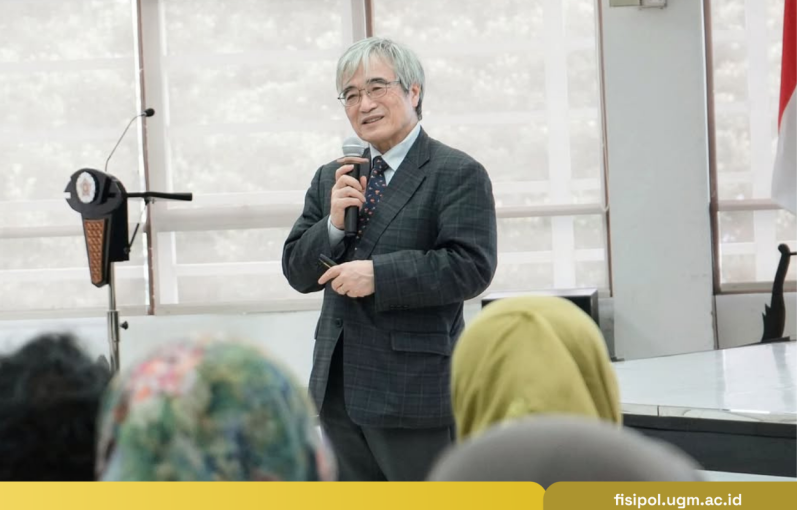
Yogyakarta, March 31, 2026─The Department of International Relations, Faculty of Social and Political Sciences (FISIPOL) of Universitas Gadjah Mada (UGM), in collaboration with the Japan International Cooperation Agency (JICA), held a public lecture titled “JICA Chair Public Lecture: A Japanese Approach to International Cooperation” on Tuesday (31/3) at the 4th Floor Mandiri Auditorium, FISIPOL UGM.
The event was presented by Prof. Kato Hiroshi from the International University of Japan and moderated by Drs. Siti Daulah Khoriati. This public lecture was part of the Japanese Political Economy and International Relations course in the International Undergraduate Program in International Relations (IUP in IR) and the Japanese Political Economy and International Relations course in the regular Bachelor of International Relations study program.
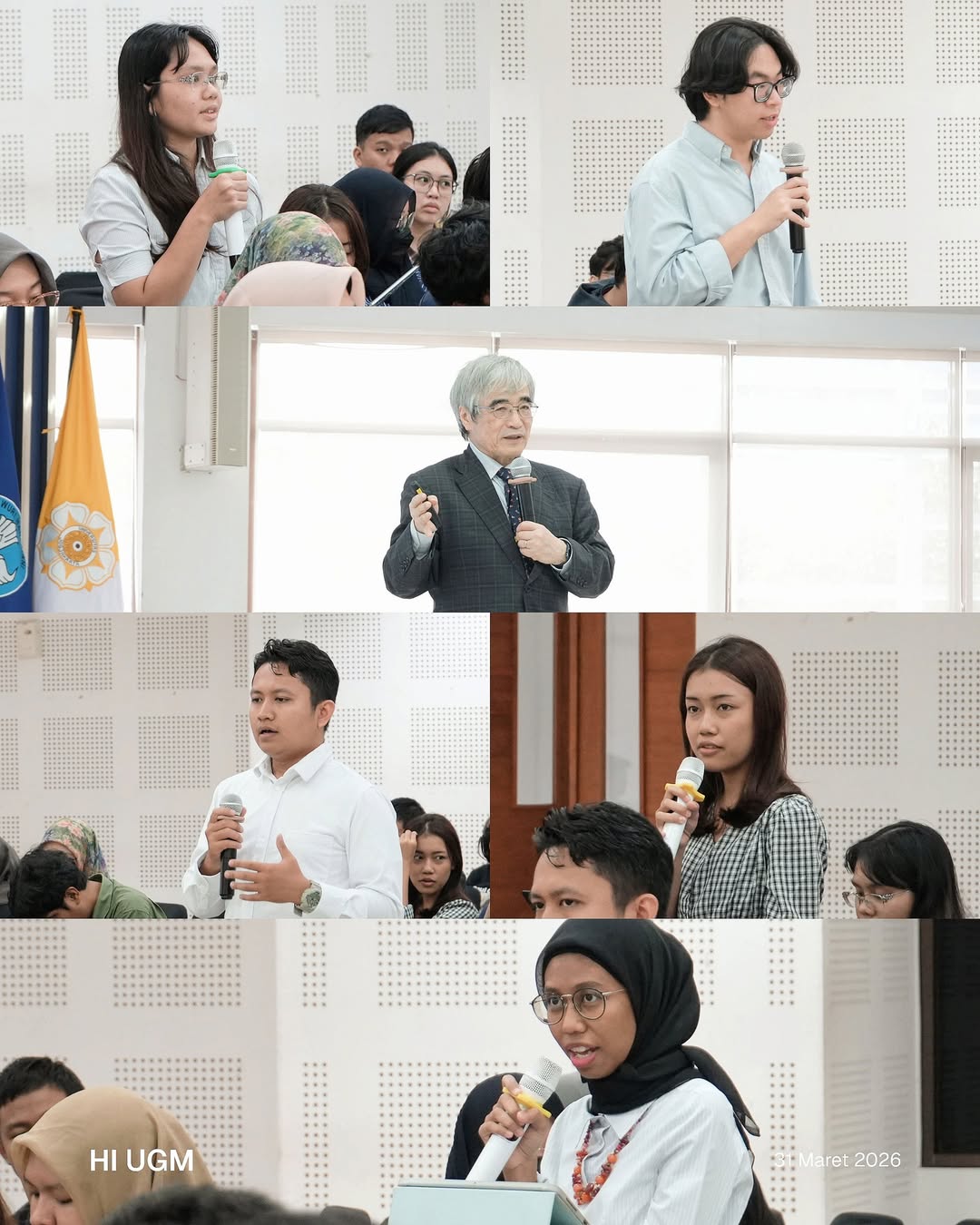
Prof. Hiroshi Kato explained that Official Development Assistance (ODA) has been a key instrument of Japan’s post-World War II foreign policy. During this period, Japan shifted its focus from military development to economic development through ODA (Organization for Development Assistance) to rebuild its economy, while simultaneously improving relations with Asian countries and gaining re-acceptance into the global community. ODA instruments include soft loans for infrastructure, grants for social projects, and technical cooperation through training, volunteering, and emergency assistance.
During the question-and-answer session, one participant inquired about the direction of Japan’s foreign policy, particularly through JICA, towards Indonesia, given that Indonesia and Japan are no longer each other’s primary trading partners. Prof. Kato stated that Japan still views Indonesia as an important partner. Under JICA, the focus on Indonesia is no longer as a country in need of aid in the traditional sense, but rather as a development cooperation partner. Therefore, the focus of JICA assistance in Indonesia now shifts to sectors such as infrastructure development, human resources, and sustainability programs.