
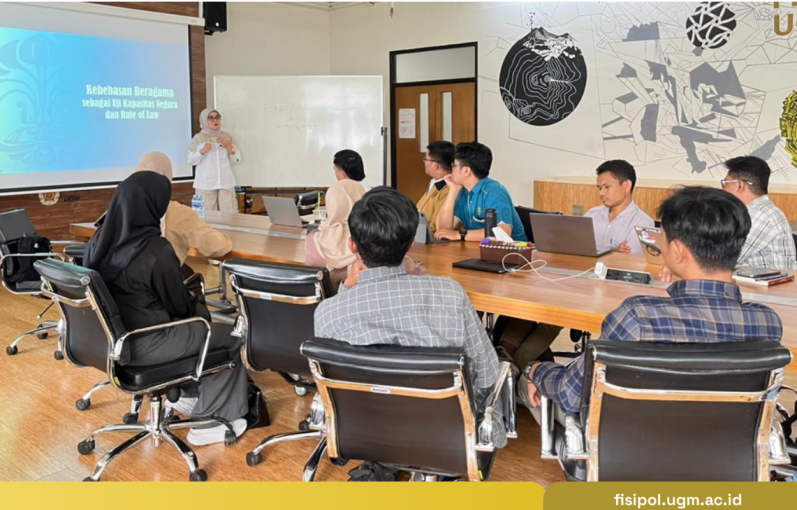
Yogyakarta, May 8, 2026─The Department of Politics and Government (DPP) of the Faculty of Social and Political Sciences (FISIPOL) UGM reaffirms its commitment to advocating for democracy and human rights issues. Through the Master’s Program in Political Science, DPP FISIPOL UGM organized a guest lecture titled “Religious Freedom as a Test of State Capacity and the Rule of Law” on Friday (8/5). The event, held at the Big Data Lab, featured Dr. Hurriyah, an academic from the Department of Political Science, Faculty of Social and Political Sciences (FISIP) Universitas Indonesia (UI), as the guest lecturer.
This guest lecture is part of the Political Institutions and Democracy course taught by Dr. Abdul Gaffar Karim. In this forum, the discourse on Freedom of Religion or Belief (FoRB) is not merely viewed as an abstract human rights issue, but rather as an empirical instrument to dissect the extent to which a state is able to carry out its functions democratically and fairly.
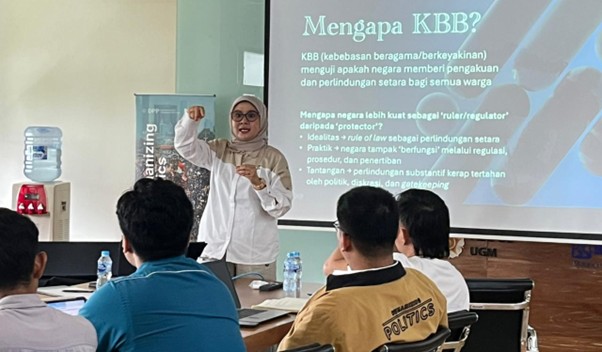
Dr. Hurriyah emphasized that the FoRB issue is a real “laboratory” for testing the quality of political institutions. It tests whether the state is capable of providing equal recognition and protection for all citizens without exception. “How the state manages this negotiation and contestation demonstrates the extent to which the state has the capacity to regulate and treat the rule of law—whether it is highly flexible and loose, or conversely, strictly firm,” said Hurriyah.
Hurriyah also shared her research findings in Sumba regarding the penghayat kepercayaan (indigenous faith believers) community. She recounted how administrative barriers create a domino effect on the fulfillment of basic human rights. Many believers face difficulties in obtaining a marriage certificate because their faith is not officially recognized by the state administrative system. As a result, their children do not possess legal birth certificates.
Without birth certificates, these children struggle to access basic education. Administrative requirements, such as an identity card that includes a religion column, become a major obstacle. If the religion column is left blank, their belief is considered non-existent, which ultimately leads to the non-issuance of an ID card (KTP). “So it is not just their religion and beliefs that are unrecognized, but their right to access administrative public services is completely denied,” Hurriyah asserted. This phenomenon demonstrates that without the recognition of FoRB, a person’s citizenship rights can be entirely lost.
For FISIPOL UGM, hosting this guest lecture serves as a strategic space to encourage postgraduate students to think critically beyond academic texts. By dissecting cases of marginalization like the one in Sumba, students are urged to see that state capacity is measured by its ability to protect the most vulnerable. It is hoped that this discussion will generate new perspectives in the formulation of more inclusive public policies and strengthen the pillars of democracy in Indonesia.