
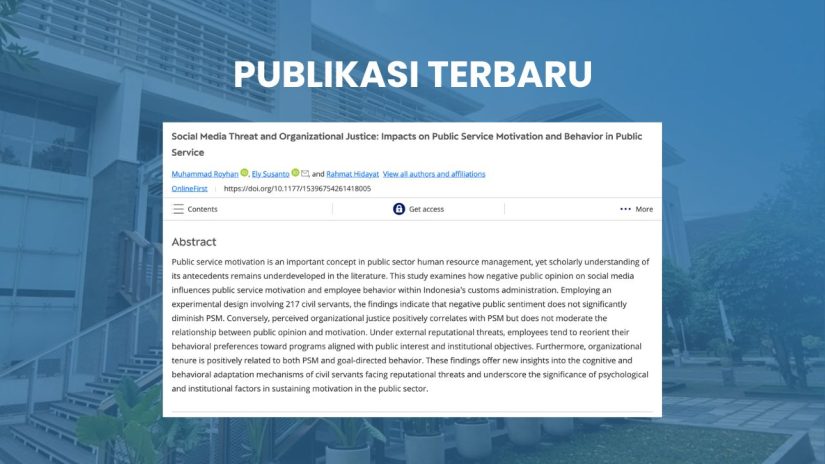
A lecturer from the Department of Management and Public Policy (DMKP), Faculty of Social and Political Sciences, Universitas Gadjah Mada (FISIPOL UGM), Ely Susanto, has released his latest academic publication together with Muhammad Royhan and Rahmat Hidayat. The article, titled “Social Media Threat and Organizational Justice: Impacts on Public Service Motivation and Behavior in Public Service,” has been published in the internationally reputable Chinese Public Administration Review, marking an important contribution to contemporary public administration scholarship.
The study addresses an increasingly relevant issue in the digital era: how public opinion pressure, especially negative sentiment on social media, influences the motivation and behavior of civil servants (ASN). Using an experimental approach involving 217 civil servants in Indonesia’s customs sector, the research offers new insights into psychological and institutional dynamics shaping public service motivation amid increasingly complex reputational challenges.
The findings indicate that negative sentiment on social media does not significantly weaken public service motivation. Instead, perceived organizational justice plays an important role in enhancing civil servants’ motivation, although it does not moderate the effect of public opinion on motivation. Under external pressure, civil servants tend to adapt their behavior to remain aligned with institutional goals and public interests, and tenure is also positively associated with motivation and goal‑oriented behavior.
This research makes a significant contribution to the public administration literature by deepening understanding of how civil servants respond to reputational threats in the digital era. It further underscores the importance of psychological factors and institutional justice in maintaining performance and integrity in the public sector.
The study’s contributions align with efforts to achieve SDG 16 (Accountable and Responsive Institutions) and SDG 8 (Decent Work and Economic Growth) by highlighting the need for a productive and quality public service environment.