
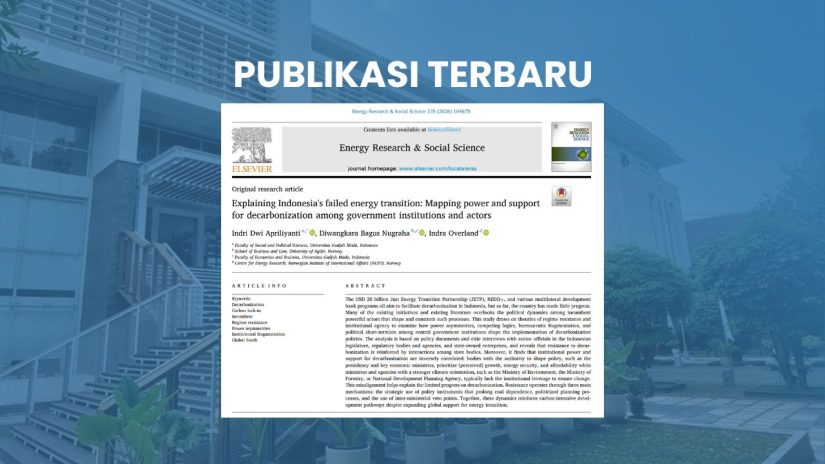
A lecturer from the Department of Management and Public Policy (DMKP), Faculty of Social and Political Sciences, Universitas Gadjah Mada (FISIPOL UGM), Indri Dwi Apriliyanti, along with Diwangkara Bagus Nugraha and Indra Overland, has once again demonstrated her academic contribution at the global level through an international journal publication. The article, titled “Explaining Indonesia’s Failed Energy Transition: Mapping Power and Support for Decarbonization among Government Institutions and Actors,” has been published in the reputable Energy Research & Social Science, marking an important achievement in the study of energy transition and policy politics in Indonesia.
This research addresses the crucial issue of why various energy transition initiatives in Indonesia—such as the Just Energy Transition Partnership (JETP), REDD+, and programs supported by multilateral development agencies—have yet to achieve their full potential. Rather than focusing solely on technical or economic aspects, the study highlights often overlooked political dimensions, especially the power dynamics among government actors and institutions in determining the direction of decarbonization policy.
Using theoretical approaches of regime resistance and institutional agency, the study finds that power imbalances, differing institutional interests, bureaucratic fragmentation, and short‑term political orientations are key factors hindering the transition to clean energy. Powerful institutions tend to prioritize economic growth, energy security, and affordability, while those focusing on climate change issues have limited influence in policy decision‑making processes.
Further, the study reveals that resistance to decarbonization operates through mechanisms such as policy instruments that maintain dependence on coal‑based energy, planning processes laden with political interests, and inter‑institutional veto practices. These conditions ultimately reinforce carbon‑based development pathways, even as global pressure and support for energy transition continue to grow.
The findings make a significant contribution to the energy transition literature, underscoring that success in decarbonization is not only determined by global commitments but also by the configuration of power and domestic governance. This research is relevant to efforts to achieve SDG 7 (Affordable and Clean Energy), SDG 13 (Climate Action), and SDG 16 (Peace, Justice, and Strong Institutions), particularly in strengthening effective institutional governance for sustainable public policy.