
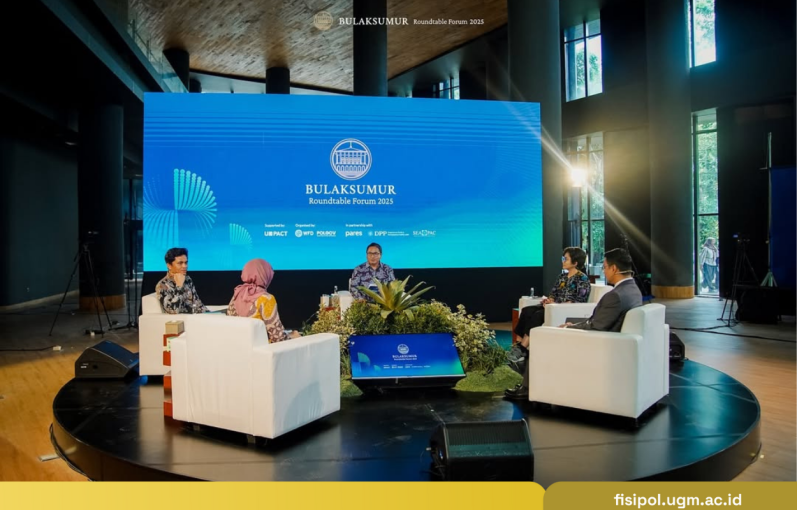
Climate change is not a problem that centers on a single root cause. Collaboration and understanding are needed, as systems greatly influence their impact. Government policy is key to ensuring that this issue does not create deeper divisions between communities. Instead, good national policy in addressing climate change must be inclusive and equitable.
Patra added that, like it or not, many climate change challenges need to be prepared for. This is especially true as global support in the financial sector is beginning to shift towards this issue. However, climate action in Indonesia has grown organically within communities. This means that public awareness of climate change has already started to grow. The government must be able to formulate grassroots-based policies that can reach the smallest units of society.
In line with this, Abdul Gaffar Karim, the Head of the Department of Politics and Government (DPP) at UGM, said that the key solution in this case is collaboration. Academics cannot move forward without research commercialization, industry cannot move forward without academic research, and the government cannot implement policies effectively without the support of academics and industry. Therefore, the commitment to realizing a green government must be strengthened through multi-sector synergy.
The speech of the British Ambassador to ASEAN, Helen Fazey, supported this statement. According to her, ASEAN is one of the regions most affected by climate change. Geographically, ASEAN consists of islands with strong agricultural and maritime characteristics. Green government policies need to be implemented to strengthen the potential of these natural resources, particularly in the areas of food security and renewable energy. Furthermore, ASEAN has the potential to contribute to addressing climate change globally.
“Through forums, politicians, communities, and academics, we can find creative initiatives to increase ambition, strengthen green government, and fight climate change,” said Helen.
At the Bulaksumur Roundtable Forum 2025, the Department of Politics and Government, Faculty of Social and Political Sciences, UGM, launched the ASEAN Environmental Democracy Observatory Report & Datasets together with the Westminster Foundation for Democracy (WFD) in a number of Southeast Asian countries: Cambodia, Indonesia, Malaysia, Myanmar, the Philippines, Singapore, Thailand, and Timor-Leste. This assessment was managed by the Research Center for Politics and Government (PolGov) together with assessment partners in the seven other countries. This collaboration is expected to encourage democratic, equitable, and inclusive green government policies in ASEAN for the benefit of society.