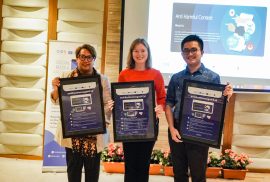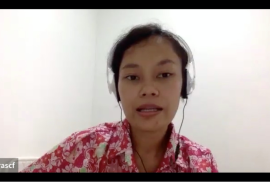
Yogyakarta, March 8th 2022─The UGM Update Series that is routinely held by UGM Yogyakarta is back with the Postgraduate Talk series that talked about three favorite magisters in the social humanities cluster. One of the magisters is the Communication Studies Magister from the Faculty of Social and Political Science. In this session, Drs. I Gusti Ngurah Putra, M.A. as the Secretary of Communication Studies was chosen as the speaker. According to him, the communication studies department is still relatively young. However, it has been able to launch graduates who now work in multiple sectors, starting from the corporate sectors, to communication manager, organizations, and media.
News
“Teamwork means that there is an individual’s ability to cooperate well in achieving common goals and that its members are able to participate with the characteristics of having a purpose, trusting each other, supporting and being responsible for the task,” Sholeh explained.
In addition to mentioning teamwork issues, Sholeh also explained his explanation regarding leadership. This concept becomes important in seeing that leadership is the ability of an individual to influence and guide other members. In addition, Sholeh also mentioned several leadership skills that at least a prospective leader must possess, namely the ability to communicate, be creative, be able to motivate, delegate, provide feedback, and be responsible.
Yogyakarta, March 2nd 2022─The Department of Politics and Government (DPP) Fisipol UGM collaborated with Citizen Engagement, Transparency & Transnational Natural Resource Governance (CitRes) to hold a public lecture with the title “The Politics of Energy Transition and the Ukrainian Crisis”. The speakers, which consisted of lecturers from DPP Fisipol UGM and researchers from CItRes, talked about the political side of the EU’s effort in transitioning their energy which affects the EU’s stance towards Russia’s invasion in Ukraine that started last February until now. Nanang Indra Kurniawan, a DPP lecturer, explained that the effort to lower carbon emission under the Net Zero 2050 vision means that the EU needs gas supplies from Russia and Norway to fulfill their energy needs. Both of those countries play an important role in sustaining the EU’s energy transition. On the other hand, EU citizens’ energy consumption also increased during the Covid-19 pandemic. Therefore, even though renewable energy is already developed in Europe, that energy is still unable to sustain the energy consumption needs in the region.
Russian President, Vladimir Putin, views the expansion of membership as a signal of the ‘betrayal’ of the countries that won the Cold War against Russia, which does not want the expansion of NATO post-Cold War.
“Currently, NATO’s actions to expand its membership to the east threatens Ukraine’s position as the ‘last fortress’ for Russia. If Ukraine joins NATO, the borders between Russia and NATO will coincide,” Muhadi explained.
Muhadi suspects that Russia is currently experiencing anxiety over the prospect of losing buffer zones that can support its security, especially Ukraine. Today, Russia is demanding something that has long been ‘on its claim’. “The Ukraine issue has even become a ‘life and death’ for Russia’s security and geopolitics. And in desperation, it is feared that Russia could make nuclear weapons an option, whether forced or not.” Muhadi said.
In this discussion, Rimun focuses on discussing equitable development in the case of infrastructure development—chosen because of its tangible form, occupying space and time aspects so that it is closely related to social and environmental issues, and touches many aspects of the element of justice. Based on Rimun’s experience and observations, justice is indeed easy to write and formulate. Unfortunately, justice is also not easy to implement, realize, coordinate and fight for. To clarify this point and its context with infrastructure development, Rimun gave several examples of cases, such as the case of Tuban, Merpati Beach, and Wadas.
Prof. Dr. Suharko opened his speech by talking about the Covid-19 pandemic condition that has created a condition of worry and uncertainty in our society. Therefore, an analysis of risks in sociology studies needs to be developed, considering that the physical, spatial, and social environment changes rapidly in the Anthropocene era. “In the era of advanced modernization, the production of wealth is systematically accompanied by the production of risks. The problems and conflicts that arise from the unequal production of wealth then intersect with problems that come from the production, definition, and risk distribution created techno-scientifically. This is what we call a society of risk, which refers to an era where risk-aware thinking is the dominant way of thinking in confronting urgent and potential problems.” said Prof. Suharko in his speech.
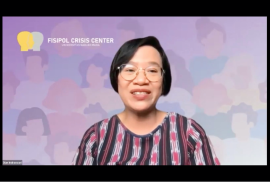
Yogyakarta, February 16th 2022─Fisipol Crisis Center (FCC) Fisipol UGM held a webinar titled “When Dating Turns Violent: Notice the Red Flags and What to Do” on Wednesday (16/2). The event held through Zoom Meeting invited Putri Khatulistiwa, a Community of Practice Officer of Siklus Indonesia as the speaker.
In her discussion, Putri talked about how to create a healthy relationship, also widely known as a relationship goal. According to her, even though there’s always the good and the bad in a relationship, if things are starting to go out of line, we need to start paying attention to the relationship’s red flags so we don’t get stuck in a toxic relationship.
Yogyakarta, February 7th 2022─Fisipol UGM’s Center for Digital Society is back with the 26th OPOSIT with the title “Is the Digital Space Safe from Sexual Violence?” on Monday (7/2). The event that was held through @cfds_ugm’s Instagram Live invited Duke from University of Indonesia Criminology and Puke from University of Indonesia Sexuality and Gender Study Center.
Sexual violence is a term which belongs to a bigger concept which is the Online Gender-based Violence. Contained in the Online Gender-Based Violence term is the privacy violation, surveillance, defamation of reputation or credibility, violation which can be complemented by online violation, direct violence and threat, as well as targeted attack towards certain communities.
In the Private Data Protection Bill, an opportunity of privacy violence can be highlighted in which citizen’s data can be taken for the purpose of the state’s data collection. However, there is not one part in the bill which mentions the parties who will be authorized to take the data. This is a dangerous loophole because the ambiguous third party can weaken law enforcement and surveillance.
“Take for example the instance when we are being recorded but the party who does this isn’t responsible which, in many events we’ve seen recently, leads to data leakage. Data collection is important for the state, however from the law perspective, we still don’t feel safe about this,” Fatah Yusi said.
Yogyakarta, February 4th 2022─The first Fisipol Open Days were held by the Faculty of Social and Political Sciences UGM with the theme “Socialization of Academic and Mixed Lectures” on Friday (4/2). The event, which took place via Instagram Live @fisipolugm, presented speakers Wawan Mas’udi (The Dean of Fisipol UGM) and Poppy S. Winanti (Vice Dean for Academic & Student Affairs of Fisipol UGM). The latest academic guide for all lecturers and students of Fisipol UGM was finalized in mid last January. Some of the things formulated in the guide are the issue of Merdeka Learning Campus Merdeka (MBKM), fast track programs, and academic ethics outside the scientific study program. Wawan Mas’udi said that the MBKM system is an SKS (Semester Credit Unit) conversion and is more emphasized as a method to achieve knowledge and competence outside the study program.