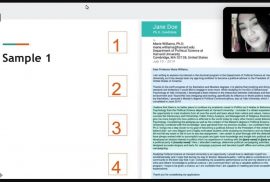
Yogyakarta, October 15th 2020—Global Engagement Office or GEO Fisipol UGM came back with Exposure Talks. Having previously managed to attract many participants with the theme of the LPDP Scholarship, in its seventh series, Exposure Talks brought a topic about “Chevening 101” by presenting two Chevening Scholarship awardees as the speakers, Retno Lestari Ningsih, M.Sc., dan Yasinta Ariesti, S.I.P. The GEO Fisipol UGM designed this Exposure Talks to be more productive, by providing essay writing workshops in the event. After it was opened at 01.05 p.m. by the short speech of the topic and the introduction of speakers by presenter and moderator. Retno as the first speaker was also invited to directly deliver the material.
News
Yogyakarta, October 15th 2020—The anniversary of Fisipol which is always celebrated lively, felt different this year. Because, in its 65th anniversary, it was celebrated in the middle of a pandemic era that is full of challenges. Because of that, Fisipol reflected the challenges that its faced through reflective discussion called “Social Sciences and Higher Education in a Pandemic Period” on YouTube Live on Thursday (15/10).
The reflective discussion was opened by the delivery of a speech titled as “Social Sciences and the Covid-19 Pandemic: Scientific Opportunities and Challenges in a Networked Society”, which was delivered by Haryanto as the Professor of the Department of Politics and Government.
Yogyakarta, October 14th 2020—Fisipol UGM Student Board is back with a Dean Hearing on Wednesday afternoon (14/10). In this event, the Dean hearing is created to accommodate university students’ academic and non-academic questions about the university process in the new normal. As always, in the hearing there was Prof. Dr. Erwan Agus Purwanto, M. Si as the dean, Dr. Wawan Masudi as the Vice Dean of Academics and Students Relations, as well as Ika Wulandari Widyaningrum, S.Pd., MBA as the Head of Students Relations. The event was held from 16.00 until 17.30 pm.
Yogyakarta, October 12th 2020—The 65th Fisipol UGM Dies Natalis celebration is more festive with the Politic and Government Student Corps (KOMAP) event called Politico Tour or better known as Poltour. As an annual program held by the Department of Government and Politics, Poltour that is usually done by visiting many government organizations is now changed into an online webinar event. Taking the theme of Indonesia’s social and political dynamics after the pandemic, Poltour is hoped to be a place to think critically together on the issue of the pandemic. This webinar series has three focuses; the state (12 october 2020), intermediary (13 october 2020), and society (14 october 2020).
Yogyakarta, October 9th 2020 – Organization of Humanity of FISIPOL UGM came back with another OH Online Edition of Visitation on Friday night (9/10). This Online Visitation via Google Meet raised the topic “The Story of COVID-19 Volunteers: Fighting for Humanity”. Sherry Anastasya (Nutritional Science of Faculty of Public Health of University of Indonesia 2017). a COVID-19 volunteer at Wisma Atlet, became the speaker this time. The event lasted from 07.00 p.m. to 08.30 p.m and was moderated by Felice, a student of Communication Science class 2019.
Yogyakarta, October 8th 2020—The International Relations Students Corps (KOMAHI) UGM held Diskors (Diskusi Olahraga Skuy!) on Thursday night (8/10). This sports discussion invited a speaker, an alumna of International Relations of UGM class 2016, Antakarana Tanugraha. In this event, they discussed Tanugraha’s thesis titled as Nation Branding in the Politics of Organizing International Sports Events in Developing Countries. This event started at 06.15 p.m. The background of choosing sports as a discussion material in his thesis was because sport has universal properties that make it attractive to most of the people in the world. The organization of sports events is eagerly awaited by people from all over the world to watch or even visit the venues directly. Becoming a host country for organizing international sporting events is a very dreamy thing because the arrival of tourists to watch matches provides an opportunity and become an economic boost, it makes developing countries compete to host sporting events. This event discussed the comparative study of developing countries that host the Olympics, such as China (2008), South Africa (2010), Greece (2004), and Brazil (2016).
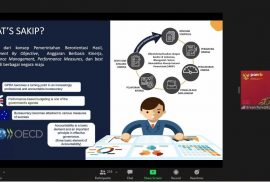
Yogyakarta, October 8th 2020 – The Public Sector Risk Management by the Undergraduate Program of the Department of Public Policy and Management held an open lecture. By presenting Hanif Muhammad, M.Sc. as the guest lecturer, this open lecture discussed specifically about Risk Management and Business Agility in Facing COVID-19. Other than being held according to the course hours—at 07.30 a.m., the discussion session with the speaker was also guided by one of the lecturers in the Public Sector Risk Management course, Media Wahyudi Askar, S.I.P, M.Sc., Ph.D. As the CEO of Boogie Protective and Head of INDEF Center for Innovation and Digital Studies, Hanif combines existing theory with the experience he had had, both from a personal and corporate point of view. However, before entering into the presentation of the material from the guest lecturer, Media as the moderator read out the CV which Hanif responded directly to as a form of introduction to the participants.
Gandung said that the concept used by the models to do a virtual photoshoot is by having a video call with the photographer, hold a pose, then take a screenshot. For the equipment, photographers often use SLR, DSLR, Mirrorless & Pocket. The preparations are the same with a normal photoshoot which is by checking the location and property. For example, the day before the photoshoot, photographers need to video call the model to see in which area of the house can the photoshoot be done by seeing which spot has a good light and which spot is unique. Other than that, the internet connection in the spot needs to be paid attention to. “The internet quality is the key. No matter how expensive, how good, how sophisticated the equipment is, it won’t mean a thing if the internet is slow,” Gandung said.
The screen is also important. Every media screen has their plus-minus in terms of the pixel, color gamut, or other aspect that determines the quality of the photo. “If you’ve seen a virtual photo that is too pixelated, it’s because of the screen. But the latest tech usually has good screens,” Gadung said. Additionally, the hour of the photoshoot also needs to be paid attention to because it determines the amount of light in the photo. Actually, through our handphone we can already set the ISO, the sensor sensitivity to light. The higher the ISO, the more sensitive it is to light. If the photo location is dim, then the handphone will automatically raise the ISO. The risk of a high ISO is the noise, it can be seen through the pixelated picture and unsharp picture. After this elaboration, Gandung shows some pictures with high and low ISO.
On the end of the elaboration, Gandung has a little tips to direct the model. The tip is to hold on to the principle “give compliments, not critics”. Gadung said “If you want the model to smile, make them smile. Don’t say ‘come on, smile!’” he said. The discussion is then followed by a question and answer session. The event ended at 9.pm.