
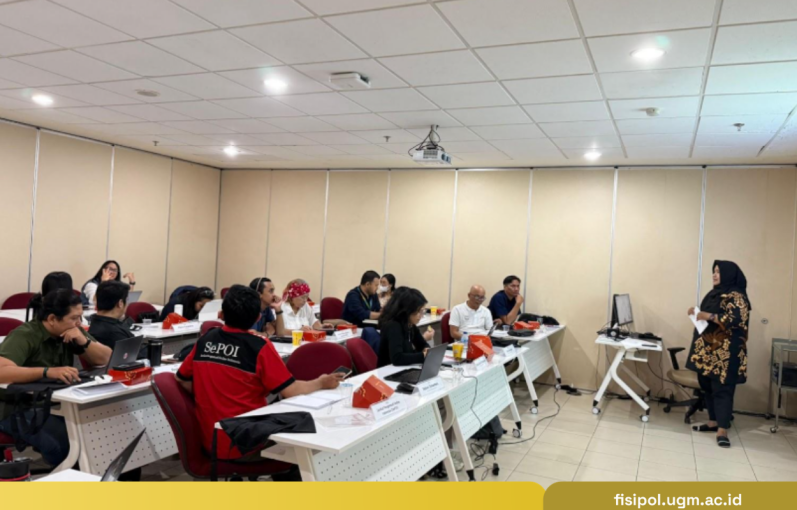
Jakarta, February 3, 2026—The use of artificial intelligence (AI) in online motorcycle taxi platforms has become a system that actively regulates, assesses, and disciplines drivers. Amidst the lack of algorithmic transparency and weak legal protection for platform workers, the Center for Digital Society (CfDS) of Universitas Gadjah Mada (UGM) and the Pulitzer Center held an offline workshop at the Faculty of Social and Political Sciences (FISIPOL) of Universitas Gadjah Mada (UGM) Jakarta Campus on Tuesday (February 3). The workshop, titled “Strengthening the Role of Advocates in Addressing Algorithmic Inequality in Online Motorcycle Taxi Platforms in Indonesia,” aimed to bridge empirical research findings and investigative reporting with legal practice by strengthening the capacity of advocates and digital rights advocates to understand, critique, and challenge the algorithmic systems that shape working conditions in the platform economy. This event brought together academics, researchers, representatives from taxi and motorcycle taxi driver associations, and legal practitioners to discuss litigation pathways, regulatory gaps, and data-driven advocacy strategies.
The CfDS research dissemination session explained that AI systems on online motorcycle taxi platforms operate through four main domains: dynamic fares, work allocation, route optimization, and automatic suspension. These features, often described as “black boxes,” directly impact drivers’ income and job stability. Research findings showed that 68% of drivers felt that order distribution was uneven, while many believed that longer working hours increased the “visibility” of their accounts in the system. Half of respondents also did not understand how their data was used by the platform.
The research, which also gathered driver input through focus group discussions (FGDs) in Jakarta and Gunungkidul from February to June 2025, showed how drivers developed terms such as “gacor account” and “anyep account” to describe alleged algorithmic favoritism.
The practice of “account therapy” emerged as an adaptive strategy, reflecting the uncertainty and high reliance on opaque system logic. Research also found that AI opacity is not simply a technical issue, but rather part of a system design that maximizes driver availability while shifting risks to workers.
Dr. Suci Lestari Yuana (FISIPOL UGM) highlighted the issue of online transportation governance in Indonesia, which remains institutionally void. “Existing regulations, such as PM 118/2018 and PM 12/2019, are unable to address the complexity of platform business models. On the other hand, local governments exhibit varying tariff policies that fuel disparities and resistance. This situation exacerbates legal uncertainty for drivers and complicates comprehensive protection efforts,” she explained.
The workshop also reviewed international standards, including the draft ILO convention on digital platform workers, which emphasizes algorithmic transparency, proper classification of employment relationships, adequate remuneration, social security, and access to dispute resolution. Compared with developments in other countries such as Singapore and Malaysia, which have begun to introduce specific regulations for platform workers, Indonesia is considered to need to accelerate policy reform.
As a follow-up, the discussion generated several regulatory options, including the drafting of a specific law for platform workers, redefining employment relations in the Manpower Law, or issuing a Presidential Regulation focusing on basic protections for platform workers. Participants also emphasized the importance of evidence-based litigation strategies, strengthening data documentation, and collaboration between advocates, researchers, driver organizations, and civil society.
The workshop emphasized that justice in the digital economy depends not only on technological innovation, but also on the courage to open algorithms to accountability and strengthen the legal framework that protects workers. CfDS UGM and the Pulitzer Center affirmed their commitment to continue supporting research, advocacy, and multi-stakeholder collaboration to promote fair, transparent, and driver-oriented platform governance in Indonesia.