
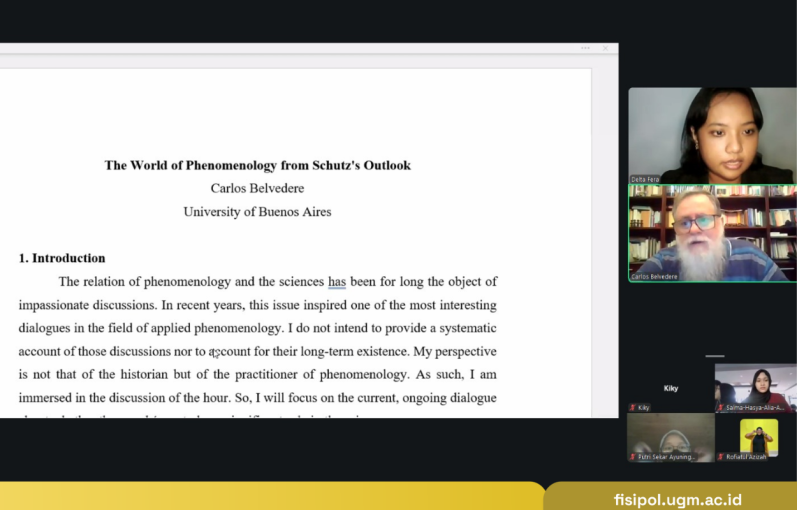
Yogyakarta, March 4, 2026—The Department of Sociology at FISIPOL UGM held an open guest lecture titled “The World of Phenomenology from Schutz’s Outlook” as an effort to deepen students’ understanding the Modern Sociological Theory. The event was held online on Wednesday, March 4, 2026.
The guest lecture featured international phenomenology expert Prof. Carlos Belvedere, an academic from the University of Buenos Aires. The discussion was guided by Delta Fera Apriani, a Sociology alumna of FISIPOL UGM, acting as the moderator. Also in attendance was UGM Sociology Lecturer, Muhamad Supraja, who further enriched the perspective in the academic discussion regarding phenomenology and the social sciences.

The collaboration among these academics was specifically designed to further elaborate on Alfred Schutz’s approach and thoughts on phenomenology. In his presentation, Prof. Carlos broke down the material from the perspective of a practitioner. “My perspective is not that of the historian but of the practitioner of phenomenology.” he said.
Furthermore, the discussion highlighted the role of Epoché, a concept of eliminating initial assumptions and biases in scientific research. This comprehensive material presentation was then followed by an interactive Q&A session. Supraja specifically explored Prof. Carlos’s views on the essential differences in applying phenomenology within three intersecting disciplines such as sociology, psychology, and philosophy. The participants’ enthusiasm was evident from the discourse built to sharpen their understanding of how Schutz’s phenomenological theory can be dissected and practically applied in various social research contexts.
The organizing of this guest lecture serves as a concrete manifestation of the UGM FISIPOL Department of Sociology’s commitment to fostering an inclusive and high-quality educational environment. By providing an in-depth theoretical discussion space, the department ensures participants receive robust academic enrichment. Through the execution of this event, it is hoped that a profound understanding of social action and subjectivity can serve as a sharp analytical foundation for future generations of social researchers.