
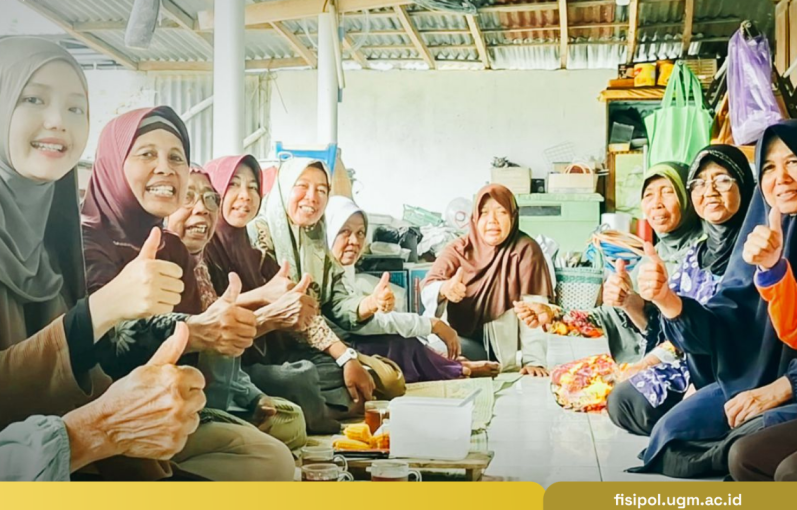
Yogyakarta, January 23, 2026—As an effort to encourage socio-economic empowerment of residents in the implementation of the Tri Dharma of Higher Education, the Faculty of Social and Political Sciences (FISIPOL) of Universitas Gadjah Mada (UGM), through the Department of Public Policy and Management (DPPM), has again deployed a community service team to Karanganom Hamlet, Sitimulyo Village, Piyungan District, Bantul Regency. For this activity, the DPPM Team partnered with the Ngudi Hasil Women’s Farmers Group (KWT) in a collaborative initiative involving lecturers and students from various levels, from Bachelor’s (S1), Master’s (S2), to Doctoral (S3). This academic synergy aims to provide comprehensive and sustainable support to the partner community.
The Ngudi Hasil KWT has been active since September 27, 2010, thanks to the synergy between field extension workers and local residents. However, following the Covid-19 pandemic, this group experienced a period of stagnation or “suspended animation.” Some of the main obstacles faced included operations that were still reliant on individuals, weak work collectives, and production that was only momentary (based on orders).
Furthermore, the lack of skilled workers and the absence of legal business requirements—such as business permits and halal certification—significantly limited the Ngudi Hasil KWT’s business opportunities.
In response to these conditions, at the end of 2025, the DPPM UGM community service team, led by Dr. Ambar Teguh Sulistiyani, M.Si., initiated an empowerment initiative titled “Aloe Vera Cracker Making.” This program aimed to upgrade the group’s capacity, improve organizational governance, and guide them on more effective marketing and entrepreneurial strategies.
The DPPM UGM team provided upstream and downstream support, starting with the replanting of aloe vera by the KWT women and local residents. The aloe vera pulp is then processed into the base ingredient for cracker dough, using a mixture of wheat flour, eggs, starch, rice flour, and spices.
To improve production efficiency, the Student Association of DPPM UGM also donated a cracker slicer.
“The donation of this tool is expected to simplify the production process, which was previously manual using a regular knife, to become more effective, productive, and produce uniform slices,” explained the team representative in their report.
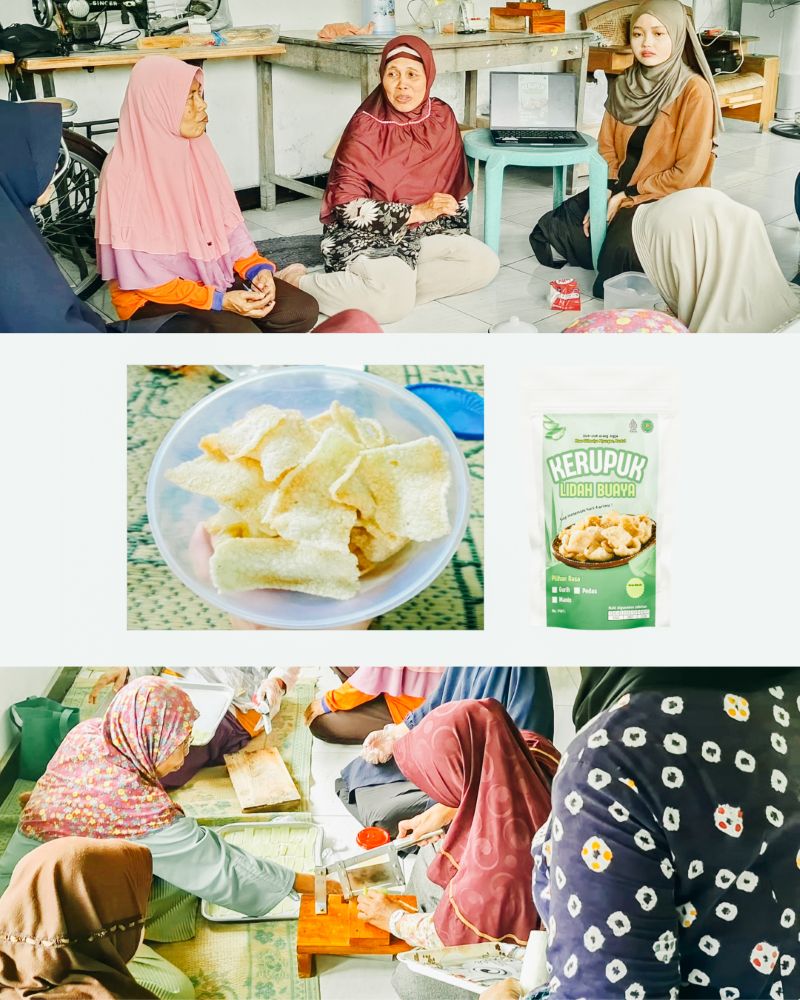
After slicing, drying, and frying, the final product is packaged in a modern design specially designed by the community service team. This packaging rebranding aims to make the Ngudi Hasil KWT Aloe Vera Crackers marketable and ready to compete as an alternative Yogyakarta souvenir from Piyungan, Bantul.
This program is supported by a joint research team consisting of:
- Lecturers: Dr. Ambar Teguh Sulistiyani, Dr. Samodra Wibawa, Dr. Suripto.
- Students & Research Assistants: Amanda Elista (Research Assistant), Otto Yasa Abdullah (S1), Arista Dwi Yanti (S1), Seprina Hasan Effendi (S2), Manurgara Rara Talaohu (S2), Fajarwati Kusumawardhani (S3), and Titis Dewi Anggalini (S3).
Through this activity, the faculty hopes to continue raising public awareness to increase productivity based on local resources and build village food security.