
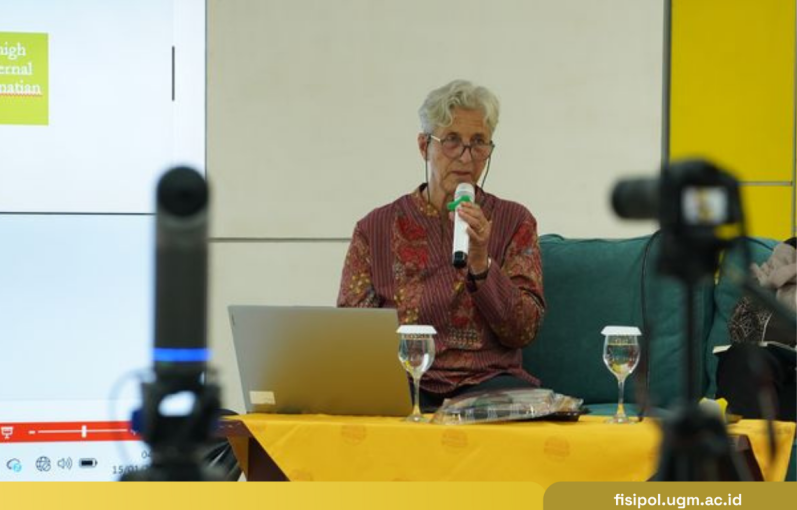
Yogyakarta, January 15, 2026—The Faculty of Social and Political Sciences (FISIPOL) of Universitas Gadjah Mada (UGM) held a Public Discussion entitled “Sexual Politics in Indonesia: Depoliticization and Destruction of the Indonesian Women’s Movement” today (January 15). This event was held in a hybrid format, with the event taking place in the 4th-floor Auditorium of FISIPOL UGM and participating online via Zoom. This discussion provided a critical academic space to discuss the relationship between politics, power, and women’s position in the history and practice of democracy in Indonesia.
The event featured Prof. Saskia Wieringa, Professor Emeritus at the Universiteit van Amsterdam, Ita Fatia Nadia from the Indonesian Women’s Archives and History Room, and Fina Itriyati, Lecturer in Sociology, as resource persons. The discussion was moderated by Sana Ulaili from the Cik Di Tiro Forum and attended by students, academics, researchers, and women’s activists from various backgrounds.
In her presentation, Prof. Saskia Wieringa emphasized that the depoliticization of women is part of a systematic democratic decline. “Since around 2010, we have experienced democratic sliding. Women’s political space has become increasingly narrow, while masculine dominance in the public sphere has strengthened,” she said. She also highlighted the low representation of women in formal politics. “Currently, women only make up around 22 percent of the House of Representatives (DPR). Without strong representation, women’s agendas and experiences continue to be marginalized from political decision-making,” she stressed.
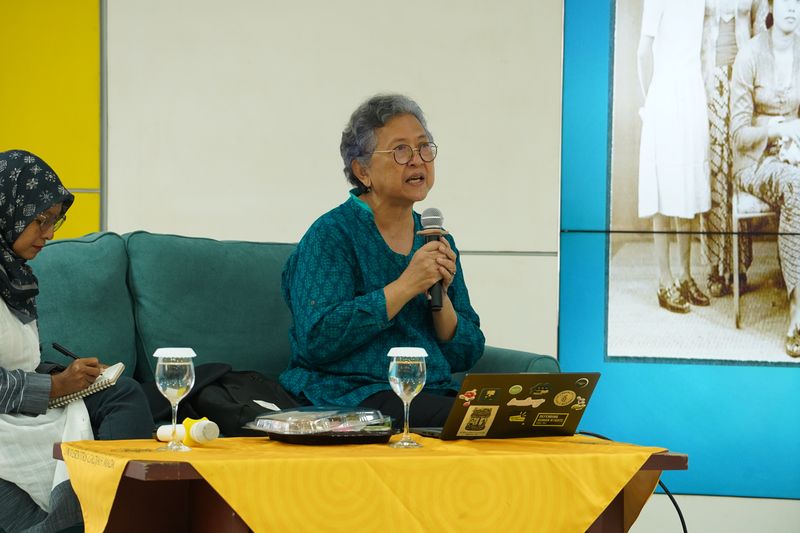
Meanwhile, Ita Fatia Nadia examined in depth the practice of destroying women’s movements through violence, stigma, and historical erasure, particularly against the Indonesian Women’s Movement (Gerwani). She explained that Gerwani was a women’s organization actively fighting for social justice and women’s rights, but was subjected to political violence after 1965. Many of its members experienced arrest, murder, and enforced disappearance, with victims found at various massacre sites, including wells in South Malang.
According to Ita, the violence against Gerwani was reinforced through the construction of a misleading narrative. “Gerwani was framed as brutal, greedy, and depraved women. This narrative of sexual sadism was widely disseminated, even though, based on autopsy reports, the allegations of abuse against soldiers that had been reported were never proven,” she said. This narrative was then widely disseminated to incite public hatred and legitimize attacks on the entire Gerwani community.
Furthermore, Ita emphasized that these practices were inextricably linked to the New Order regime’s power structure. She stated that democracy at that time was built on masculinity and control over women’s bodies and sexuality. “During the New Order, democracy was built on masculinity and women’s sexuality. Women were made political objects, while their voices were excluded,” she said. Ita also warned that without critical historical learning, similar patterns of depoliticization have the potential to reappear in the current political context. “This pattern could happen again if masculine political structures and narratives continue to be allowed to persist,” she added.
This discussion emphasized that the depoliticization and destruction of the women’s movement in Indonesia is a long process involving physical violence, the production of political narratives, and the erasure of collective memory. The impact is not only felt by the victimized generation, but also severing historical knowledge and solidarity among women across generations.
Through this activity, the Faculty of Social and Political Sciences (FISIPOL) of Universitas (UGM) reaffirms its commitment to continuously providing an academic space that is critical, inclusive, and supports social justice. This discussion is expected to strengthen public awareness regarding sexual politics, the importance of recognizing the history of the women’s movement, and the development of a gender-just democracy in Indonesia.