
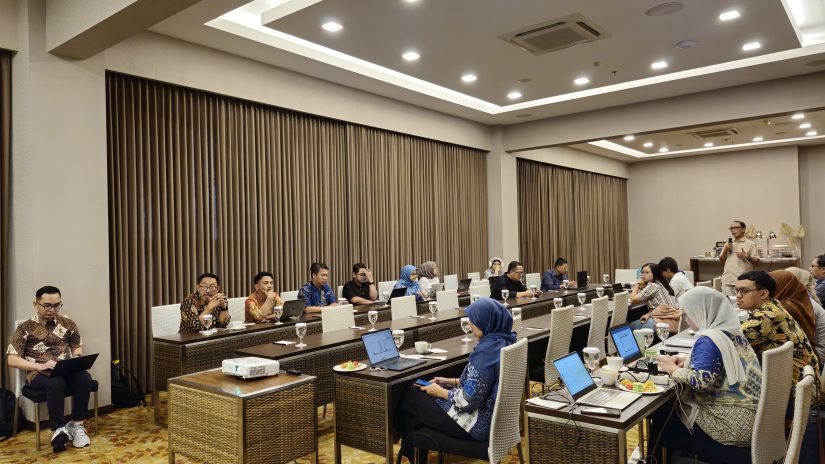
Yogyakarta, July 5, 2025 — The Faculty of Social and Political Sciences (FISIPOL) at Universitas Gadjah Mada continues to demonstrate its commitment to strengthening an academic culture that is reflective, productive, and impact-oriented. Through the Research, Publication, and Community Engagement Unit (UP3M), FISIPOL organized the Research Grant Progress Report Presentation Week from June 30 to July 4, 2025. The event was attended by nearly 80 grant recipients from various internal faculty funding schemes.
The grant schemes included Writing Grants for Lecturers, International Collaborative Grants, Triple Helix Collaborative Grants, and Student Grants for undergraduate, master’s, and doctoral levels. Each scheme reflected diverse approaches to knowledge development, ranging from individual research to cross-sector and international collaborations.
The presentation week was not only a routine monitoring mechanism but also a strategic space to strengthen work plans and ensure the sustainability of research outputs throughout the year. Participants were grouped into cross-departmental thematic clusters, enabling them to receive constructive feedback from broader perspectives.
The event was conducted in a hybrid format: in-person for lecturers and research center staff, and online for students. The process was supported by around 25 members of the FISIPOL academic community, including lecturers, researchers, and students—either through student organizations or individually—who actively participated as moderators, reviewers, technical operators, and supporting staff.
Through this cross-element collaboration, FISIPOL reaffirmed its role as a hub for an inclusive, participatory, and interdisciplinary research ecosystem. Participants not only presented their research progress but also engaged in academic reflection processes that contributed to strengthening the substance and methodology of their studies.
This initiative also embodies FISIPOL’s contribution to the Sustainable Development Goals (SDGs), particularly SDG 4 (Quality Education) through strengthening research culture and lifelong learning; SDG 9 (Industry, Innovation, and Infrastructure) by encouraging collaborative and solution-oriented research; and SDG 17 (Partnerships for the Goals) through partnerships among academics, researchers, and students in advancing knowledge with broad societal impact.
With the successful implementation of this week-long program, FISIPOL UGM reaffirms its vision to become a center of excellence in social and political sciences that is dynamic and impactful, while continuously fostering the production of scholarly works that respond to contemporary social challenges.