
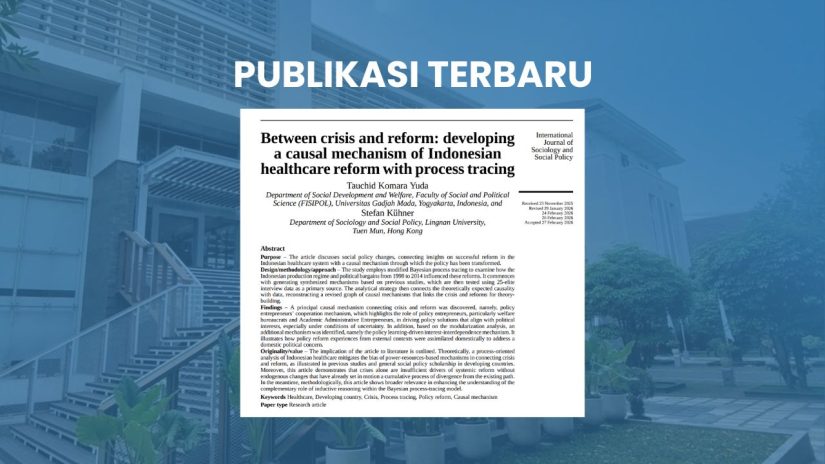
A lecturer from the Social Development and Welfare Study Program (PSdK), Faculty of Social and Political Sciences, Universitas Gadjah Mada (FISIPOL UGM), Tauchid Komara Yuda, has further strengthened his academic contribution at the international level with a new publication addressing strategic issues of healthcare system reform in Indonesia. Together with Stefan Kühner, he authored the article “Between Crisis and Reform: Developing a Causal Mechanism of Indonesian Healthcare Reform with Process Tracing.” The paper offers an in‑depth perspective on how crisis dynamics and political processes are intertwined in driving social policy change. This publication demonstrates his consistent scholarly contribution to enriching public policy discourse while emphasizing his role as an academic actively bridging theoretical analysis with real‑world policy in Indonesia.
Using an innovative methodological approach—modified Bayesian process tracing—the study comprehensively traces how crisis dynamics and political processes from the reform era in 1998 through 2014 shaped the direction of national health policy. Drawing on primary data from interviews with 25 key elites, the research not only tests previously theorized causal mechanisms but also reconstructs a new model that explains the linkage between crisis and reform more sharply and contextually.
One of the key findings highlights the crucial role of policy entrepreneurs, particularly welfare bureaucrats and academic administrative entrepreneurs, who were able to drive policy solutions aligned with political interests amid uncertainty. The study also reveals an additional mechanism—policy learning‑driven interest‑interdependence—showing how reform experiences from global contexts can be strategically adapted to meet domestic needs and challenges. These findings enrich perspectives in social policy studies by emphasizing that crisis alone is not sufficient to trigger reform; rather, it must be accompanied by cumulative and sustained internal change processes.
As an academic achievement, this publication not only strengthens FISIPOL UGM’s position as a center of excellence in social development and public policy studies but also contributes substantively to global discourse on healthcare system reform in developing countries. Furthermore, the insights and findings in this article hold strong relevance for efforts to achieve SDG 3 (Good Health and Well‑Being) by promoting inclusive, quality health systems and SDG 16 (Peace, Justice, and Strong Institutions) by emphasizing strong, adaptive, and responsive public institutions.