
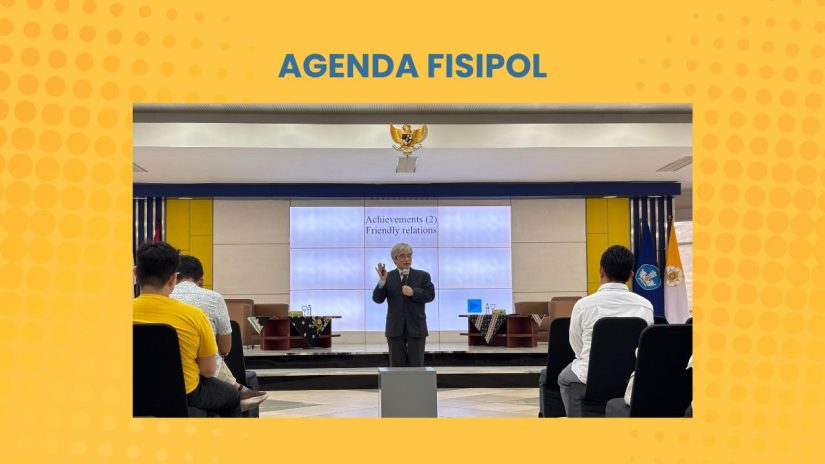
Yogyakarta, March 31, 2026 – The Department of International Relations (DIHI) of the Faculty of Social and Political Sciences (FISIPOL) of Universitas Gadjah Mada (UGM), in collaboration with the Japan International Cooperation Agency (JICA), held a public lecture entitled “A Japanese Approach to International Cooperation,” which reviewed Japan’s approach to building international cooperation. The event, held in the 4th Floor Auditorium of FISIPOL UGM, featured Professor Kato Hiroshi from the International University of Japan as the key speaker.
In his presentation, Hiroshi highlighted Official Development Assistance (ODA) and Official Security Assistance (OSA) as key instruments in Japan’s foreign policy. These two approaches are considered not only diplomatic tools but also long-term strategies for building sustainable partnerships with various countries, including Indonesia.
Hiroshi explained that ODA is one of the most important and impactful policies in Japan’s journey on the global stage. He outlined how Japan went through various phases in developing ODA, from mere post-war economic assistance to becoming a comprehensive development instrument. Japan, he explained, not only provides financial assistance but also emphasizes support for infrastructure development, technical cooperation, social services, and humanitarian assistance as part of its efforts to promote sustainable development in developing countries.
He further emphasized that ODA also plays a strategic role in building trust and strengthening Japan’s position in the international community. “Indonesia and Japan have many similarities. And I think, from the perspective of Japanese leaders, Indonesia remains an important partner,” he said.
This discussion also reflected the academic contributions of the Faculty of Social and Political Sciences, Universitas Gadjah Mada (UGM), in supporting the global agenda, particularly the Sustainable Development Goals (SDGs). The discussion on development cooperation and international aid aligns with efforts to promote SDG 17 (Partnerships for the Goals) through strengthening global collaboration, and SDG 16 (Peace, Justice, and Strong Institutions) through developing cooperation oriented toward stability and inclusive governance. Furthermore, the emphasis on sustainable development within the ODA scheme also overlaps with SDG 4 (Quality Education) through capacity building and cross-border knowledge exchange.
Through this activity, FISIPOL UGM and JICA hope to enrich the academic community’s understanding of the dynamics of international cooperation, particularly the practices and strategies implemented by Japan. This forum is also expected to become a space for constructive dialogue to strengthen collaborative networks between academics, practitioners, and international institutions, while also encouraging the emergence of new perspectives in the development of international relations studies in Indonesia.