
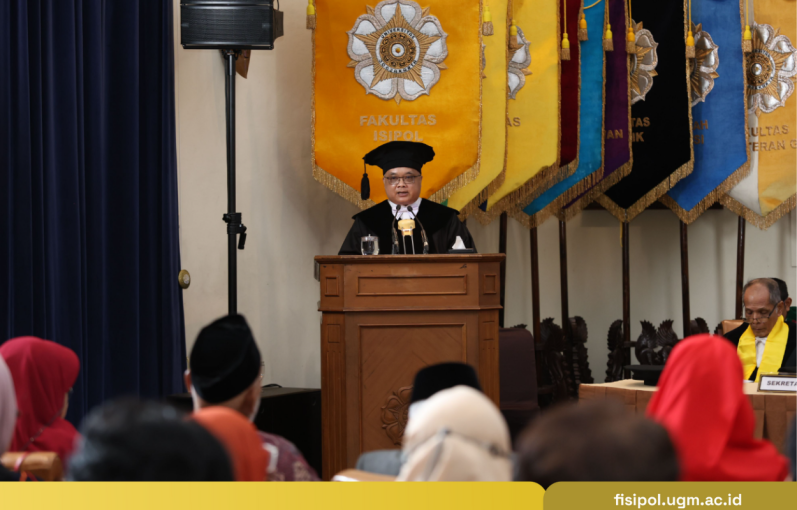
Yogyakarta, July 24th 2025─Prof. Dr. Nur Rachmat Yuliantoro was officially inaugurated as Professor of International Development in East Asia, Faculty of Social and Political Sciences, Gadjah Mada University. In his speech, he highlighted the issue of loans or debt in foreign Belt and Road Initiative (BRI) projects, which has sparked debate over the relationship between Indonesia and China. Prof. Rachmat’s perspective offers a broad view that raises concerns about national finance and stability.
Prof. Rachmat said that Indonesia’s foreign debt to China can be seen as a “Gordian knot,” or a phenomenon that cannot be analyzed using conventional approaches. This case reflects the complex intertwining of economic dependence, territorial sovereignty challenges, and the political interests of the domestic elite. “In this context, Indonesia faces not only financial problems in financing its development, but also major challenges to national politics and security, so we need to understand the dynamics of bilateral relations and the urgency of caution in foreign policy,” he said on Thursday (24/2).
National development is essentially used for the benefit of society. Unfortunately, creating development requires a holistic perspective, not just focusing on a single orientation of modernization that risks eliminating local values. One of the challenges that often arises is structural inequality in the global economy. This situation benefits developed countries, while developing countries find it difficult to achieve long-term growth. According to Prof. Rachmat, this gap is a new form of colonialism that keeps developing countries dependent on the capitalist economic chain.
“That’s where decolonization came from, to question the dominance of Western views and methods through cooperation between developing countries,” said Prof. Rachmat. This spirit is manifested in various forms of cooperation, such as South-South Cooperation (SSC). Looking at the case in Africa, much of the national development funding is channeled by China as a donor. China is regarded as a good international collaboration partner. However, many people are concerned about China’s presence, which may lead to “dependence” or a debt trap in such cooperation.
The same thing happened in the case of the BRI development with China. The BRI is an important strategic effort that aims to deepen infrastructure connectivity, increase trade flows, and encourage economic integration between East Asia and other regions. It is reported that there are at least 71 BRI projects sponsored by China. One of these projects is the Whoosh High-Speed Rail project, valued at IDR 76.95 trillion. However, there was a cost overrun of IDR 114.1 trillion, forcing Indonesia to cover the costs using the state budget and incurring hidden debt to China.
“It cannot be denied that China’s massive investment has brought benefits to infrastructure development, but there are widespread concerns about increasing dependence on China,” added Prof. Rachmat. For him, development policies need to be based on caution regarding various factors that could pose risks to the country’s security and stability in the future.
Prof. Rachmat is one of 538 active professors at UGM, while at the faculty level, he is one of 23 out of 39 professors that have ever been affiliated with the Faculty of Social and Political Sciences (Fisipol) UGM. The Chair of the UGM Professorial Council, Prof. Dr. M. Baiquni, M.A., extended congratulations and appreciation for Prof. Rachmat’s appointment as a professor in the field of international relations. It is hoped that his ideas and works will contribute to the development of science and society.