
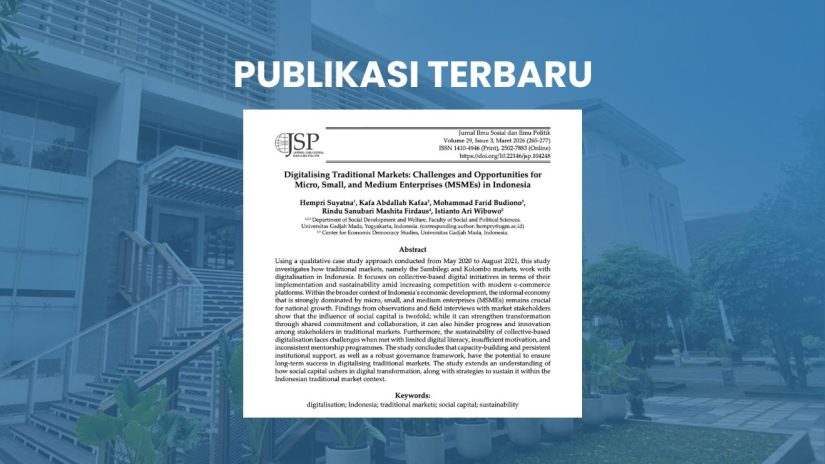
Lecturers from the Social Development and Welfare Study Program (PSdK), Faculty of Social and Political Sciences, Universitas Gadjah Mada (FISIPOL UGM)—Hempri Suyatna, Kafa Abdallah Kafaa, and Mohammad Farid Budiono—together with researchers Rindu Sanubari Mashita Firdaus and Istianto Ari Wibowo, have published a new scholarly article titled “Digitalising Traditional Markets: Challenges and Opportunities for Micro, Small, and Medium Enterprises (MSMEs) in Indonesia” in the Journal of Social and Political Sciences.
The study investigates how traditional markets in Indonesia are adapting to the process of digitalisation in the context of rapidly growing digital economic transformation. Using a qualitative case study approach in traditional markets in Yogyakarta, the research highlights that digitalisation involves more than just technology adoption—it is also influenced by social factors such as social capital, inter‑actor collaboration, digital literacy, and institutional support.
Findings show that collective‑based digital initiatives have the potential to strengthen the competitiveness of traditional markets and MSMEs. However, the sustainability of these initiatives depends heavily on capacity building among participants, solid governance, and ongoing commitment from various stakeholders. Key challenges include low digital literacy, limited infrastructure, and weak support systems that hinder the transformation process.
In the context of sustainable development, this research is relevant to efforts to achieve the Sustainable Development Goals (SDGs)—particularly SDG 8 (Decent Work and Economic Growth) through MSME empowerment, SDG 9 (Industry, Innovation, and Infrastructure) by promoting digital transformation, and SDG 11 (Sustainable Cities and Communities) by emphasizing the importance of sustainable local economic ecosystems.
Through an inclusive approach, the study underscores the importance of ensuring that digitalisation does not leave behind small economic actors, but rather strengthens their role within the national economic system. This publication is expected to make a significant contribution to academic discourse and public policy on inclusive economic digitalisation, as well as provide a reference for designing adaptive, inclusive, and sustainable traditional market development strategies in Indonesia.