
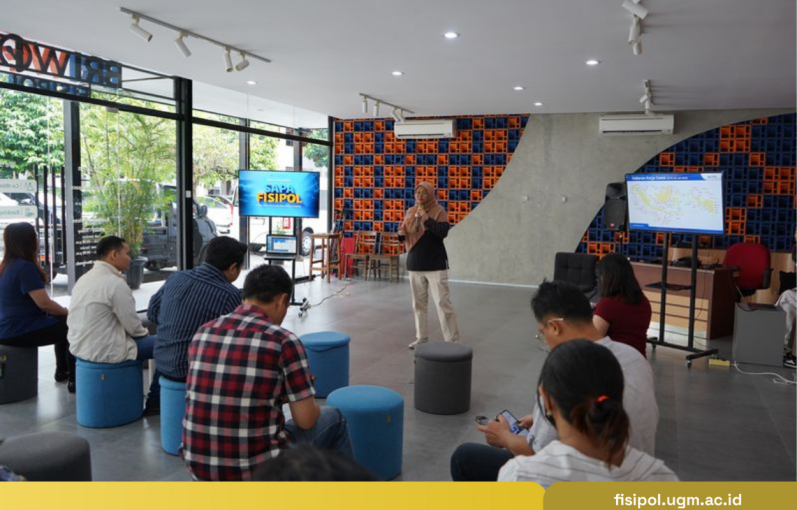
Yogyakarta, 25 Juli 2025—To strengthen its relationship with media and academic networks, the Faculty of Social and Political Sciences, Universitas Gadjah Mada, held a Media Gathering program, “Sapa FISIPOL (Silaturahmi dan Pemberitaan Aktual FISIPOL),” on Friday (25/7). This event is a forum for discussion and collaboration with the mass media as the faculty’s strategic partners in contributing to social issues.
In this first meeting, Fisipol introduced two research centers that actively research various digital and social phenomena in society: the UGM Center for Digital Society (CfDS) and the Center for Capacity Development and Cooperation (PPKK). Syaifa Tania, Executive Secretary of CfDS, explained several CfDS commitments to realize a healthy and safe digital ecosystem through digital society education. “This year we have three research focuses, such as digital democracy and new governance, human-centered AI, and environmentally friendly and sustainable technology,” she said.
CfDS’s main approach to downstream research results is responding to current issues. Recently, CfDS researched Indonesia’s employment ecosystem to realize “Green Jobs.” A number of sectors have great potential, such as agriculture, waste management, and renewable energy. However, the fulfillment of welfare and wage eligibility has not been maximized, so there are still many challenges to making a green transition.
Similar to CfDS, Fisipol UGM also has a unit of the Center for Capacity Development and Cooperation (PPKK) as a form of contribution to education, research, and community service. As explained by the Deputy Director of PPKK UGM, Dr. Pradhikna Yunik Nurhayati, PPKK has a mission to examine various social issues from an academic perspective. Through cooperation with local governments, PPKK goes directly to the community to conduct in-depth research. Furthermore, the research is used as a basis for government policy recommendations.
“We don’t stop at research, so we work on how our findings can solve societal problems,” said Pradhikna. Since its establishment in 2010, PPKK has actively collaborated with various institutions, including the central government, local governments, universities at home and abroad, and international institutions. The main activities carried out are community assistance, education, and training. Pradhikna emphasized that PPKK Fisipol UGM seeks to encourage welfare through community assistance to improve their standard of living.
One of PPKK Fisipol UGM’s latest research has revealed the shocking reality behind the provision of social assistance (Bansos) to the community. The program, which is supposed to be a solution to poverty, actually increases the poverty level itself. The results of PPKK’s in-depth research say that people want to stay below the poverty line to continue receiving government assistance. This reality also raises questions about the government’s commitment to alleviating poverty.
The Sapa FISIPOL discussion presents various interesting perspectives between the media and academics. This event is also a forum to open opportunities for collaboration through issue response, opinions, and research with the mass media. Through cooperation and synergy, it is hoped that innovations and initiatives will emerge that can create changes in order to realize equitable and just national development.