
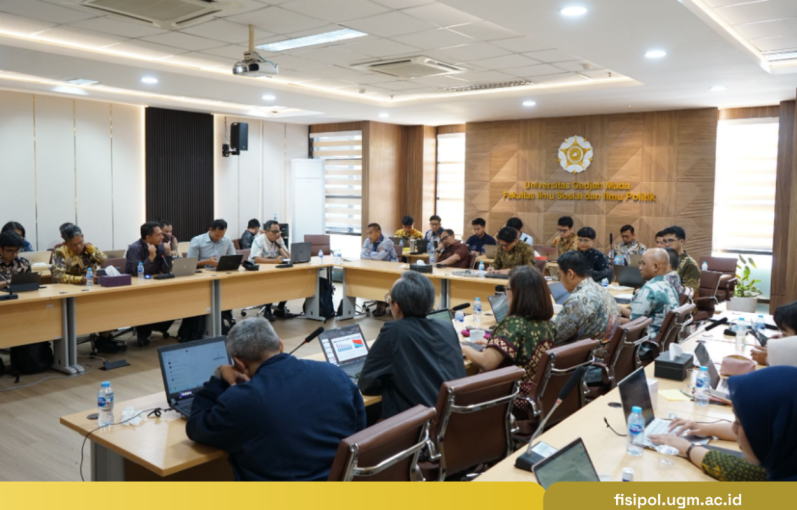
Yogyakarta, June 11, 2026─The Faculty of Social and Political Sciences (FISIPOL) UGM hosted a national-level Focus Group Discussion (FGD) on June 11-12, 2026, with the agenda “Data and Information Gathering for the Preparation of the Policy Paper ‘South-South Transition Minerals Learning Cohort’.” This event was initiated by the National Economic Council of the Republic of Indonesia in collaboration with the Department of Politics and Government, FISIPOL UGM, represented by two department lecturers, Hasrul Hanif and Primi Suharmadhi Putri.
This event was held as a follow-up to the South-South Inter-Governmental Dialogue on “Unlocking Equitable Mineral Value Addition” meeting previously held in Nusa Dua, Bali on December 1-3, 2025. Through the initiative of the Natural Resource Governance Institute (NRGI), this FGD is aimed at formulating two policy papers. These documents will function as cross-country learning tools between Indonesia, the Democratic Republic of the Congo, the Republic of Zambia, and the Republic of Chile regarding critical mineral governance.
The preparation of the policy papers is focused on documenting and reflecting on Indonesia’s experience in critical mineral governance, economic benefit management, industrial downstreaming, and strengthening Environment, Social, and Governance (ESG). The first document will specifically examine the rationale, effectiveness, and impact of the series of downstreaming and export ban policies. Meanwhile, the second document will highlight how traceability systems such as SIMBARA can contribute to securing state revenues and strengthening the implementation of ESG principles.
To dissect these issues, the activity led by the Executive Secretary of the National Economic Council used a comprehensive thematic discussion method. The discussion sessions were divided into five main focuses, including: critical mineral downstreaming strategies, state revenue governance and traceability systems, global geopolitical policies, artisanal mining issues and social impacts, and environmental management standards.
This FGD involved a range of cross-sectoral stakeholders, starting from the Ministry of Energy and Mineral Resources (ESDM), the Ministry of Finance, the Ministry of Industry, the Ministry of Investment/BKPM, to the Ministry of Environment and Bappenas. In addition, there were also representatives from state-owned enterprises (BUMN), namely PT Mineral Industri Indonesia (MIND ID), local government represented by the Regent of Central Halmahera, and researchers from the Institute for Economic and Social Research, Universitas Indonesia.
The involvement of the UGM academic community was directly represented by Assistant Professor Hasrul Hanif and Researcher Primi Suharmadhi Putri from the Department of Politics and Government, FISIPOL UGM. This institutional synergy is expected to be able to produce an accurate map of opportunities and challenges, so that Indonesia’s experience can become an essential learning reference for other developing countries in optimizing development benefits from mineral resources amidst the global energy transition. The second day of the FGD, Friday (12/6), will be held for the elaboration of two policy papers titled “Strategy Development and Intragovernmental Coordination” and “ESG and Community Impacts”.