
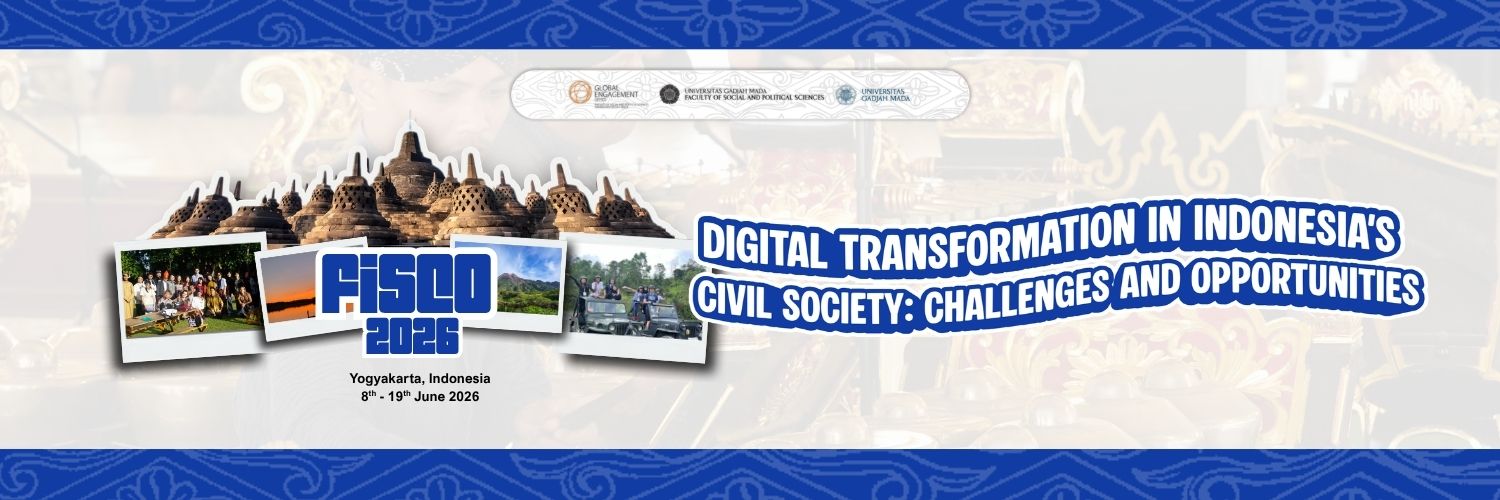
FISIPOL International Short Course (FISCO) 2026
The FISIPOL International Short Course (FISCO) 2026 is a two-week intensive program organized by the Global Engagement Office, Faculty of Social and Political Sciences, Universitas Gadjah Mada (UGM), in Yogyakarta, Indonesia, from 8–19 June 2026. The program is supported by the Academic Innovation and Internationalization Grant through the Interdisciplinary Flagship Short Course Program (EQUITY Scheme) for the 2025/2026 fiscal year.
Under the theme “Digital Transformation in Indonesia’s Civil Society: Challenges and Opportunities,” FISCO 2026 explores the dynamic relationship between technology and civil society in Indonesia and the broader ASEAN region. As digital technologies increasingly influence civic engagement, governance, advocacy, and organizational practices, the program examines both the opportunities they offer and the challenges they present for civil society organizations.
FISCO 2026 combines academic learning with cultural immersion through interactive lectures, expert discussions, field-based learning, and cultural excursions. Participants will engage with scholars, practitioners, and fellow students from diverse backgrounds while gaining firsthand insights into Indonesia’s social, political, and cultural landscape. Beyond the classroom, the program provides opportunities to experience Indonesian culture and interact with local communities, fostering meaningful cross-cultural exchange and a deeper understanding of digital transformation in contemporary civil society.
Learning Outcomes and Curriculum Description:
The curriculum of the FISIPOL International Short Course (FISCO) 2026 has been designed and developed based on internationally recognized learning standards and informed by Bloom’s Taxonomy of cognitive learning. Through a comprehensive and interdisciplinary learning experience, participants are expected to achieve the following Expected Learning Outcomes (ELOs):
ELO 1 – Remembering/Identifying
Participants will be able to identify key concepts of digital transformation, civil society, digital governance, and technological developments in Indonesia and the ASEAN region.
ELO 2 – Understanding/Describing
Participants will be able to describe the general and context-specific opportunities and challenges associated with adopting digital technologies to achieve organizational goals.
ELO 3 – Applying
Participants will be able to apply relevant analytical frameworks to examine the impact of digital transformation on the effectiveness, accountability, and sustainability of civil society organizations.
ELO 4 – Analyzing
Participants will be able to analyze case studies of successful digital transformation initiatives as well as challenges encountered by civil society organizations in Indonesia and other countries.
ELO 5 – Comparing
Participants will be able to compare digital transformation strategies employed by civil society organizations across diverse social, political, and institutional contexts.
ELO 6 – Evaluating
Participants will be able to evaluate the risks and ethical implications of digital technology use, including cybersecurity, personal data protection, misinformation, and the digital divide.
Eligible Participants:
- Non-Indonesian nationality
- A bachelor’s or master’s degree student enrolled at an accredited university, not registered as active students or participants in any other academic programs at Universitas Gadjah Mada
- Good written and spoken English skill
- Minimum GPA of 2.5/5.0 or 2.0/4.0
Benefit:
- Earn 3 credits equivalent to 36 hours of lecture
- Immerse yourself in a new culture and language, gaining a deeper understanding and appreciation of diversity
- Acquire specialized knowledge and insights into global issues that may be unavailable in your country or differ from your academic background, enriching both your academic and personal development
- Able to step out your comfort zone, develop valuable skills such as intercultural competence, independence, and adaptability
- Discover the uniqueness and richness of Yogyakarta with a lot of activities offer for tourists
- Connect with fellow participants and instructors from around the world, expanding your global network and potential career opportunities
Field-base Learning and Cultural Excursion
As part of the experiential learning component, participants will engage in cultural excursions and field observations across the Special Region of Yogyakarta, including an educational visit to Museum Sonobudoyo, a heritage walking tour in Kotagede, and the Merapi Lava Tour. These activities provide participants with firsthand exposure to Javanese cultural heritage, local community dynamics, and examples of community resilience, while offering opportunities to observe how cultural values, historical legacies, and local communities interact with and adapt to contemporary processes of digital transformation. This component contributes to the achievement of ELO 4 and ELO 5, enabling participants to analyze real-world cases of success and challenges in community adaptation and to compare strategies employed by civil society actors and local communities across different social and cultural contexts.
Lectures
The lecture component consists of a series of sessions delivered by distinguished scholars, practitioners, and experts from Indonesia and abroad with expertise in digital transformation and related fields. Conducted in both onsite and online formats through video conferencing platforms, each session combines thematic presentations with interactive discussions and question-and-answer segments, fostering active engagement and knowledge exchange among participants. Through these learning activities, participants are expected to achieve ELO 1, ELO 2, ELO 5, and ELO 6, including the ability to identify key concepts of digital transformation, examine organizational opportunities and challenges in adopting digital technologies, compare digital transformation strategies across different contexts, and evaluate ethical risks and implications related to cybersecurity, personal data protection, misinformation, and the digital divide.