
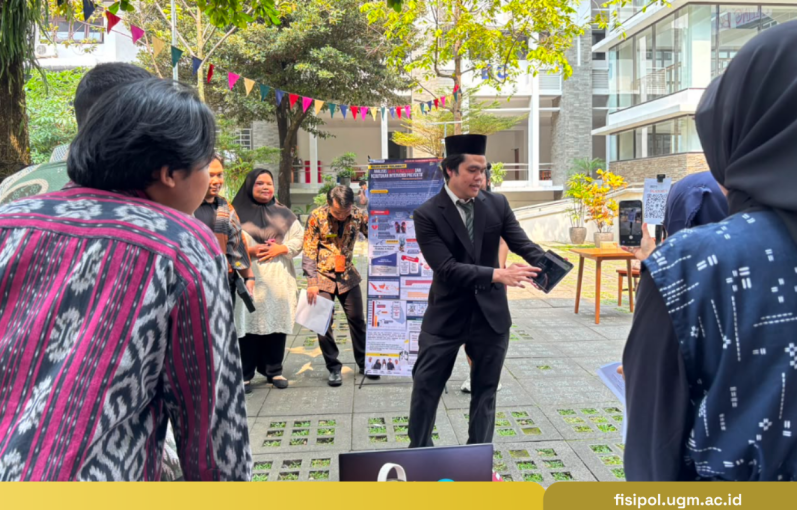
Yogyakarta, 17 June 2026─The Master of Public Administration (MAP) program at the Faculty of Social and Political Sciences (FISIPOL) of Universitas Gadjah Mada (UGM) held a Project Showcase on the use of data for public policy. The event featured student projects that transformed data into insights to support policy formulation and the resolution of various public issues.
This project showcase serves as a platform for students to showcase their work and share ideas and perspectives on the use of data in public administration. Through this event, visitors can see firsthand how data is processed into information that can support policy formulation and the resolution of various public issues.
This event is led by an interdisciplinary teaching team consisting of Media Wahyudi Askar, S.I.P., M.Sc., Ph.D., a lecturer in the Department of Management and Public Policy at FISIPOL UGM; Dr. Novi Paramita Dewi, S.IP., MDP., a lecturer specializing in environmental policy and development; and Dr. techn. Aufaclav Zatu Kusuma Frisky, S.Si., M.Sc., a lecturer at the Faculty of Mathematics and Natural Sciences (FMIPA) at UGM who also serves as the Chair of the Bachelor’s Program in Electronics and Instrumentation.
The use of data in public administration is becoming increasingly crucial in line with the government’s agenda in Indonesia. The government must strengthen national data governance so that public policies can be formulated more accurately, measurably, and evidence-based. Good policies must be data-driven, scientifically tested, and provide concrete benefits to the public
Rasyid Ridha, a MAP student, emphasized the importance of public awareness regarding data, particularly for decision-making in the public sector. “We need to increase our sensitivity to data, especially when it comes to making decisions. After all, we can’t possibly make policy decisions based solely on instinct. One of the learning objectives is to understand how to use data to develop policy,” he said.
This initiative aligns with the Sustainable Development Goals (SDGs), particularly in promoting quality education and ensuring inclusive and equitable access to education for all. With a conducive atmosphere, this event is expected to serve as an interactive forum for students, academics, and the general public to exchange ideas on the role of data in addressing public policy challenges in the digital age.