
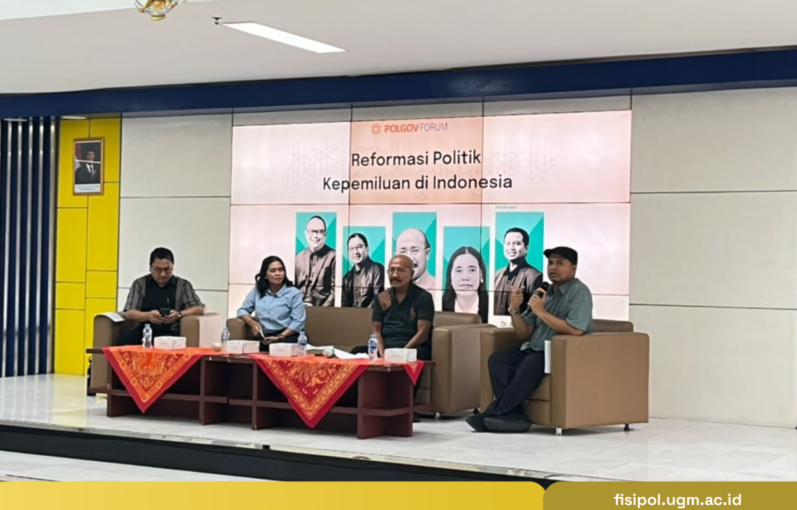
Yogyakarta, September 17, 2026—A PolGov Forum titled “Electoral Political Reform in Indonesia” was held this morning, Thursday (Sept 17), at the Auditorium of the Faculty of Social and Political Sciences (Fisipol) UGM, located on the 4th floor of the BB Building. This public forum aimed to discuss the dynamics and agenda of political and electoral reform in Indonesia.
The event featured several experts and electoral practitioners as speakers: Dr. Abdul Gaffar Karim (Lecturer at the Department of Politics and Government/DPP UGM), Prof. Ramlan Surbakti (Professor of Political Science at UNAIR), and Sri Surani, S.P. (Commissioner of the DIY General Elections Commission/KPU). The discussion was moderated by Dr. Arya Budi, a lecturer at DPP UGM.
DIY KPU Commissioner Sri Surani, S.P., examined electoral issues from the perspective of the election organizer. One crucial issue she highlighted was the rising trend of single-candidate races, a phenomenon that became widespread during the 2024 regional head elections (Pilkada).
According to Surani, this situation limits the scope of choice and access to information. While the KPU, as the organizer, is bound by regulations to proceed with the election stages, the very essence of the contest itself becomes a major question.
“It impacts voters because they lack the room to make a broader choice; they do not have a sufficient range of options. There is only one source of information—just that one. Yet, as election organizers, we continue to carry out the process. We execute every stage. So, procedurally, the election does take place. But regarding the substance of the competition—does that actually occur? That is something I believe we need to reflect on together,” Sri stated.
Building on this point, Dr. Abdul Gaffar Karim highlighted the irony of democratic backsliding, noting that it often originates within the electoral system itself. He underscored that those who potentially undermine elections are often the very individuals elected through the process. Gaffar emphasized that an ideal election should essentially be measured by the extent of the benefits experienced by the people.
“There are five such benefits: representative, corrective, protective, citizenship-related, and—finally—policy-related benefits,” he stated.
Gaffar then detailed these five aspects, noting that their practical implementation remains far from ideal. Regarding representation, elections are expected to produce representatives who genuinely champion the public interest. From a corrective standpoint, the public ought to have the capacity to penalize or rectify poor governance at the ballot box; however, this capacity is perceived as not yet fully established.
Furthermore, he lamented the weakness of the protective function, noting that elections have failed to shield the people from the centralization of power by manipulative elites. The fourth aspect—citizenship—should ideally grant full sovereignty to the public, in line with the principle of government “of the people, by the people, and for the people.” Finally, elections must deliver policy benefits, giving the public the leverage to help shape the direction of post-election policies.
Through these various perspectives, the PolGov Forum aims to spark public awareness, encouraging citizens not to view elections merely as a routine five-year administrative procedure, but to demand a return to the substance of democracy that upholds the sovereignty of the people.
Kirim masukan