
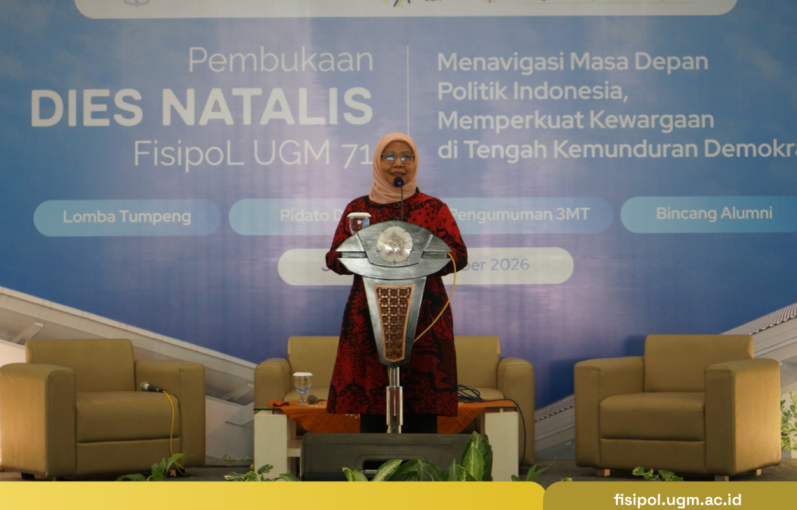
Yogyakarta, September 18, 2026—Prof. Amalinda Savirani advocates for strengthening the capacity of citizens to participate, organize, hold power to account, and influence public decisions amidst the state of Indonesian democracy, which she assesses as experiencing a decline.
Amalinda presented this idea during her speech at the 71st Anniversary (Dies Natalis) of the Faculty of Social and Political Sciences at Universitas Gadjah Mada (FISIPOL UGM) in 2026, titled “Navigating the Future of Indonesian Democracy and Strengthening Citizenship.”
In her speech, Amalinda stated that the issues facing Indonesian democracy cannot be adequately understood solely through the existence of formal institutions such as elections, political parties, parliament, the press, and civil society organizations. The mere presence of these institutions does not automatically equip citizens with the ability to influence public decisions.
According to Amalinda, while citizens certainly possess the right to vote and participate in political processes, this right is not always accompanied by the capacity to influence policy in the intervals between elections. “The issue is whether the ability to speak is also matched by the ability to influence,” she said.
Therefore, Amalinda proposes a shift from civic knowledge to civic capacity, and subsequently to civic power—defined as the tangible ability of citizens, particularly when acting collectively, to influence decisions that shape their lives and to hold those in power accountable.
In this context, Amalinda noted that FISIPOL UGM bears a responsibility to help build civic capacity. It is not enough for the university merely to study democracy; it must also translate academic knowledge into forms that citizens can use to understand public issues, scrutinize political claims, comprehend policies, and make informed decisions. She also encouraged campuses to serve as spaces where students can practice democracy through citizen research, policy clinics, community engagement, policy monitoring, social audits, and collaborative projects with the community and local government.
In her closing remarks, Amalinda emphasized that democracy cannot be sustained solely through constitutions, elections, and state institutions. Democracy also relies on the ability of citizens to think, speak, organize, exercise oversight, and help shape their shared future.
“Democracy endures because citizens bring it to life. Democracy requires not merely citizens who vote, but citizens who are empowered,” said Amalinda.