
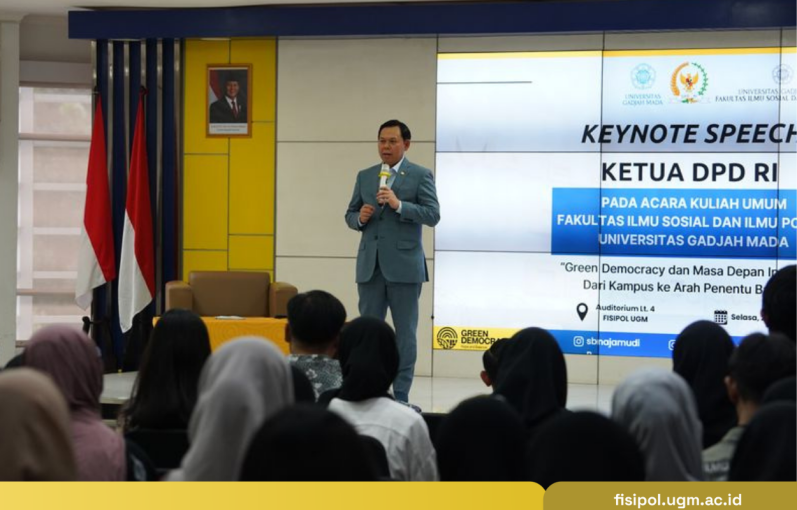
Yogyakarta, April 21, 2026—The Chairman of the Regional Representative Council of the Republic of Indonesia (DPD RI), Dr. (H.C.) Sultan Baktiar Najamudin, emphasized the strategic role of universities in realizing green democracy in Indonesia.
In his opening remarks, the Dean of FISIPOL UGM, Wawan Mas’udi, emphasized the importance of discussing green democracy amid the current challenges posed by climate change. “With climate change, we are facing the challenge of creating a governance system that is aware of global changes that increasingly require green politics, green policies, and in this case, green democracy,” he said.
In a public lecture held at the FISIPOL UGM Auditorium, Najamudin emphasized the Green Democracy ideas he has outlined in his book, “Green Democracy: Ideas for Democratic Innovation in Strengthening the DPD RI Institution, Environmental Conservation, and Improving Human Resources Quality Towards a Golden Indonesia 2045.” According to Najamudin, universities are not merely spectators or critics of policies, but rather key drivers of democratic transformation toward an ecologically sustainable system.
“We are facing a situation we need to be aware of together: we are experiencing a surplus of politicians and a deficit of statesmen,” he said. “From that anxiety, the idea of green democracy was born. An effort to reorient democracy so that it is not only about power and growth, but also about sustainability and intergenerational justice.”
Najamudin highlighted the importance of basic education in fostering a culture of ecological awareness and civic responsibility among the younger generation. He pointed out that education is a fundamental pillar in building individual capacity to engage in sustainable practices and contribute to the democratic process.
This public lecture drew the academic community’s attention to discussions on the intersection of democracy, education, and environmental sustainability. Najamudin encouraged participants to think critically about their roles in green democracy and to become active participants in supporting ecological preservation.
This public lecture emphasized the importance of collaboration between government, academics, and students in achieving the Sustainable Development Goals (SDGs), particularly in the areas of education and ecological sustainability.
This public lecture serves as a reminder of the vital role of education in shaping a sustainable future and the responsibility of all stakeholders to work towards a more just and equitable society.