
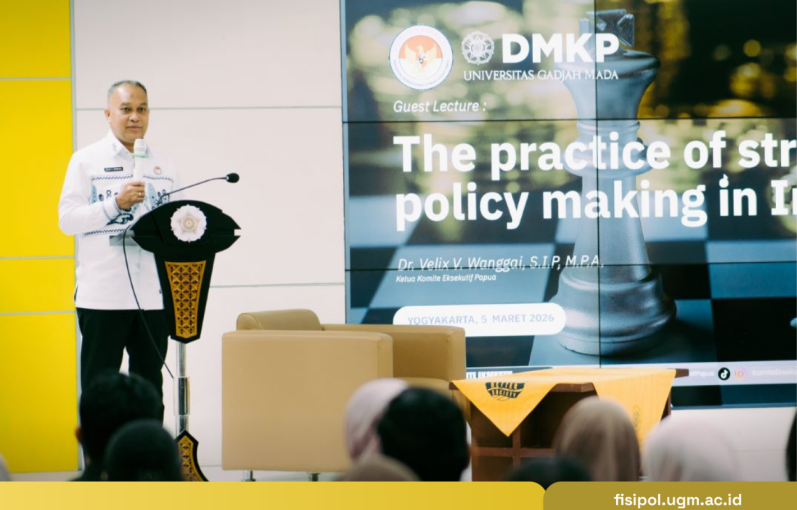
Yogyakarta, March 5, 2026—The Department of Management and Public Policy (DMKP), Faculty of Social and Political Sciences (FISIPOL), Universitas Gadjah Mada (UGM), held a guest lecture entitled “The Practice of Strategic Policymaking in Indonesia” on Thursday (March 5) at the 4th Floor of the Mandiri Auditorium, FISIPOL UGM. The event featured Dr. Velix V. Wanggai, Chair of the Executive Committee for the Acceleration of Papua’s Special Autonomy Development, to discuss the dynamics and practice of strategic policymaking in Indonesia.
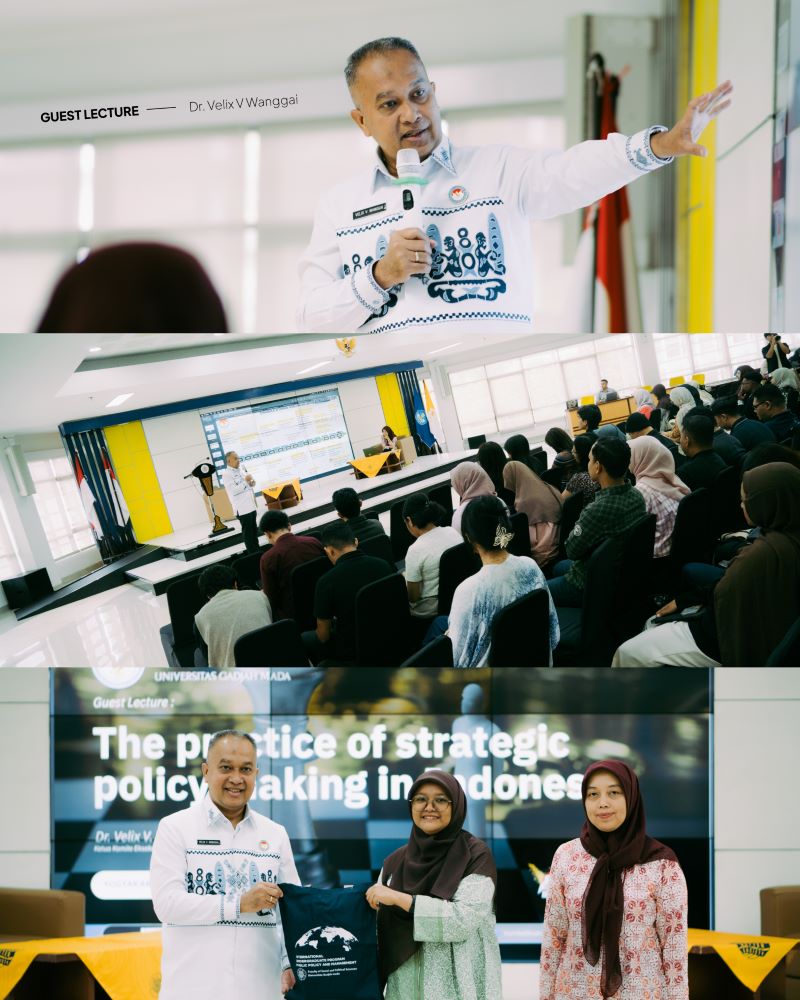
In his presentation, Velix emphasized that the current public policy formulation process can no longer be understood simply and linearly. The complexity of social, economic, and political issues demands a more adaptive and strategic policy approach. According to him, the theory of the policy cycle remains relevant as a basic framework for understanding the policy process, from agenda setting and policy formulation to decision-making, implementation, and evaluation. However, in practice, this process does not always proceed linearly.
“Some theories state that the policy cycle is linear, but in practice, the process is very dynamic,” he explained. Velix also highlighted the importance of understanding global changes and megatrends as a basis for formulating strategic policies. Global megatrends, he argued, influence various development sectors and must be taken into consideration when formulating long-term policy directions.
He explained that analyzing global change patterns is crucial for mapping future development directions. In the context of public policy in Indonesia, Velix believes that managing public issues cannot be handled sectorally by a single institution. The complexity of policy requires a collaborative approach across sectors and actors.
“Managing a single topic cannot be done by just one ministry; it requires cross-sectoral and cross-institutional collaboration,” he explained.
He also emphasized that within the policy process, there is a debate between closed and more participatory policy models. An open policy model involving multiple public actors is considered increasingly important in the context of modern governance. In addition to discussing the concept of strategic policy in general, Velix also touched on the dynamics of Papua’s special autonomy policy as an example of a policy practice that has gradually evolved through a process of evaluation and improvement.
He explained that the Papuan Special Autonomy policy is part of a long journey of national policy that has undergone continuous adjustments since the reform era.
“Papua’s special autonomy policy is a long journey that continues to undergo improvements over time through the policy improvement process,” he said.
Through this guest lecture, students are encouraged to understand how public policy theory is applied in government practice, while also examining the dynamic relationship between national and regional policies and the underlying socio-political context.
This activity also provides a discussion forum for students to explore strategic policy practices in Indonesia and understand the challenges of governance in the face of global change.