
Yogyakarta, May 7, 2026─Ernani Dewi Kusumawati, a doctoral student in International Relations at FISIPOL UGM, has achieved a new milestone on the global stage. Joining the Department of International Relations in 2024 as a doctoral student with a concentration in Digital Transformation and Competitiveness (DTC) led her to become Indonesia’s one and only delegate at the Raisina IE-Global Student Challenge 2026, held in New Delhi, India, in March 2026.
This competition is part of the Raisina Dialogue international forum, a strategic gathering that brings together world leaders, government officials, academics, and practitioners to analyze geopolitical and geoeconomic issues. Ernani shared that she initially had doubts because her undergraduate background was in pharmacy. Nevertheless, those doubts transformed into a strong motivation as she delved into the essence of the event. She views an interdisciplinary approach as the key.
“I believe that integrating various academic backgrounds will be the future solution for understanding and bridging the complexity of various global issues,” Ernani stated.
The journey in this program began with an online collaboration phase from January to February 2026. A total of 86 selected delegates from various parts of the world were grouped into 12 international teams. Ernani was part of a team with colleagues from Canada, India, Jordan, Poland, and Ethiopia, under the guidance of an academic advisor from the São Paulo School of Business Administration (FGV EAESP) in Brazil. The team proposed the theme “AI for Civilian Use” to formulate equitable utilization of artificial intelligence for countries in the Global South.
The dynamics of this cross-continental collaboration presented unique challenges. Time zone differences required Ernani to frequently participate in discussions late into the night, especially as this coincided with the observance of Ramadan. Integrating diverse academic perspectives also demanded intense discussions, occurring nearly every day as the proposal submission deadline approached.
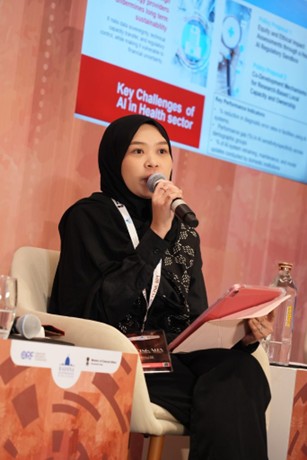
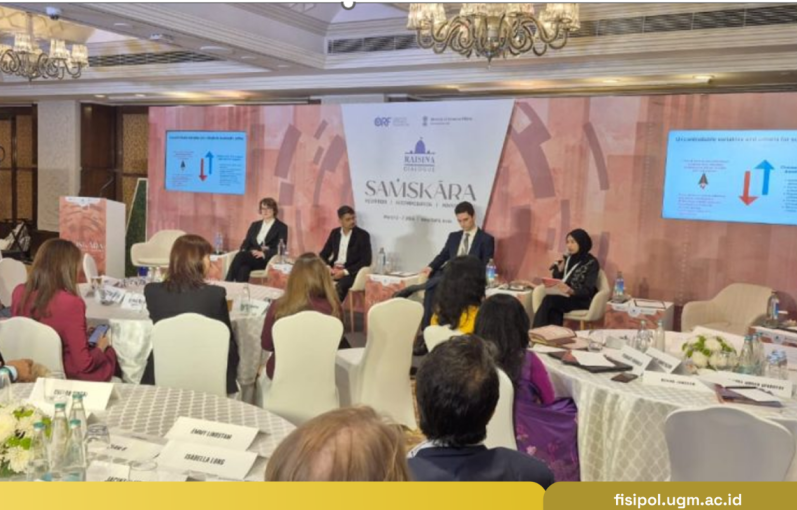
On March 4, 2026, Ernani traveled to India at no cost, as expenses were fully covered by the Observer Research Foundation (ORF), the IE School of Politics, Economics & Global Affairs (SPEGA), and the Indian Ministry of External Affairs. At the event’s climax, she presented her research findings in person before an international panel, including former Swedish Prime Minister Stefan Löfven, Vina Nadjibulla (Asia Pacific Foundation of Canada), Gautam Chikermane (ORF), and Suzannah Jessep (Asia New Zealand Foundation).
Ernani’s team proposed a triad governance approach that positions the education, health, and agriculture sectors as the foundation for sustainable economic development in the Global South. This approach is translated into six policy interventions that emphasize strengthening data governance, building local capacity, and the importance of pre- and post-implementation assessments of AI. This idea successfully caught Stefan Löfven’s attention due to its strong emphasis on inclusivity. All the hard work finally paid off.
For Ernani, engaging in global discourse and exchanging insights with the world’s top talent represents an extraordinary reflection of professional growth. This academic endeavor embodies a concrete step by UGM’s academic community in nurturing global partnerships to achieve shared goals. The cross-border collaboration forged during this program serves as proof that synergy and knowledge exchange between nations are crucial for formulating responsive, adaptive, and inclusive policies to address the world’s future challenges.