
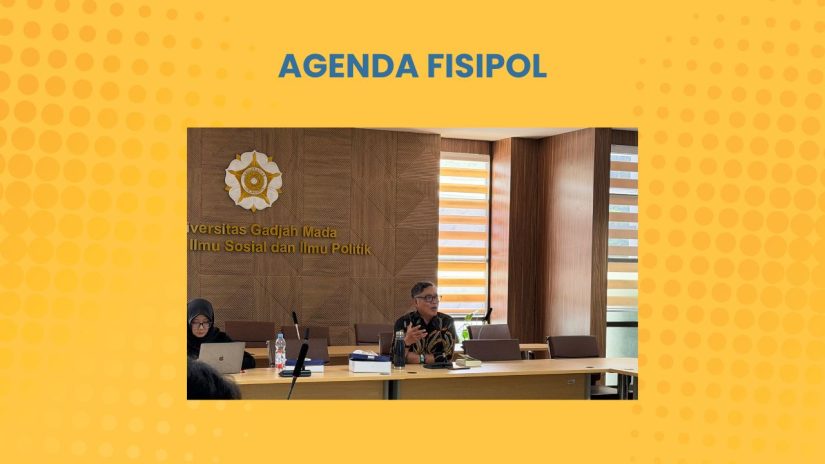
Yogyakarta, April 16, 2026 – The Faculty of Social and Political Sciences (FISIPOL) UGM held a workshop titled “Comparative Southeast Asia” on Thursday (April 16). This academic event was part of a series of visiting scholar programs by Dr. Priyambudi Sulistiyanto, an Adjunct Senior Lecturer at Flinders University, Australia. The workshop was attended by doctoral students, lecturers, and academics from various institutions.
Dr. Priyambudi’s presence provided a valuable discourse space for participants to deepen their insights into the political, social, and cultural dynamics of the Southeast Asian region through a comparative approach. In his research, he compared three Southeast Asian countries: Indonesia, Thailand, and Burma (Myanmar). He also shared his field experiences, from the similarities and differences he found during the 1997 political and economic crisis, the dynamics of field research, to his reflections, which are included in the book “Melawai ke Asia.”
Furthermore, Dr. Priyambudi emphasized that comparative studies cannot be based on a single theory or scenario. Researchers need to critically examine the similarities and differences based on the context of each country. This approach is a significant contribution to his research, particularly in comparing countries with strong military traditions. “The contribution is something that hasn’t existed before, namely comparing three countries with strong military traditions,” he said. The event then continued with an interactive discussion and question-and-answer session.
This activity contributes to the achievement of several Sustainable Development Goals (SDGs), particularly SDG 4 (Quality Education) through strengthening academic and research capacity; SDG 16 (Peace, Justice, and Strong Institutions) through the study of regional politics and governance; and SDG 17 (Partnerships for the Goals) through strengthening academic networks and collaboration across institutions and countries.
Through this activity, FISIPOL UGM is expected to continue strengthening its role as a center for Southeast Asian studies, encouraging research collaboration, knowledge exchange, and tangible contributions to the development of science and policy at the regional level.