Arsip:

SDG 2: Zero Hunger

WhatsApp Workflow: When a Message Can Save National Food Production

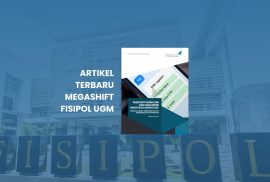
New Release: Megashift FISIPOL UGM Article
“Digital Orchestration for Indonesian Agriculture: From WhatsApp Workflow to Food Security”
By: Setiawan Guntoro

Megashift FISIPOL UGM has once again published an article that sparks discussion on the future of agriculture and food security in Indonesia. This piece highlights a simple yet revolutionary idea: how an everyday app like WhatsApp can become the backbone of agricultural digitalization.

The article sheds light on a long-standing issue in agriculture, particularly in broiler farming: the slow flow of field data from farms to management, which often leads to delayed and risky decision-making. Many agritech startups have failed because their applications did not match farmers’ habits. However, WhatsApp—used by 9 out of 10 Indonesians—emerges as an alternative solution. read more

From Fields to Power: When Farmers Become Clean Energy Producers

Latest article from Megashift FISIPOL UGM
“Energy Transition from the Fields: Agrivoltaics Meets Agroforestry”
By: Fikri Danang Himawan

This article explores the concept of agrivoltaics — the integration of solar panels and agriculture on the same land — and how this system can be combined with agroforestry, a land management practice that integrates trees, food crops, and/or livestock. The combination of these two approaches offers a solution to address the challenges of renewable energy, food sustainability, land-use efficiency, and climate change adaptation. read more

KAPSTRA FISIPOL UGM Discusses the Future of the Pre-Employment Card Program Amid Government Transition in KAPSTRA Dialogue #4

The Pre-Employment Card (Kartu Prakerja) Program, initiated by President Joko Widodo as a response to the surge in unemployment during the pandemic, now faces uncertainty at the beginning of 2025. According to data from Statistics Indonesia (BPS), open unemployment remains high, reaching 7.28 million people in early 2025, with 26,455 cases of layoffs recorded.

Since its launch in 2020 until 2024, the program has supported 18.9 million beneficiaries, including 1.4 million workers in 2024 alone. The program provides digital-based training and financial incentives amounting to IDR 4,200,000 per participant, aiming to enhance skills and productivity among job seekers. read more

Highlighting Issues of Food Security and Urban Industry, Fisipol UGM Organizes Discussion with Gaziantep University

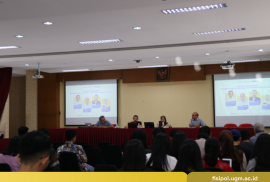
Yogyakarta, May 22, 2025—Community empowerment, energy transition, and food security became government agendas in an effort to achieve the Golden Indonesia 2045 Vision. UGM’s Faculty of Social and Political Science organized a discussion session regarding the challenges and development of these three agenda together with experts from the Gaziantep University, Turkey. Held on Thursday (22/5), the discussion talked about how factors such as climate change and food crisis became determinant of the success of the government’s agenda.

Dr. Mehmet Cevat Yildirim, as Associate Professor of Public Administration, explained that the global crisis has experienced its own set of dynamics from time to time along with technological advancements and climate change. For example,  in 1970, there was a transition from the import sector to global manufacturing. It then developed further to global factory networks due to globalization. Now, the world has entered an era of robotic technology and the neoliberal economic structure. These changes have caused a number of disruptions in various fields, including employment. “This creates new problems for countries that depend on the development of  urban areas. This is the case in Turkey, where the growth of industry outpaced the infrastructure planning process,” Mehmet stated. Gebze, one of the centers of the automotive and chemical industries that drive Turkey’s economy, is now faced with the lack of adequate infrastructure. Unprepared, the city infrastructure is increasingly under pressure, causing several social problems such as congestion, minimal public service, and high population density. 

Similar things are happening in Indonesia, specifically in the city of Bekasi, West Java. Mehmet’s research has shown Bekasi as the centre of the world’s automotive industry that has grown at a rapid pace due to investments. However, the area of Bekasi itself is separated into two very unequal areas, namely the modern industrial district and the residential district. “The city infrastructure that we see in Bekasi is under pressure due to high amounts of migration, land purchase for investment and infrastructure gaps,” Mehmet explained. According to him, the economic growth experienced  is not accompanied by proper access to public services and infrastructures.
read more

FISIPIT: Cycling While Donating in the Month of Blessings

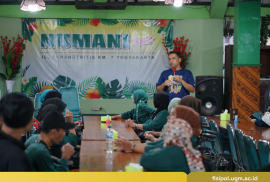
Yogyakarta, 21 March 2025–The FISIPIT Charity Fun Ride is a sharing program by the Faculty of Social and Political Sciences (Fisipol) cycling community, Universitas Gadjah Mada. This time, FISIPIT held various actions with the disability group “Paguyuban Bangkit Bersama” on Friday (21/3). The event was held through a gathering and breakfasting with several education staff and lecturers at Resto Numani, Parangtritis, Yogyakarta.

Paguyuban Bangkit Bersama is a Yogyakarta disability group whose members are mostly earthquake victims. When it was initiated in 2012, the first 30 members joined to raise the spirit and empowerment as a disability. Paguyuban representatives expressed gratitude to the FISIPIT Charity Run for providing meaningful support for the association’s sustainability. read more

Studium Generale of the DMKP FISIPOL UGM Answers the Challenges of Food, Water, and Energy Management in Public Policy

Yogyakarta, February 25th 2025─The Department of the Public Policy and Management held a Studium Generale entitled “Integrated Hydro – Irrigation – Restoration Systems”. This theme is a response to overcome various challenges, especially in water resources.

The event presented Prof. Edward P. Weber, professor of Public Policy of the Oregon State University, USA. He saw that problems regarding the management of our food, water and energy are still seen as partial problems. This perspective makes food, water and energy management inefficient and unsustainable. read more