A lecturer from the Faculty of Social and Political Sciences (FISIPOL), Universitas Gadjah Mada, has contributed to the academic discourse on human rights with the launch of a new publication titled the Routledge Handbook of Human Rights in Southeast Asia. The book was officially launched at the University of Melbourne, Australia, and is co-edited by Prof. Amalinda Savirani, a lecturer from the Department of Politics and Government at FISIPOL UGM, alongside Dr. Ken M.P. Setiawan, Senior Lecturer in Indonesian Studies at the Asia Institute, University of Melbourne.
SDGs 10: Reduced Inequalities
The Department of Public Policy and Management (DMKP) at the Faculty of Social and Political Sciences (FISIPOL), Universitas Gadjah Mada (UGM), welcomed a study visit from the Faculty of Administration and Social Sciences, Universitas Bina Taruna (UNBITA) Gorontalo. The event was part of a collaborative academic initiative aimed at expanding inter-university engagement, particularly in the field of inclusive digital transformation policy and governance in Indonesia.
As part of the visit, students from UNBITA participated in a guest lecture delivered by Alvi Syahrina, S.T., M.Sc., a lecturer at DMKP UGM. The session, titled “Inclusive Digital Transformation Policy and Governance in Indonesia,” emphasized the need to view digital transformation not only as a technological advancement, but also through the lens of social justice, digital literacy, and the risks of digital exclusion.
Melbourne, 9 July 2025 — The Faculty of Social and Political Sciences (FISIPOL) at Universitas Gadjah Mada (UGM), in partnership with the University of Melbourne, successfully held the 5th Australia-Indonesia in Conversation (AIC) 2025. This year’s forum took place at the University of Melbourne, Australia, following its previous iteration hosted at FISIPOL UGM.
Carrying the theme “Bridging Development, Representation, and Indigenous Knowledge: Learning from Australia and Indonesia”, the forum brought together scholars and representatives of Indigenous communities to discuss critical issues at the intersection of social justice, sustainable development, and recognition of local knowledge.
Yogyakarta, July 8, 2025—The Master’s Program in Social Development and Welfare (PSDK) of the Faculty of Social and Political Sciences (FISIPOL) UGM successfully held the 5th Graduate Symposium on Social Development and Welfare 2025 from July 7 to 8, 2025. With the theme “Quo Vadis Contemporary Development,” the event provided a platform for cross-perspective academic discussions to address the challenges and direction of sustainable development in Indonesia.
The first day of the symposium opened with a keynote speaker session titled “Frugal Innovation: A New Strategy for CSR Program Planning,” featuring Adi Rahmadi (Officer II CSR at PT Pertamina Geothermal Energy Tbk.) and moderated by Galih Prabaningrum, S.Sos., M.A. (PSdK Lecturer). The discussion highlighted the concept of Frugal Innovation as an efficient approach to designing CSR programs based on optimizing company resources. Participants were invited to understand the definition of Frugal Innovation, its implementation, the benefits it offers companies and communities, and its practical applications at Pertamina Geothermal. The session also highlighted criticisms of CSR practices in Indonesia and the relevance of this new approach.
The Master’s Program in Social Development and Welfare (PSdK) of FISIPOL UGM successfully held the PSdK Master’s Symposium over two days, July 7–8, 2025. Taking place at the BA Building and FISIPOL Auditorium, the event became a space for the exchange of strategic ideas involving students, lecturers, practitioners, and alumni.
The symposium opened on Monday (7/7) with a seminar entitled “Frugal Innovation & CSR” delivered by PSdK alumnus Adi Rahmadi. Held in BA 501, this session highlighted the role of low-cost innovation and corporate social responsibility in addressing pressing development issues.
Yogyakarta, July 4th 2025—With the increase of internet access by children, safety of digital spaces became a key concern. A 2024 data from BPS shows that 35,5 percent of children aged 0-4 have access to the internet, marking a sign of digital exposure in the early ages. This does not only create opportunities, but also serious challenges, starting from exposure of dangerous content, cyberbullying, as well as other misdeeds like digital exploitation. As a response to these challenges, UGM Centre for Digital Society (CfDS) organized the DIFUSSION #124 discussion session titled “Protecting Digital Space for Kids: Can PP TUNAS become the answer?”. This discussion presents many experts in the field of online child protection, which includes Andy Ardian (Coordinator for Nasional ECPAT Indonesia), Nenden Sekar Arum (Executive Director of SAFENet), and Ayom Mratita Purbandani (Researcher at CfDS UGM), with Nabila Rizkita (Researcher at CfDS UGM) as moderator.
Yogyakarta, 4 July 2025 — As internet access becomes increasingly prevalent among children, ensuring a safe digital environment has emerged as an urgent priority. According to data from Statistics Indonesia (BPS) in 2024, 35.5 percent of children aged 0–4 years have accessed the internet, indicating that digital exposure now begins at a very early age. While this brings opportunities for learning and development, it also presents serious risks—including exposure to harmful content, cyberbullying, and digital exploitation.
Research is not merely a process of data collection, but also a meaningful space for learning. This was evident in the fieldwork experience of students from the Faculty of Social and Political Sciences (FISIPOL) at Universitas Gadjah Mada (UGM), who joined a research team focusing on women’s empowerment and social justice across various regions in Indonesia. Through direct interaction with women from diverse social, cultural, and economic backgrounds, these young researchers not only sharpened their technical skills but also reflected deeply on their own position, privilege, and social responsibility as academics.
Seoul, June 26, 2025 — As the urgency of the climate crisis continues to intensify, the global community faces a growing obstacle: the spread of misinformation and disinformation that hampers public understanding and concrete climate action. At the prestigious 9th Climate Energy Summit held in Seoul, South Korea, Dr. Novi Kurnia, a lecturer in the Department of Communication Science at FISIPOL UGM and lead researcher at the Centre for Digital Society (CfDS) UGM, delivered a keynote address offering a critical perspective from the Global South on the rampant spread of climate-related falsehoods.
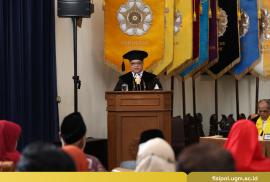
Yogyakarta, 19 June 2025–The history of the development of international relations with the Middle East shows the identity and alignment of Indonesia’s foreign policy. Consistency over the years reflects the strong solidarity of the past and present governments, especially in the Palestinian conflict. Prof. Dr. Dra. Siti Mutiah Setiawati, M.A., Professor of Middle East Geopolitics, Faculty of Social and Political Sciences, Universitas Gadjah Mada, raised the issue in her speech on Thursday (19/6).