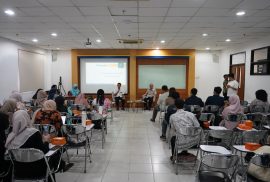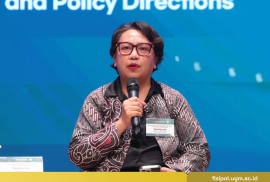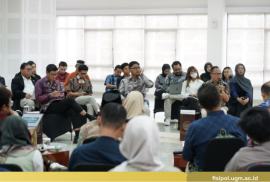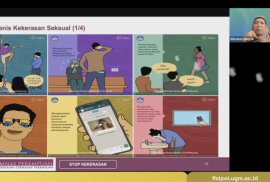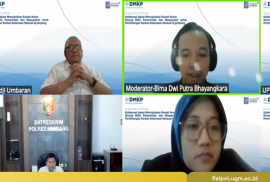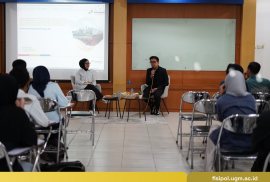
Yogyakarta, 11 March 2025–In commemorating International Women Day 2025, Fisipol Crisis Center (FCC) held a live Instagram event titled “Setara Bukan Sekadar Kata” (Equal is not just a word). The event, which was hosted by Nurul Amaliah (Master Student of DPP UGM), also presented speakers who enriched each other’s perspectives, namely Maygsi Aldian Suwandi, S.Sos., M.A (Lecturer of PSDK UGM) and Valenidha Sulafi (Peer Counselor CDC Fisipol UGM). This multi-perspective discussion aims to raise the issue of gender equality, challenges that are still faced, and concrete efforts that can be made to realize inclusive and sustainable equality.
SDGs 10: Reduced Inequalities
The Indonesian government initiated the implementation of AI in the public sector by issuing the Ministry of Communication and Information Technology (Menkominfo) No. 9 of 2023 on the ethics of artificial intelligence. However, according to Hossea Immanuel, research assistant at CfDS UGM, the initiative still faces some challenges due to inadequate digital infrastructure.
“There are still problems regarding AI implementation in Indonesia, such as the ransomware attack on the national data center last year. Of course, this contradicts the purpose of implementing AI,” said Hossea in his presentation.
Celebrating International Women’s Day, Dema Fisipol UGM Raises the Issue of Safe and Inclusive Space
Yogyakarta, March 5th 2025─To commemorate International Women’s Day (IWD), the Student Council (Dewan Mahasiswa/Dema) of Fisipol UGM opened the Forum Selasar Fisipol. This time the forum took the title “Towards Safe and Inclusive Spaces for All Women”. This theme was chosen to dissect together the urgency of eliminating violence and discrimination in public spaces. This event presented various speakers ranging from the academic community of Faculty of Social and Political Sciences, IWD activists, to NGOs.
Yogyakarta, 5 March 2025–After passing through a democratic party over the past year, Indonesia has experienced a dynamic political movement. At the same time, Election Corner Fisipol UGM released a new research titled “Coalition Map of 2024 Simultaneous Regional Election Winners in Indonesia”. This research reveals the political dynamics in the 2024 Simultaneous Regional Head Elections (Pilkada) held throughout Indonesia. The main finding of this research highlights the trend of minimal electoral competition due to the dominance of large coalitions.
“Through the roadshow, we want to “kulanuwun”, greeting friends from various university in Indonesia and introducing the Ajisaka Festival as a collaborative space for creative folks in expressing their care and concern towards the issue that we have raised,” Adelia Christi mentioned in the interview, as the Leader of Ajisaka Festival .
The Ajisaka Roadshow started on the 20th of February at Universitas Teknologi Yogyakarta and UIN Sunan Kalijaga Yogyakarta. The roadshow program is planned to be organized frequently until the 24th of March. The roadshow agenda is done offline in campuses at Yogyakarta and Solo, while it will be done online at the other campuses. The roadshow consists of information sharing in regards to the competition categories, janamejaya video screening, and icebreaking activities.
Yogyakarta, March 1st 2025─Festival Ajisaka, an annual event initiated by the Department of Communication Science students, is back with a theme that carries the spirit of sustainability. This year, the Festival Ajisaka raises the issue of green economy with the title “Gaman Kamulyan: Echoing the Hope of Sustainability”. This theme was chosen as a form of concern for the importance of environmentally sound economic development, especially in the midst of an increasingly worrying environmental crisis.
The ASEAN-Maybank Scholarship programme is a partnership between Maybank Foundation and the ASEAN Secretariat. It is one of the ASEAN-level initiatives undertaken by Maybank Foundation, a newly accredited ASEAN entity, with the aim to “promote an innovative ASEAN approach to higher education”, which is one of the strategic measures listed in the ASEAN Socio-Cultural Community Blueprint 2025.
The scholarship programme is designed to provide young, talented, and deserving ASEAN nationals with full scholarships to pursue their undergraduate studies at prestigious universities listed under the ASEAN University Network (AUN), located outside their home countries within the ASEAN region, while promoting intra-ASEAN integration.
Yogyakarta, 21 February 2025–Pursuing higher education is not easy. Students, including doctoral or PhD students, often face various problems or challenges, from financial to mental health. Responding to this issue, The Conversation Indonesia held a webinar entitled “The Doctoral Road: From Financial Difficulties to Mental Stress” with academics and doctoral candidates. The event invited Pratiwi Utami, PhD (Lecturer at the Department of Communication Sciences UGM) and Herman Yosef Paryono (Doctoral Candidate in Organizational Behaviour, University of Groningen) as webinar speakers.
Dr. Wawan Mas’udi, S.IP., MPA, as the Dean of Fisipol UGM, welcomed all the postgraduate students who were officially accepted to Fisipol UGM with open arms. “Welcome and happy learning. It is expected that once in the postgraduate level, all of you can further explore social, economical, and political phenomenons not only as empirical aspects, but as a framework that requires discipline,” Dr. Wawan mentioned. He then went on to explain that Fisipol UGM provides the much needed access for students to create, build their career, as well as networking.
Postgraduate education holds an important role in cultivating the development of knowledge. Dr. Wawan explained further that the faculty has an agenda to make Fisipol UGM as the center for the development of the study of social and political sciences. Of course, this mission is not only aimed at reaching new heights nationally, but globally as well. Because of that, Fisipol UGM always tries to build international networks in order to further push the development of the study of social and political sciences even wider. “If we want to be the global center for knowledge, it is necessary for Fisipol UGM to interact with the outside world. The academic world is broad and borderless,” Dr. Wawan explained. He also explained the three flagship research that Fisipol UGM owns, which includes the research regarding climate change, digital transformation, and social inclusivity. The development of these three flagship research cannot be separated with the roles of postgraduate students in responding to these issues through a global academic lens.
The welcoming event was continued with the presentation of basic public policy by Dr. Rob Manwaring. Dr. Rob explained the important foundations regarding the field of public policy and why the development of this field is very important. According to him, the government carries an important mandate in organizing the livelihood of thousands or even millions of the population. The process of decision-making then has to consider the interests and needs of the people as a whole. Rob then elaborated the two main elements in public policy, that is the tool and instrument of the government.
“One of the instruments in public policy is the law. The government of Australia, in some cases, used the law as the main instrument, although the people-centered perspective is still used,” Dr. Rob mentioned. He gave several examples in how the government handled the problems of drivers going over the speed limit and Driving Under the Influence (DUI). For some time, Australia experienced a spike in traffic fatalities due to crashes. Responding to this issue, the Australian government then gave out sanctions to drivers who were caught to be under the influence by taking away their drivers license.
2 percent of positions in central government institutions to persons with disabilities, and 1 percent of positions in the private sector. Nevertheless, the National Economic Survey also noted that the amount of persons with disabilities in the productive age who are currently employed is less than 10 percent.