Vandy Yoga Swara, lecturer at the Department of Social Development and Welfare (PSdK), Faculty of Social and Political Sciences (FISIPOL) Universitas Gadjah Mada, has recently published his latest scholarly work in the international journal Habitat International (Elsevier). The article, titled “River’s End: The Violence of Indigenous Riverine Urbanization in the Making of Indonesia’s New Capital,” was co-authored with Kei Otsuki and Femke van Noorloos (Utrecht University, Netherlands) as well as Michelle Kooy (IHE-Delft Institute for Water Education, Netherlands).
SDGs 16: Peace Justice and Strong Institutions
Yogyakarta, August 21st 2025─Amidst the bustling cafes, restaurants, shopping malls, and other venues where music is a key element of the atmosphere, a public debate has arisen regarding regulations for playing music in public spaces. This is especially true when news reports indicate that the government and music industry organizations (LMK) are reaffirming the obligation to pay royalties for playing Indonesian music in places like cafes, restaurants, hotels, and shopping malls. In fact, it’s not uncommon for this issue to be turned into memes or other digital jokes on social media.
The Center for Digital Society (CfDS), Faculty of Social and Political Sciences, Universitas Gadjah Mada (FISIPOL UGM), hosted the Information Resilience and Integrity Symposium (IRIS) 2025, an international academic and policy forum addressing the challenges of Generative Artificial Intelligence (GenAI).
The event was held in collaboration with the Safer Internet Lab (SAIL)—an initiative by the Centre for Strategic and International Studies (CSIS) and Google Indonesia—together with CfDS FISIPOL UGM. IRIS 2025 provided a cross-sector dialogue space to respond to the impacts of GenAI on democracy, digital security, and social life across the Asia-Pacific region.
Climate change is not a problem that centers on a single root cause. Collaboration and understanding are needed, as systems greatly influence their impact. Government policy is key to ensuring that this issue does not create deeper divisions between communities. Instead, good national policy in addressing climate change must be inclusive and equitable.
Patra added that, like it or not, many climate change challenges need to be prepared for. This is especially true as global support in the financial sector is beginning to shift towards this issue. However, climate action in Indonesia has grown organically within communities. This means that public awareness of climate change has already started to grow. The government must be able to formulate grassroots-based policies that can reach the smallest units of society.
The Department of Politics and Government (DPP), Universitas Gadjah Mada (UGM), in collaboration with the Westminster Foundation for Democracy (WFD) and the Southeast Asia Parliamentarians Against Corruption (SEAPAC), convened the Bulaksumur Roundtable Forum (BRF) 2025 under the theme “Promoting Environmental Democracy to Counter the Climate Crisis.” The event was held at UGM’s Gelanggang Inovasi & Kreativitas Building and livestreamed through the DPP UGM YouTube channel and Pares.id.
The forum opened with a keynote speech by Helen Fazey, the UK Ambassador to ASEAN, who highlighted the importance of environmental democracy as a foundation for global governance in addressing the climate crisis.
Yogyakarta, 19 August 2025–The phenomenon of Roblox online gaming, which is now popular among Indonesian children, has attracted public attention, especially regarding the potential risks and security of the digital space for the younger generation. In response to this, Dr. Adrian Indro Yuwono, S.I.P., M.A., or familiarly known as Mas Dadok, a lecturer in Communication Science at Universitas Gadjah Mada (UGM) who specializes in cultural studies and new media, emphasized the importance of digital literacy and the responsibility of various parties in protecting children in cyberspace.
Celebrating the 80th Independence Day of Indonesia, Dema Fisipol UGM Organizes Pasar Merdeka Fisipol
“There are tons of exciting things happening at this time of year in Fisipol. One of them includes being able to see the first-year students interact with each other. From that, I saw that Pamerpol works as some sort of an inclusive bridge for interactions,” Fiorenza mentioned, as one of the staff of Pamerpol.
As a way to show appreciation, Pamerpol also gave out prizes to those who won. The announcement for the winners are done at the end of the event, with the winners representing their departments. The winner for the sodor panci, tarik tambang, and goyang kardus competition came from the Department of Sociology; the winner for the makan nasi kucing competition came from the Department of Management and Public Policy, the winner for the fashion show competition came from the Department of Social Development and Welfare, while the award for best supporters was won by the Department of Communication Science.
The Faculty of Social and Political Sciences (FISIPOL) at Universitas Gadjah Mada has once again demonstrated its academic engagement on the global stage. One of its lecturers, Dr. Novi Kurnia from the Department of Communication Science, contributed as a key resource in the development of an online course entitled “Navigating Climate Information with Media and Information Literacy”, initiated by UNESCO in collaboration with the Mahatma Gandhi Institute of Education for Peace and Sustainable Development (MGIEP).
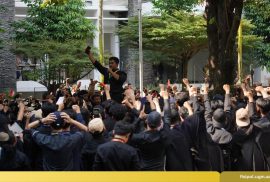
Yogyakarta, August 7, 2025 — The series of events for PIONIR Society FISIPOL UGM 2025 officially concluded with the Consolidation, Action Simulation, and Inauguration. Quoting Tan Malaka, “Idealism is the final luxury possessed by the youth,” this very spirit was instilled through open forums and public orations.
New students were invited to discuss two critical issues in Indonesia’s socio-political landscape: the commercialization of education in state universities and freedom of expression. They were not only encouraged to voice their opinions but also to understand that oration is not merely about speaking loudly—it serves as a medium to deliver sharp, argumentative, and substantive criticism.
Latest Article on Megashift FISIPOL UGM
“Rethinking the Architecture of Climate Finance: How Political Discretion Undermines Global Commitments”
By: Meilisa Anggraeni
Megashift FISIPOL UGM has released another thought-provoking and timely article, this time spotlighting global climate finance, which is under immense pressure due to the shifting tides of international politics. In her piece, “Rethinking the Architecture of Climate Finance,” author Meilisa Anggraeni examines how climate funding pledges from developed nations often weaken — not because of technical or economic constraints, but due to the political choices of their leaders.