Arsip:

SDGs 16: Peace Justice and Strong Institutions

Fisipol Welcomes Newly Accepted Postgraduate Students, Introduces Three Flagship Researches

Yogyakarta, February 19th 2025—The welcoming event for the year 2024/2025 postgraduate students was held by UGM’s Faculty of Social and Political Science (Fisipol) on Wednesday (19/2). Followed by a total of a hundred college students from the magistery and doctoral programmes, the welcoming event includes activities aimed at introducing the newly accepted students to the faculty, as well as basic social and political sciences. Fisipol UGM invited Dr. Rob Manwaring, a lecturer from the Flinders University, to teach the basics regarding the field of public policy

Dr. Wawan Mas’udi, S.IP., MPA, as the Dean of Fisipol UGM, welcomed all the postgraduate students who were officially accepted to Fisipol UGM with open arms. “Welcome and happy learning. It is expected that once in the postgraduate level, all of you can further explore social, economical, and political phenomenons not only as empirical aspects, but as a framework that requires discipline,” Dr. Wawan mentioned. He then went on to explain that Fisipol UGM provides the much needed access for students to create, build their career, as well as networking.

Postgraduate education holds an important role in cultivating the development of knowledge. Dr. Wawan explained further that the faculty has an agenda to make Fisipol UGM as the center for the development of the study of social and political sciences. Of course, this mission is not only aimed at reaching new heights nationally, but globally as well. Because of that, Fisipol UGM always tries to build international networks in order to further push the development of the study of social and political sciences even wider. “If we want to be the global center for knowledge, it is necessary for Fisipol UGM to interact with the outside world. The academic world is broad and borderless,” Dr. Wawan explained. He also explained the three flagship research that Fisipol UGM owns, which includes the research regarding climate change, digital transformation, and social inclusivity. The development of these three flagship research cannot be separated with the roles of postgraduate students in responding to these issues through a global academic lens. 

The welcoming event was continued with the presentation of basic public policy by Dr. Rob Manwaring. Dr. Rob explained the important foundations regarding the field of public policy and why the development of this field is very important. According to him, the government carries an important mandate in organizing the livelihood of thousands or even millions of the population. The process of decision-making then has to consider the interests and needs of the people as a whole. Rob then elaborated the two main elements in public policy, that is the tool and instrument of the government. 

“One of the instruments in public policy is the law. The government of Australia, in some cases, used the law as the main instrument, although the people-centered perspective is still used,” Dr. Rob mentioned. He gave several examples in how the government handled the problems of drivers going over the speed limit and Driving Under the Influence (DUI). For some time, Australia experienced a spike in traffic fatalities due to crashes. Responding to this issue, the Australian government then gave out sanctions to drivers who were caught to be under the influence by taking away their drivers license. read more

Discussing the Role of the State in Ensuring Human Rights Protection, DPP FISIPOL UGM Held Public Lecture with Practitioners

Yogyakarta, February 14th 2025─The public lecture titled “Holding the State Accountable: Human Right Commitments and Institutional Responsibility” discussed the role of the state and its institutions in ensuring the protection of human rights. Through discussions with human rights practitioners, the lecture looked at the state’s commitment and institutional accountability in ensuring human rights in Indonesia.

Human rights cannot be implemented when there is no mechanism, or when the mechanism for implementing human rights is weak. Although human rights mechanisms have been regulated at the international level such as the Paris Principles, every time there is a human rights violation at the domestic level, the resolution takes precedence over national mechanisms. Meanwhile, national human rights protection institutions vary from the Indonesian Child Protection Commission (KPAI), National Commission on Violence Against Women (Komnas Perempuan), to the Truth and Reconciliation Commission (Komisi Kebenaran dan Rekonsiliasi). For this reason, the seminar organized by the study program of the Department of Politics and Government at Faculty of Social and Political Sciences of UGM aims to examine the standards of work carried out by human rights protection institutions in Indonesia. read more

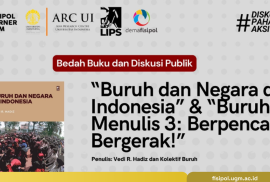
Fisipol Corner UGM Raises Labor Issues in Book Review with Experts

Yogyakarta, January 15th 2025 ─ Looking at the movement of labor organizations in Indonesia, Fisipol Corner of Universitas Gadjah Mada held a book review session of Labor and the State in Indonesia and Labor Writes 3: Split, Move on Wednesday (15/1). Both books contain reflections on labor experiences that are packaged in history so as to produce a picture of the political economy situation from time to time.

Vedi R. Hadiz, author of Labor and the State in Indonesia, states that the cultural condition of the current government’s fundamental system is not much different from the New Order. Starting from the question of why the voice of workers is still weak, even though democratization has been running after the reformation, Vedi thinks that this condition is due to the complex situation of the government. “Even though during the new order, the institutions and the government were destroyed, the power relations are still running until now,” explained Vedi. read more

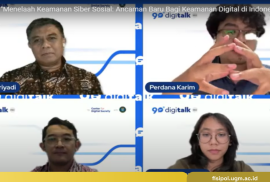
CfDS Holds DigiTalk, Emphasizing the Importance of Mainstreaming Social Cybersecurity Amid Digital Transformation

Yogyakarta, 24 January 2025–CfDS Fisipol UGM held another discussion session at the DigiTalk event, “Examining Social Cyber Security: Indonesia’s New Digital Threat?”. The discourse examined the problems developing amid increasingly massive digital transformation and the rise of online misinformation. Therefore, cybersecurity becomes crucial for integrating technological protection with socio-cultural awareness through effective regulation. 

“Social cybersecurity focuses on manipulating and influencing individual humans, groups, or communities that impact social, cultural, and political behaviour. Both use technology, but the technology is not to steal credentials or take over an electronic system. But it is used to influence the mindset of the target, community, or group,” said Dhoni Kurniawan, Policy Analyst of the Indonesian National Cyber and Crypto Agency.  read more