Arsip:

SDGs 4: Quality Education

UGM’s Faculty of Social and Political Sciences Creative Hub, the Driving Force of Social Entrepreneurship

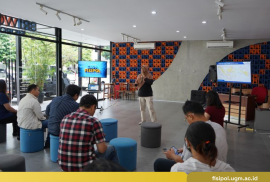
Yogyakarta, July 15, 2025—The Faculty of Social and Political Sciences (FISIPOL) at Gadjah Mada University (UGM) is rich with diverse innovation units operating in various fields, from academic to social. The Creative Hub, or C-Hub, under the faculty’s auspices, is no exception. It brings together various disciplines to elaborate and hone creative ideas that can improve the quality of life.

Using a transdisciplinary approach, C-Hub serves as a dialogue space for young people to create opportunities from the challenges and problems facing society today. These opportunities are developed with a proven spirit of social entrepreneurship (sociopreneurship), which has proven to have social and economic impacts. read more

Coming Soon! Faculty of Social and Political Sciences UGM Offers Free Digital Intelligence Class 2025

Yogyakarta, July 15, 2025─The Faculty of Social and Political Sciences (FISIPOL) of Gadjah Mada University (UGM), through the Center for Digital Society (CfDS), is once again offering the Digital Intelligence course in 2025. The Digital Intelligence course is an annual CfDS initiative that encourages the public, especially students, to become critical, reflective, and empowered digital citizens. This course is an official elective under the Faculty of Social and Political Sciences, Gadjah Mada University, and is open to the general public free of charge. read more

FISIPOL UGM Lecturers Launch New Book on the Theory and Practice of Indonesia’s Political System

The Faculty of Social and Political Sciences (FISIPOL), Universitas Gadjah Mada, has once again achieved an academic milestone with the launch of a new book authored by faculty members and researchers from the Department of Politics and Government: Alfath Bagus Panuntun El Nur Indonesia, M.A., A. Sudiana Sasmita, Ph.D., and Prof. Haryanto.

The book, titled “Mengenal Sistem Politik Indonesia: Pengantar Teori dan Praktik” (Understanding Indonesia’s Political System: An Introduction to Theory and Practice), represents a significant contribution to Indonesia’s political science literature and serves as a strategic reference for students, academics, and practitioners seeking a deeper understanding of the country’s political dynamics. read more

[Call for Articles] – Megashift FISIPOL UGM Open for Submissions Throughout 2025

Are you passionate about writing and interested in issues related to digital transformation? We invite you to contribute your ideas and submit your articles to be published on the Megashift FISIPOL UGM website! ☺️

Important Notes:

Detailed submission guidelines and suggested subtopics are clearly outlined in the official poster.

This call for articles is open year-round, with no submission deadline.

Articles should be no longer than 1,000 words, including references.

Submissions must include citations from publications, journals, or books written by FISIPOL UGM lecturers or researchers. read more

[Call for Abstracts Invitation] – Go South 2025

We would like to invite you to the 2025 Annual Convention on the Global South, organized by the Institute of International Studies (IIS), Universitas Gadjah Mada (UGM). This year’s convention will be held in person in Yogyakarta, on October 1st – 2nd, 2025. 

GO SOUTH 2025’s theme is “70 Years Bandung Spirit: Re-invigorating Decolonial Struggle amidst Geopolitical Turbulence.” It seeks to foster discussions and debates on the dynamics of the Global South, 70 years after the Bandung Conference. As material conditions of the Global South countries have changed and new global-regional powers have emerged, how can such a global emancipatory project be reinvigorated? How can imaginaries of the Bandung Spirit be expanded, to project ideas for a just and peaceful world order amidst current geopolitical turmoils? This forum provides platforms for academics, policymakers, and the general public to connect, collaborate, and interact with peers with regards to the above questions. read more

FISIPOL UGM Faculty Launches Book on Theories and Practices of Indonesia’s Political System

The Faculty of Social and Political Sciences (FISIPOL) at Universitas Gadjah Mada (UGM) continues to affirm its academic excellence with the launch of a new scholarly book authored by three faculty members from the Department of Politics and Government: Alfath Bagus Panuntun El Nur Indonesia, M.A., A. Sudiana Sasmita, Ph.D., and Prof. Haryanto.

Titled “Understanding Indonesia’s Political System: An Introduction to Theory and Practice”, the book offers a significant contribution to political science literature in Indonesia. It serves as a strategic reference for students, academics, and practitioners seeking a deeper understanding of the complexities of the country’s political landscape. read more

DMKP FISIPOL UGM Explores Data Transparency and Alternative Data in the Age of Open Information on Unitalks Episode 2

The Institute for Policy and Development (PolDev), under the Faculty of Social and Political Sciences (FISIPOL) at Universitas Gadjah Mada, has released the second episode of its podcast series, Unitalks. This episode addresses the timely and critical topic of Data Transparency and Proxy Data, highlighting ongoing challenges in ensuring public access to information in Indonesia.

Hosted by Rizki Dwi Lestari, a researcher at the Department of Management and Public Policy (DMKP), the episode features guest speaker Rizki Ardinanta, a researcher at PolDev and Project Advisor at Unitrend. Together, they delve into the complexities surrounding public access to government data—especially in the realm of public policy—where transparency and accessibility remain limited. read more

Department of Social Development and Welfare Celebrates 68th Anniversary

Yogyakarta, July 11, 2025—The Department of Social Development and Welfare (PSdK), Faculty of Social and Political Sciences, Gadjah Mada University (FISIPOL UGM), celebrated its 68th anniversary on Thursday (July 10). Since its founding on July 10, 1957, the department has traveled a long path of service, instilling the values of social development and welfare. Historically, the Department of Social Development and Welfare underwent a name change from the Department of Social Affairs through Government Regulation Number 15 of 1957, more precisely, referring to UGM Rector’s Decree Number 100/P/SK/HT/2010. read more

Indigenous Papuan Women: Forest Guardians Amid Structural Inequality

MEGASHIFT, a publication initiative by the Faculty of Social and Political Sciences (FISIPOL) Universitas Gadjah Mada, has released its latest feature article highlighting urgent socio-political issues in Indonesia. Titled “Indigenous Women and the Politics of Periphery in Forest Conservation in Papua”, the article by Halimatu Sa’diah sheds light on the structural injustices faced by Indigenous Papuan women in their struggle to protect ancestral forests.

The article critically explores how Indigenous women—often positioned at the margins of state power—play a crucial role in forest conservation through their deep-rooted local knowledge. Through the lens of periphery politics, Sa’diah analyzes how centralized governance in Java, industrial expansion, and the inadequate legal protection for Indigenous communities have systematically marginalized women, both economically and socially. read more

Master’s Program in Public Administration at UGM Engages in Regional Autonomy Dialogue with Bapperida DIY

Yogyakarta, July 10, 2025─In a significant step toward experiential learning, Master of Public Policy (MKP) students at Gadjah Mada University (UGM) conducted a field visit to the Regional Development Planning Agency (Bapperida) of the Special Region of Yogyakarta (DIY). This visit was conducted as part of a field study on Regional Autonomy.

The event began with a presentation by Ni Made Dwipanti Indrayanti, Head of Bapperida DIY, who outlined strategic issues related to budget management and asset governance in regional development planning. Students listened attentively to the presentation, noting key points relevant to the implementation of regional autonomy and the complexities involved in local governance. read more