
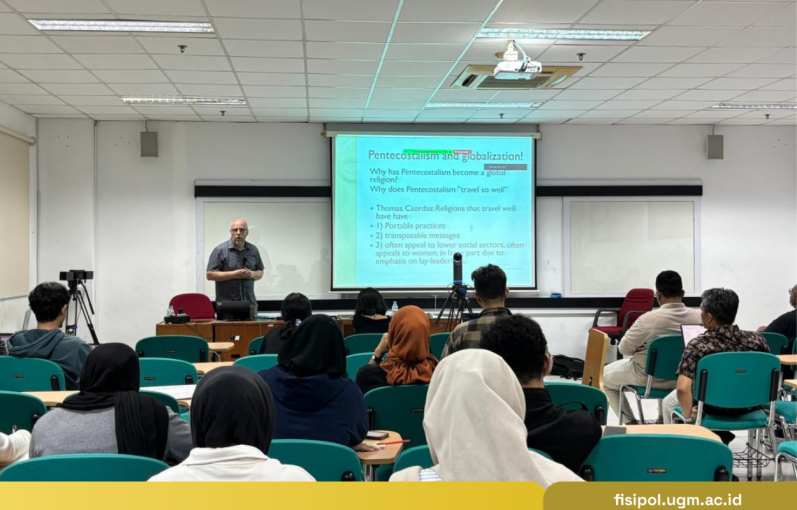
Yogyakarta, April 22, 2026—The Department of Sociology, Faculty of Social and Political Sciences, Universitas Gadjah Mada (FISIPOL UGM), highlighted the relationship between religion and economics in a public lecture on Wednesday (April 22).
Featuring Prof. Martin Lindhardt from the University of Southern Denmark as the keynote speaker, the public lecture, titled “The Economics of Pentecostal/Charismatic Christianity,” sought to understand the relationship between religion and economics, which is becoming increasingly important in Indonesia. Furthermore, religious activities play a significant role in the social and economic life of society.
This public lecture provided an opportunity for the academic community to broaden their understanding of the dynamics of religious economics, which are highly relevant to Indonesia’s current socio-economic conditions. The lecture also explored various aspects of how religious theology can influence economic policy and practice.
Falikul Isbah, the event moderator, reinforced the link between religion and economics during the lecture. He noted, “In various literature, there are discussions about figures like Aa Gym, with concepts like ‘heart management.’ Then there’s ESQ (Emotional Spiritual Quotient). More or less, these trends are similar to the prosperity gospel.” This observation sparked discussion among participants about the implications of these movements for economic behavior and social class.
This public lecture aligns with the Sustainable Development Goals (SDGs), particularly in ensuring inclusive and quality education and promoting equal learning opportunities for all.
Overall, this public lecture at the Faculty of Social and Political Sciences, Universitas Gadjah Mada (UGM), served as an important forum to discuss the complex interactions between religion and economics. It provided a platform for equal access to education and highlighted the importance of understanding these dynamics in fostering a more inclusive society. The insights shared by Professor Lindhardt and the discussions within the lecture inspired the academic community to further explore these critical issues in the Indonesian context.
This event was open to the public and was attended by undergraduate and graduate students of the Sociology of Religion course.