
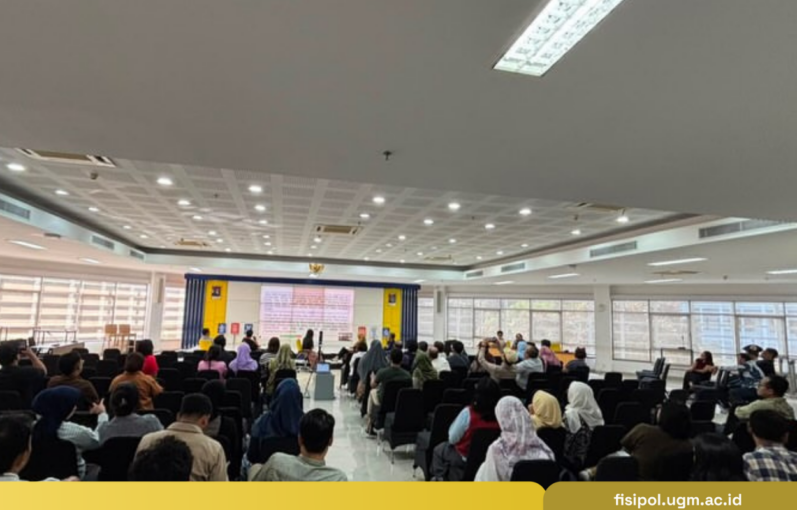
Yogyakarta, August 11, 2026—The Universitas Gadjah Mada Workers’ Union (SEJAGAD) held a forum at the auditorium to analyze the vision and mission statements of four candidates for Dean of the Faculty of Social and Political Sciences (FISIPOL) UGM, focusing on issues regarding the welfare and workloads of lecturers and educational support staff.
A 2025 survey by SEJAGAD revealed that a significant portion of income for lecturers and support staff still comes from irregular sources. Furthermore, the majority of these staff members work more than eight hours a day, and over half of the lecturers report experiencing physical and psychological strain.
Based on these findings, the four candidates were asked to present their flagship programs to address the structural issues that have long impacted the well-being of the academic community.
Arie Ruhyanto, a candidate from the Department of Politics and Government, highlighted the misalignment between service types and employment schemes. He argued for the establishment of minimum welfare standards tailored to workload and emphasized the urgent need for specific regulations for researchers at both the university and national levels.
“There must first be a baseline minimum welfare standard; only then can additional components be adjusted according to respective fiscal capacities and, of course, aligned with the staff’s actual workloads.”
Meanwhile, Fina Itriyati from the Department of Sociology raised the issue of the “care economy.” She proposed guaranteed fixed income for female lecturers on maternity leave, as well as the provision of lactation rooms and universal-access restrooms.
“I propose that fixed incentives remain in place even when they are on maternity leave,” said Fina.
“Lactation rooms are essential as safe zones where mothers can breastfeed comfortably; this also extends to the provision of universal-access restrooms for people with disabilities.” Bahruddin, from the Department of Social Development and Welfare, emphasized a collaborative approach—relying on collegial forums—to determine increases in honorarium standards. He also proposed allocating a budget for the creative economy at the faculty level.
“Let us formulate the scope of these increases together. The Dean’s office, the senate, and the departments should sit down together to decide on the best possible compensation we can offer the best people at FISIPOL,” Bahruddin explained.
“FISIPOL will allocate budget funds (RKAT) for anyone with a creative economy initiative. We must seek out and pursue those opportunities.”
Meanwhile, Prof. Gabriel Lele from the Department of Public Management and Policy proposed a measurable program with specific figures. He targeted increasing the income of administrative and support staff to 1.5 times their current level and ensuring faculty members earn at least three times their base salary, alongside a revision of honorarium standards. Gabriel also proposed providing seed funding to develop an institutional-funded proposal bank.
“It is entirely possible to raise the income of administrative and support staff to one-and-a-half times what they currently receive. Furthermore, ensuring that every lecturer earns at least three times their base salary is a highly feasible goal,” Gabriel stated.
“Those standards need to be revised. I will allocate seed funding. Each department must use that funding to compile a proposal bank. Initiation costs should not fall on individuals; the institution needs to shoulder that responsibility.”