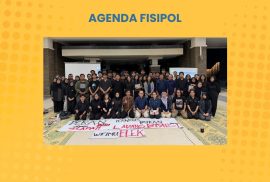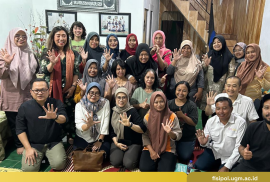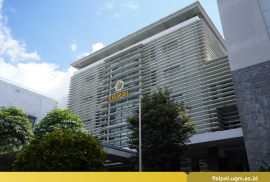
Yogyakarta, March 9, 2026—Lecturers, educational staff, and students of FISIPOL UGM broke their fast together and listened to a sermon from Prof. Suryono in the West Hallway on Monday afternoon (March 9). This breaking the fast was not only used to break the fast, but also as a moment of togetherness for the FISIPOL UGM community. The Dean of the Faculty of Social and Political Sciences, UGM, Wawan Mas’udi, said, “Of course, our breaking of the fast today is not solely to break the fast, as the main purpose of breaking the fast is to break the fast. But more than that, it is to strengthen the bonds of friendship among all members of the Faculty of Social and Political Sciences, UGM,” he said.
Yogyakarta, March 8—The Bala Gadjah Mada Team of the Faculty of Social and Political Sciences, Gadjah Mada University (UGM), restored the Miniature Tropical Rainforest of the National Capital City (IKN) by planting 100 endemic Kalimantan trees with students from SMPN 27 Penajam Paser Utara on February 8, 2026.
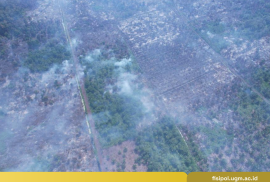
The land, which is now the IKN’s Central Government Core Area (KIPP), was previously an industrial forest concession area with eucalyptus monocultures. This plant has a short cutting cycle—six to seven years—and is designated for the paper industry.
Following the opening ceremony, the event continued with a brief profile presentation by the Study Program Management Unit (UPPS), the establishment of the Final Evaluation Document (FED), and a session on Internal Quality Assurance Implementation. A dialogue with students, lecturers, educational staff, alumni, and users was the final session before the assessment closed.
Yogyakarta, March 5, 2026—The Department of Management and Public Policy (DMKP), Faculty of Social and Political Sciences (FISIPOL), Universitas Gadjah Mada (UGM), held a guest lecture entitled “The Practice of Strategic Policymaking in Indonesia” on Thursday (March 5) at the 4th Floor of the Mandiri Auditorium, FISIPOL UGM. The event featured Dr. Velix V. Wanggai, Chair of the Executive Committee for the Acceleration of Papua’s Special Autonomy Development, to discuss the dynamics and practice of strategic policymaking in Indonesia.
Yogyakarta, March 5, 2026─The Gadjah Mada Youth Team from the Faculty of Social and Political Sciences (FISIPOL) completed a 14-day expedition, social project, and research program in the Indonesian Capital City (IKN). The team consisted of 12 students from the Faculty Student Activity Unit (UKMF) of the Nature and Environment Lovers Group (KPALH) of the FISIPOL Secretariat.
The activity, titled the Environmental Conservation Mission, ran from January 26 to February 10, 2026, and focused on mapping environmental governance, specifically waste management, while also providing concrete contributions to the communities in the buffer zone of the IKN, including Bumi Harapan Village, Pemaluan Subdistrict, and SMPN 27 Penajam Paser Utara (PPU).
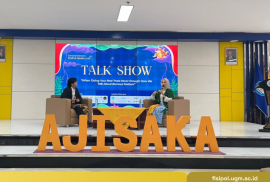
Yogyakarta, March 4, 2026—The FISIPOL Muslim Community raised the theme “Encouraging Steps Towards Actual Change: The Foundation of Islam” in a series of Ramadan events at FISIPOL (RDF) 1448H.
Yusuf Satrio Negoro, a member of the RDF Steering Committee, stated that this theme was chosen in response to current issues related to the erosion of Islamic values. “The background of this year’s RDF is to address various related issues (ecology and government policy) and how Islamic values can provide solutions or become the best values or ethos for resolving environmental damage and other issues,” he said.
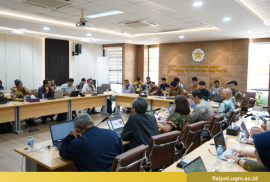
Yogyakarta, March 6, 2026─The Social Development and Welfare (PSdK) Undergraduate Program at Universitas Gadjah Mada (UGM) conducted its LAMSPAK Field Accreditation Assessment on Friday (5/3). Hosted at the FISIPOL UGM Dean’s Meeting Room and continuing at the PSdK Department, the assessment brought together a comprehensive assembly of assessors, faculty leadership, department heads, quality assurance units, and a broad spectrum of stakeholders, including students, alumni, and employers.
The Dean of FISIPOL UGM, Dr. Wawan Mas’udi, officially inaugurated the proceedings. In his opening remarks, Wawan underscored the assessment as a pivotal moment for both strategic mapping and governance evaluation. “This is an effort to showcase the program’s core strengths. Should there be any administrative refinements needed during this process, they will be addressed accordingly,” Wawan stated. He further noted that insights gained from previous assessments have been instrumental in fostering a culture of continuous learning and improvement. As the sixth program within the faculty to undergo this process, PSdK’s assessment is expected to yield benchmark-setting results.
Yogyakarta, March 4, 2026—The Department of Sociology at FISIPOL UGM held an open guest lecture titled “The World of Phenomenology from Schutz’s Outlook” as an effort to deepen students’ understanding the Modern Sociological Theory. The event was held online on Wednesday, March 4, 2026.
The guest lecture featured international phenomenology expert Prof. Carlos Belvedere, an academic from the University of Buenos Aires. The discussion was guided by Delta Fera Apriani, a Sociology alumna of FISIPOL UGM, acting as the moderator. Also in attendance was UGM Sociology Lecturer, Muhamad Supraja, who further enriched the perspective in the academic discussion regarding phenomenology and the social sciences.
Yogyakarta, March 4, 2026 ─ The Youth Studies Centre (YouSure) at FISIPOL UGM, in collaboration with the Youth, Human Capital, & Future of Work (YHCFW) Research Group from the Population Research Center of BRIN, held a virtual book discussion on Wednesday (4/3). The event, titled Reading Group “Reboan” #141 “Introduction to Youth Perspectives: Transition, Culture, and Social Generations” (Pengantar Perspektif Kepemudaan: Transisi, Budaya dan Generasi Sosial) by Oki Rahadianto Sutopo and Elok Santi Jesica.
The discussion, moderated by Delta Fera Apriani, an alumna of the Department of Sociology, Faculty of Social and Political Sciences, Universitas Gadjah Mada (UGM), was designed to enrich understanding of the theoretical foundations of modern sociology from a phenomenological perspective. The enthusiasm of the participants, consisting of students and academics, was evident in the interactive question-and-answer session, which deepened the dialogue between the speaker and the audience.
This guest lecture also reflects the institution’s commitment to supporting the achievement of the Sustainable Development Goals (SDGs), particularly point 4 on Quality Education, by expanding access to global academic discourse through open and collaborative forums. Furthermore, the cross-border collaboration between Indonesian and Argentinian academics aligns with point 17 on Partnerships to Achieve the Goals, which emphasizes the importance of international networking and cooperation in strengthening higher education capacity and developing inclusive and sustainable science.