
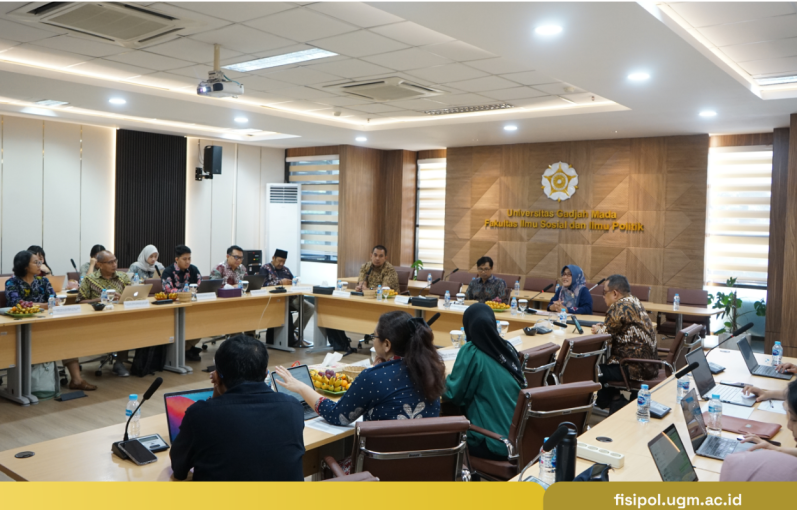
Yogyakarta, April 30, 2026 – In an effort to sustainably maintain educational quality, the Undergraduate Program in Politics and Government (DPP), Faculty of Social and Political Sciences (FISIPOL) Universitas Gadjah Mada (UGM) conducted an offline field assessment phase. This comprehensive evaluation, initiated by the Independent Accreditation Agency for Social, Political, Administration, and Communication Sciences (LAMSPAK), was held centrally in the Dean’s Meeting Room of FISIPOL UGM on Thursday (30/4).
The agenda involved the participation of the dean’s office, department and study program heads, teaching staff, educational staff, and representatives from the quality assurance unit. To provide a holistic perspective, the assessment also involved student representatives, the alumni association, and graduate user partners (employers). The assigned team of assessors consisted of Dr. Dewi Erowati, S.Sos., M.Si. from Universitas Diponegoro, and Prof. Dr.phil. Aditya Perdana, S.IP., M.Si. from Universitas Indonesia.
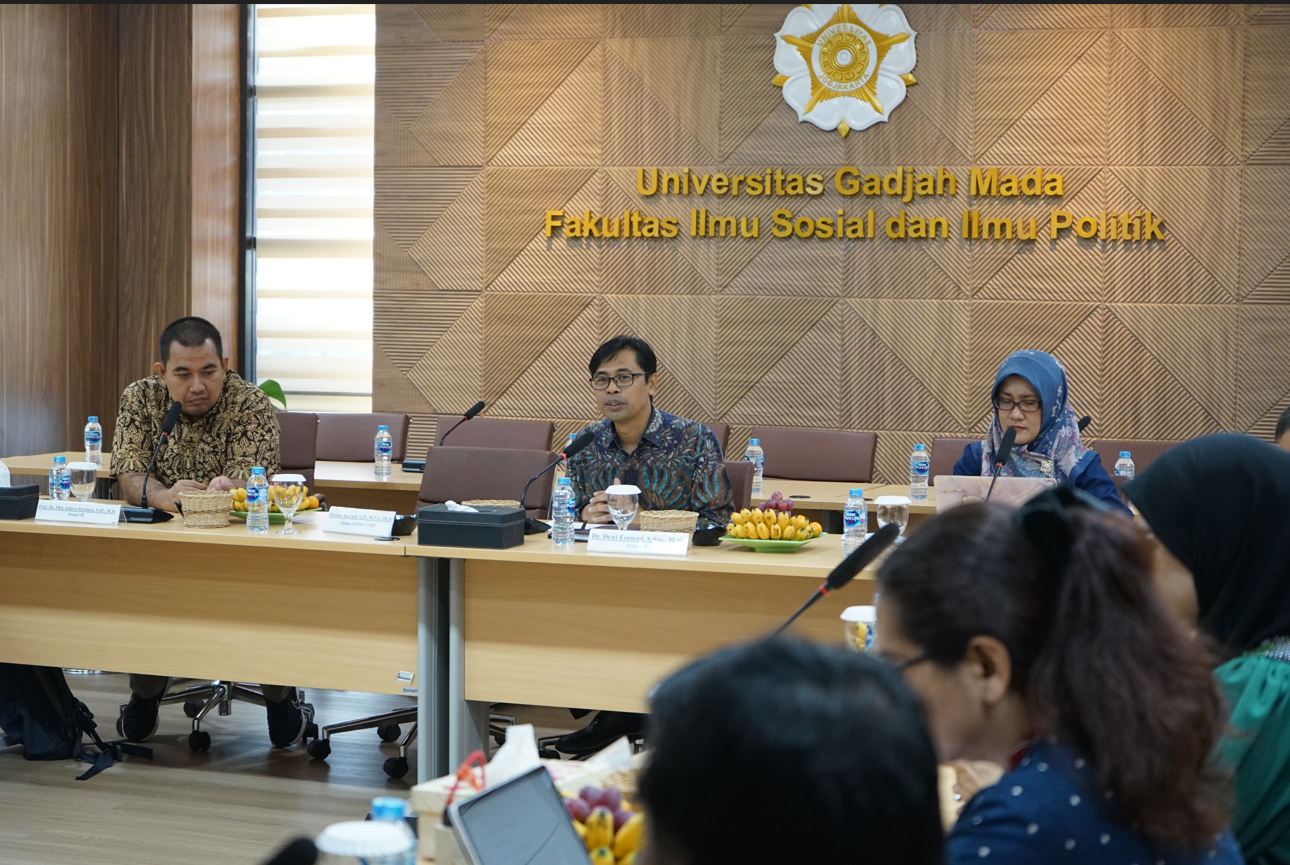
The Dean of FISIPOL UGM, Dr. Wawan Mas’udi, opened the event by briefly introducing the faculty’s academic and non-academic facilities. Specifically, Wawan emphasized that the faculty not only focuses on learning infrastructure but also places great attention on the aspect of student welfare through the provision of wellness support facilities.
He positioned the momentum of this visitation not merely as an administrative step, but as a shared space for reflection to validate performance and map out the study program’s excellences that might have escaped the spotlight.
“Thank you for taking the time to attend, specifically for the DPP undergraduate program, to review our documents and uncover our potential that may still be hidden, as well as to confirm various matters. Through this process, we will learn a great deal,” Wawan said.
Continuing the spirit of improvement, the representatives of the assessor team also conveyed that their visit aimed to conduct a continuous evaluation. This review is fundamentally an effort to map the study program’s track record of governance, innovations, and achievements.
“Our task here is to capture a picture of things—certainly, what you have accomplished over the past five years. Therefore, the results of this can later be used as a reference for the next five-year process,” Dewi explained.
The activity moved on to a series of core stages, namely comprehensive discussions with the Leaders of the Study Program Management Unit (UPPS) and the study program staff, followed by a cross-confirmation stage of the Final Evaluation Document (FED). The review continued with a special meeting with the Internal Quality Assurance Implementation team to ensure that operational education standards are running optimally. The assessment phase also encompassed interactive dialogue sessions with lecturers, students, alumni, employers, mid-level management, and educational staff, before concluding with the handover of feedback and the signing of the Minutes (Berita Acara).
Through compliance with a transparent accreditation process, FISIPOL UGM continues to reaffirm its commitment to ensuring the availability of high-quality and inclusive access to education for all learners. Continuous external evaluations like this serve as a main pillar in building a strong, accountable, and globally competitive educational institution.