
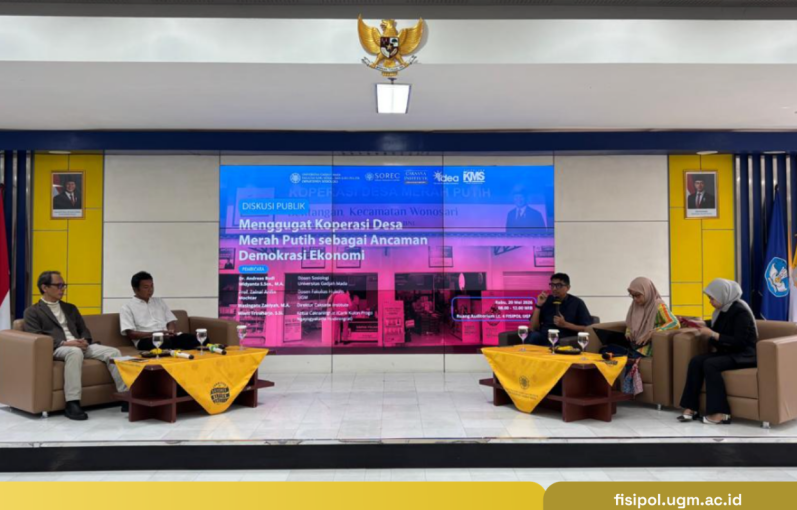
Yogyakarta, 20th May 2026—The Social Research Center at Gadjah Mada University, in collaboration with the Caksana Institute, held a public discussion to address issues with the Merah Putih Village Cooperative (KDMP) policy that threaten economic democracy.
Dr. Andreas Budi Widyanta, one of the speakers, emphasized that the current concept of KDMP has strayed far from the original ideals of Mohammad Hatta’s cooperative concept. “Cooperatives were born out of a shared need among their members, which were then managed democratically without the employer-employee divide. In contrast, KDMP is a tangible manifestation of state corporatism,” he asserted.
Additionally, Widyanta explained how the KDMP policy is being enforced by holding village funds hostage. “Of the total national village fund budget of 60.57 trillion, approximately 34.57 trillion is directly locked up for this program. From a political economy perspective, this phenomenon can be analyzed as the plundering of village fiscal space—or fiscal enclosure—legalized by regulations,” he stated.
Wiwit Triraharjo, as Chair of Carik Kulon Progo Ngayogyakarta Hadiningrat (Cakraningrat), also described how the state’s will is imposed on villages through Village Development Officers. “If a researcher says that the concept of a village cooperative was forced upon them, well, that’s true. So, the so-called Minister of Villages has an extension of his authority known as the village facilitator; if a village hasn’t formed that (KDMP), they’ll be pressured,” he said.
In addition to Widyanta and Triraharjo, other speakers such as Prof. Zainal Arifin Mochtar and Wasingatu Zakiyah also shared their insights during this discussion. Prof. Zainal Arifin Mochtar explained how the KDMP could be used by the regime as a tool for political patronage to win the 2029 elections. This raises concerns about the manipulation of cooperative structures for political gain, which undermines the democratic process.
Zakiyah, on the other hand, explained the constitutional litigation and non-litigation measures that individuals can take against the threat posed by the KDMP. She emphasized the importance of legal awareness and community mobilization in safeguarding economic democracy and the rights of villagers.
This public discussion was held to raise awareness within the movement to protect the rights and economic democracy of villagers.
Given the ongoing challenges resulting from policies like the KDMP, collaboration between academic institutions and civil society organizations is crucial. This fosters a deeper understanding of the unfolding socio-economic dynamics and empowers communities to resist coercive measures that threaten their rights and livelihoods.
The event at FISIPOL UGM marks a significant step toward mobilizing public opinion against policies that undermine economic democracy, reinforcing the importance of grassroots movements in shaping a more just and equitable society.