
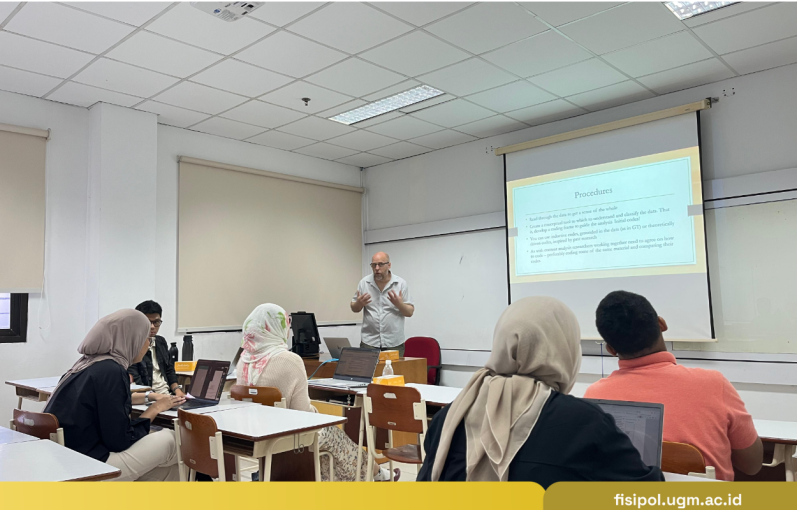
Yogyakarta, April 23, 2026—The Department of Sociology, Faculty of Social and Political Sciences (FISIPOL) Universitas Gadjah Mada (UGM) organized a data analysis workshop entitled “Thematic Analysis and its Use in the Study of Pentecostal Representations of God.” This academic activity was held in Room BG 203 on Thursday (23/4), from 10:00 to 11:30 WIB.
This workshop served as the closing event for the visiting scholar program series of Professor Martin Lindhardt from the University of Southern Denmark. Previously, Prof. Martin had led two main agendas at UGM, namely a sharing session entitled “Digital Sociology: Recent Developments in the Sociological Study of Relations between Digital Technologies and Social Life” on Monday (20/4) and a public lecture on “The Economics of Pentecostal/Charismatic Christianity” on Wednesday (22/4).
Guided by UGM Sociology lecturer, Hakimul Ikhwan, Ph.D., this closing forum—specifically intended for lecturers, professors, as well as master’s and doctoral students—thoroughly explored the use of Thematic Analysis in qualitative research. In his presentation, Prof. Martin explained that Thematic Analysis developed as a derivative of inductive content analysis. However, this method has a distinct feature as it is highly focused on how people represent or conceptualize a phenomenon through the search for patterns of meaning within the data.
Regarding this methodology, Prof. Martin highlighted its advantage in capturing the authentic perspectives of research subjects. “Thematic Analysis is very suitable for explaining the specific nature of how a certain group conceptualizes the phenomenon being studied,” he explained.
As a case elaboration, Prof. Martin shared his experience researching Pentecostal congregations in Chile. Through interview data, he identified various themes of highly personal conceptualizations of God among the congregation. For example, the representation of God as a daily protector, a listener while doing domestic chores in the kitchen, to a figure replacing the role of a husband. These meanings were obtained because thematic analysis relies on a constructionist approach that seeks to elaborate on the meanings individuals attach to their reality.
Through this dissemination and transfer of methodological knowledge, the institution continues its efforts to ensure the availability of equitable, quality education for the academic community, while simultaneously encouraging the realization of solid global partnerships to advance future research capacities.