
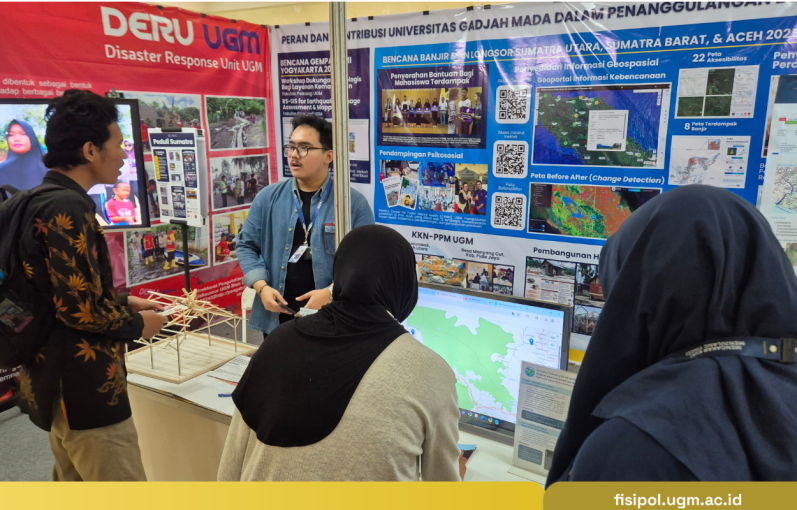
Yogyakarta, May 7, 2026—The Faculty of Social and Political Sciences (FISIPOL) UGM demonstrated its contribution to strengthening community capacity to face disaster risks by participating in the National Disaster Exhibition, part of the 9th Annual Scientific Meeting (PIT) on Disaster. Organized by the Indonesian Association of Disaster Experts (IABI) on May 6–7, 2026, at the Universitas Muhammadiyah Yogyakarta (UMY), the event provided a collaborative space for academics, practitioners, government officials, and the public to showcase innovations, good practices, and tangible contributions to disaster risk reduction in Indonesia.
In its participation at the Universitas Gadjah Mada (UGM) booth, FISIPOL UGM presented its education-based and community empowerment contributions through the Aceh Disaster Education Volunteer program. The presence of this program demonstrates that strengthening community resilience to disasters relies not only on technical aspects and emergency response, but also requires a sustainable social, educational, and community capacity-building approach.
The Aceh Disaster Education Volunteer Program is a form of community service from the Faculty of Social and Political Sciences, Universitas Gadjah Mada (UGM), which focuses on disaster education and improving community preparedness in disaster-affected areas. Through a participatory educational approach, this program encourages communities to understand disaster risks in their surroundings, strengthens disaster literacy, and builds basic skills for responding to emergency situations. The involvement of volunteers in this program serves as an important medium for strengthening collective community awareness of the importance of early mitigation and preparedness.
At the UGM booth, FISIPOL displayed various information regarding the program’s implementation through visual materials, field documentation, and narratives of education-based community strengthening practices. It is hoped that the information presented will help visitors understand how disaster education is implemented at the community level, including strategies for building community participation in identifying risks, developing preparedness measures, and strengthening the social resilience of affected communities.
This contribution from the Faculty of Social and Political Sciences (FISIPOL) UGM is part of UGM’s multidisciplinary approach to disaster management. In addition to FISIPOL, various other units and faculties also showcased disaster innovations and practices, including the UGM Disaster Response Unit (DERU), the UGM Emergency Response Unit (UGM-ERU), the Faculty of Geography, the Faculty of Engineering, the Faculty of Psychology, the Faculty of Medicine, Public Health, and Nursing (FKKMK), and the Faculty of Forestry. This interdisciplinary involvement reflects UGM’s commitment to providing comprehensive disaster solutions, from mitigation and rapid response to post-disaster recovery based on science and community service.
Visitor enthusiasm was high throughout the exhibition. Participants, including academics, students, disaster practitioners, and the general public, actively discussed UGM’s community capacity building model, field experiences, and disaster education approaches. Information about the Aceh Disaster Education Volunteers was one contribution demonstrating the importance of investing in education and strengthening community social capacity in disaster risk reduction efforts.
The participation of the Faculty of Social and Political Sciences (FISIPOL) UGM in the 9th PIT IABI also affirms the position of social and political sciences as a crucial component of disaster management. Through strengthening education, community empowerment, and cross-sector collaboration, FISIPOL UGM continues to contribute to building a resilient, adaptive, and prepared society to face various disaster risks in the future.
This agenda is in line with the commitment of the Sustainable Development Goals (SDGs), especially SDG 4: Quality Education through disaster education and strengthening community-based disaster risk literacy, SDG 11: Sustainable Cities and Communities by encouraging more resilient communities and being prepared to face disaster risks, SDG 13: Climate Action through strengthening adaptation and mitigation capacity against various disaster risks, and SDG 17: Partnerships for the Goals through collaboration between universities, government, disaster practitioners, and communities in developing sustainable disaster knowledge and practices.