
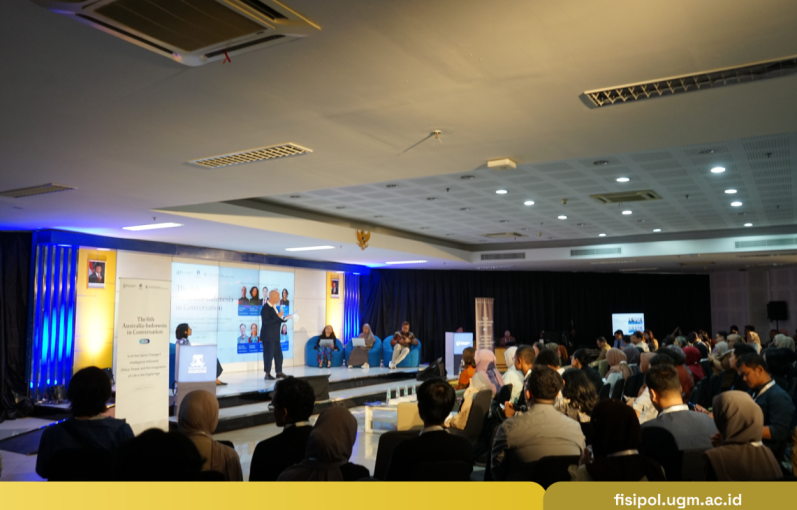
Yogyakarta, July 20, 2026—The advent of Artificial Intelligence (AI) can no longer be perceived merely as a technological marvel; rather, it constitutes a complex instrument with the potential to perpetuate domination and structural inequalities. This discourse emerged during the critical deliberations of The 6th Australia-Indonesia in Conversation (AIC) 2026. The inaugural panel, entitled “Governing Intelligence: Ethics, Power, and the Politics of Knowing,” featured Prof. Robert Hassan and Dr. Silvia Montaña-Niño from the University of Melbourne, alongside Prof. Ridi Ferdiana and Pratiwi Utami, Ph.D. from Universitas Gadjah Mada. Moderated by Dr. Indah Surya Wardhani, the session convened at the 4th Floor Auditorium of FISIPOL UGM on Monday (July 20).
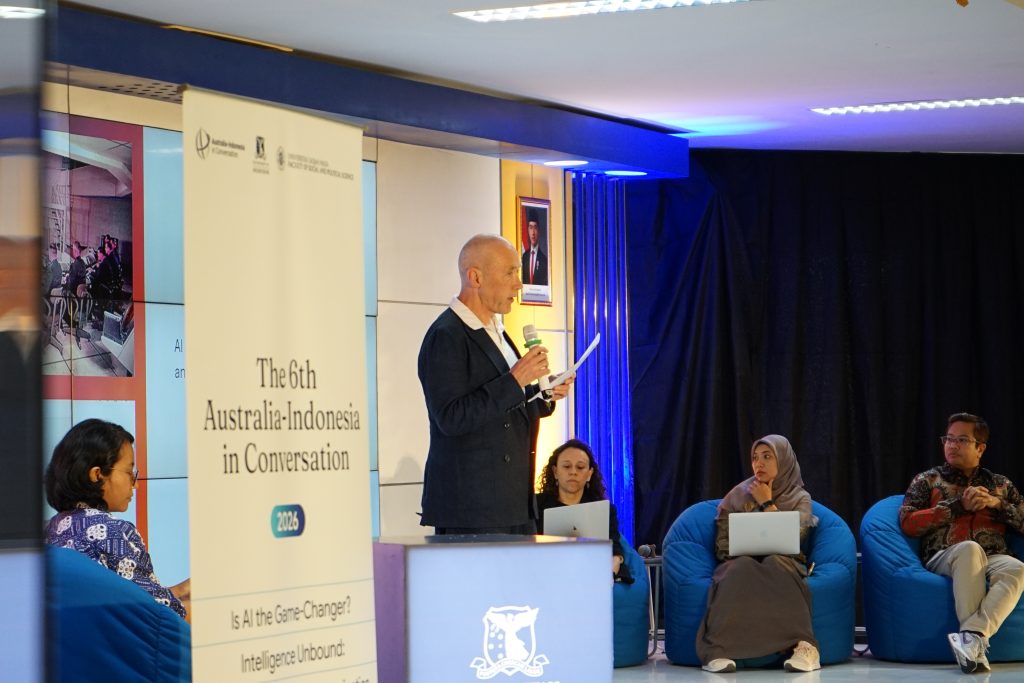
Commencing the panel, Prof. Robert Hassan introduced the concept of Homo Analogicus, positing that human development is fundamentally rooted in tangible physical experiences, social interactions, and gradual learning processes. He argued that the proliferation of digital technology has fundamentally altered human environmental adaptation. Technology no longer functions merely as a supplementary tool; it actively shapes human cognition, labor, and the comprehension of social realities.
“The fact that we stopped evolving physically when we became moderns is because technology does so much for us, and we no longer need to adapt to our environment,” he elucidated.
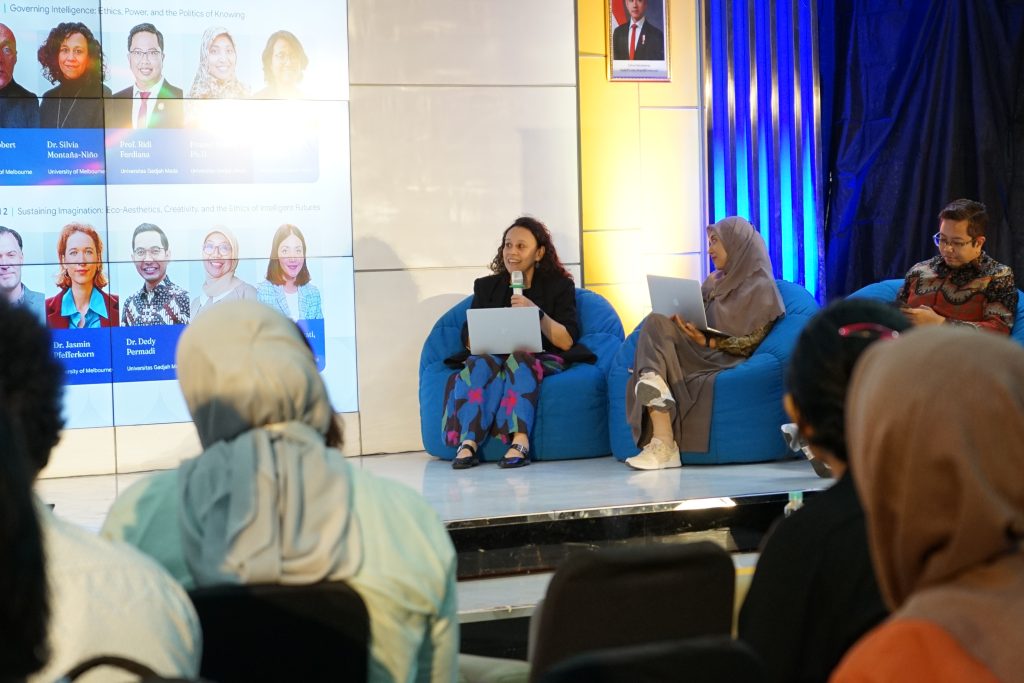
This condition is further compounded by the epistemic challenges delineated by Dr. Silvia Montaña-Niño. She articulated that the political sphere remains one of the sectors most susceptible to media manipulation, notably in the form of fakery. Drawing upon her preliminary research findings, she emphasized that the evaluation of content suspected to be AI-generated or manipulated can no longer rely on singular verification methods. The verification process necessitates triangulation which is comparing diverse sources and methodologies to ascertain informational authenticity whilst remaining heavily reliant on human examination and judgment.
She noted a paradigm shift in verification practices. Whereas journalists historically focused on substantiating empirical facts, the current landscape compels them to examine meta-evidence information detailing the provenance, distribution mechanisms, and authorship of content. Consequently, investigations extend beyond intrinsic content analysis to encompass the extrinsic digital footprints of involved actors, ranging from political figures and satirical accounts to AI creators. For Dr. Silvia, the capacity for critical information verification constitutes a vital foundation for sustaining public trust and fortifying democratic institutions.
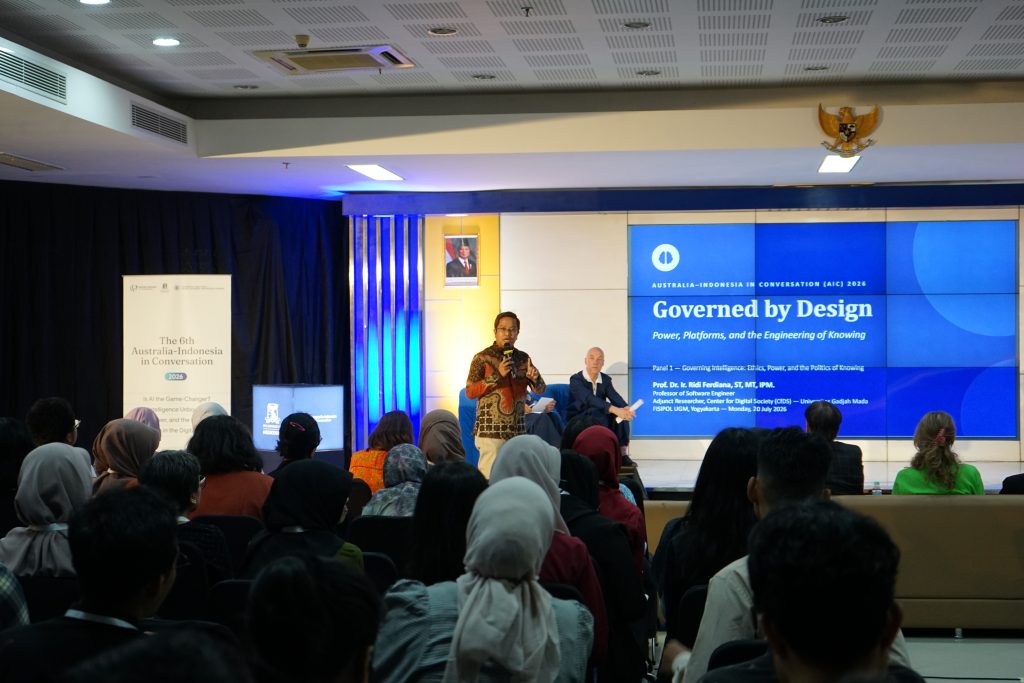
Furthermore, Prof. Ridi Ferdiana underscored the imperative of cultivating responsible AI through a four-pillar framework: Procure Governance, Mandate provenance, Full the commons, and Build the auditors, aiming to actualize governance by design. He cautioned against absolute reliance on technology, advocating for stringent human oversight by consistently implementing the human in the loop principle whenever studying or working with AI. He asserted that such infrastructural sovereignty aligns seamlessly with broader national objectives of fostering industrial autonomy and innovation.

Complementing these analyses, Pratiwi Utami, Ph.D., situated AI within the paradigm of global power relations. She posited that while AI facilitates profound advancements in technical capacities, it does not inherently disrupt pre-existing power structures. Entities commanding data and knowledge retain a dominant position in dictating how reality is produced and subsequently perceived by society. AI frequently reproduces global inequalities, as it is constructed upon data architectures, perspectives, and vested interests dominated by specific hegemonic states or elite groups. Consequently, AI can only be designated as a genuine game changer if it actively opens avenues for historically marginalized groups to partake in defining knowledge, identities, and the trajectory of technological advancement.
“I believe AI would be a genuinely game changer if it changes who has the authority to define knowledge, data, identity, and to define the shape of collective life,” she elaborated.
In conclusion, the inaugural panel of AIC 2026 underscored that AI does not automatically constitute a panacea for complex societal challenges. Devoid of inclusive regulations, accountable governance, infrastructural sovereignty, and a steadfast commitment to social justice, AI possesses the propensity to exacerbate pre-existing inequalities. Therefore, the future development of AI must ensure that technological advancements progress in tandem with the safeguarding of human values, thereby delivering equitable benefits across all strata of society.