
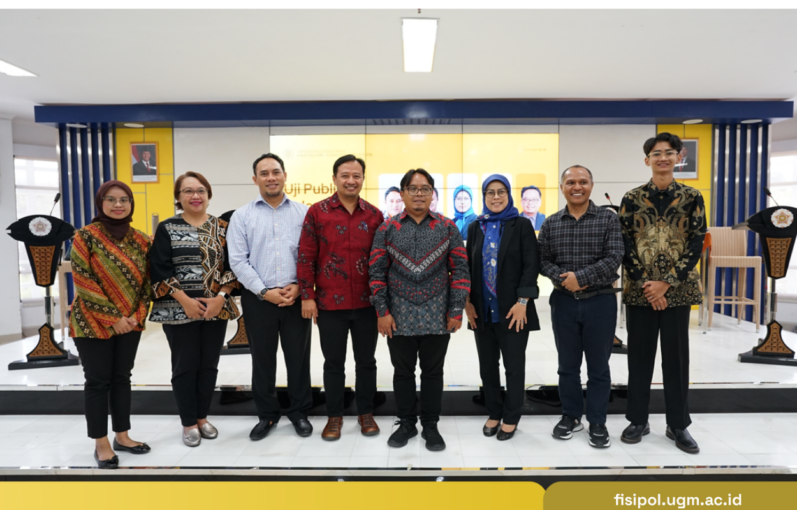
Yogyakarta, August 12, 2026─The Faculty of Social and Political Sciences (FISIPOL) at Universitas Gadjah Mada (UGM) held the next phase of its leadership election through a Public Hearing for the 2026-2031 Dean Candidates. The event served as a platform for candidates to present their ideas and a space to gather aspirations from the entire academic community.
In his opening remarks, the Dean of FISIPOL UGM, Dr. Wawan Mas’udi, reminded everyone of the importance of maintaining harmony amidst the dynamics of the election.
“Regardless of the dynamics, we must remember that FISIPOL is one family. That is the most important thing,” Wawan emphasized.
The Chair of the FISIPOL UGM Senate, Prof. Dr. Phil. Hermin Indah Wahyuni, M.Si., explained that the public hearing is one of the 15 selection stages mandated by Rector’s Regulation Number 7 of 2016, as amended by Number 12 of 2016.
“Today is officially titled a Public Hearing, but it is essentially a sharing of ideas, visions, and missions. What will be presented are inputs from our community. We hope to hear visions on how to steer our beloved big home, FISIPOL UGM, toward a brilliant five years ahead,” she explained.
Echoing this sentiment, the Chair of the Selection Committee, Prof. Dr. Wahyudi Kumorotomo, M.P.P., noted that the process reflects the faculty’s commitment to the values of free speech and institutional transparency.
“The Public Hearing followed by voting is a part of our democracy as a faculty that frequently discusses how democracy is practiced in this republic,” he stated.
Hosted by Milda Longgeita Br. Pinem, Ph.D. as the MC and Dr. Luqman-nul Hakim as the moderator, the event featured four dean candidates: Arie Ruhyanto, Ph.D., Bahruddin, Ph.D., Fina Itriyati, Ph.D., and Prof. Dr. Phil. Gabriel Lele. The forum also involved panelists representing all elements of the FISIPOL UGM community: Dr. Novi Kurnia, M.Si., M.A. (representing the lecturers), Anindya (representing the administrative staff), and Ananda (representing the students).
The hearing began with the first session, where each candidate presented their visions, missions, and proposed work programs. The event then moved into a more fundamental segment where candidates drew random questions to answer in turns, followed by a collaborative dialogue where they responded to one another. There were four in-depth sessions addressing comprehensive issues, namely:
- Academic and Student Affairs. This session discussed the candidates’ strategies and their first 100-day action plans to address limited classroom facilities, high administrative burdens, and suboptimal aspiration channels. The candidates were also asked to state their commitment to maintaining the quality of curriculum and teaching without compromising the academic autonomy of each department.
- Research, Community Service, Collaboration, and Alumni Relations. This session focused on creating an inclusive and conducive academic environment. The candidates outlined concrete steps to establish two-way communication channels that are more open, warm, safe, and responsive, ensuring all aspirations are heard without rigid bureaucratic barriers.
- Finance, Assets, and Human Resources. This session tested the candidates’ strategies to ensure that the allocation of operational budgets and asset utilization are handled transparently, efficiently, and equitably across departments. This management must genuinely support the lecturers’ Tri Dharma (Three Pillars of Higher Education) responsibilities, provide adequate facilities and incentives for administrative staff, and secure funding for student activities.
- Governance and Internal-External Relations. This session highlighted the importance of a governance system that humanizes the entire academic community. The candidates elaborated on their strategies to relieve lecturers from excessive bureaucratic tasks, provide participation opportunities and career security for administrative staff, and deliver responsive public services for students.
The public hearing concluded with a closing statement from each candidate. Through this open aspiration-gathering process, FISIPOL UGM is expected to elect a leader capable of guaranteeing access to quality education, reducing disparities among campus elements, and building a strong, equal, and truly just institutional system.