
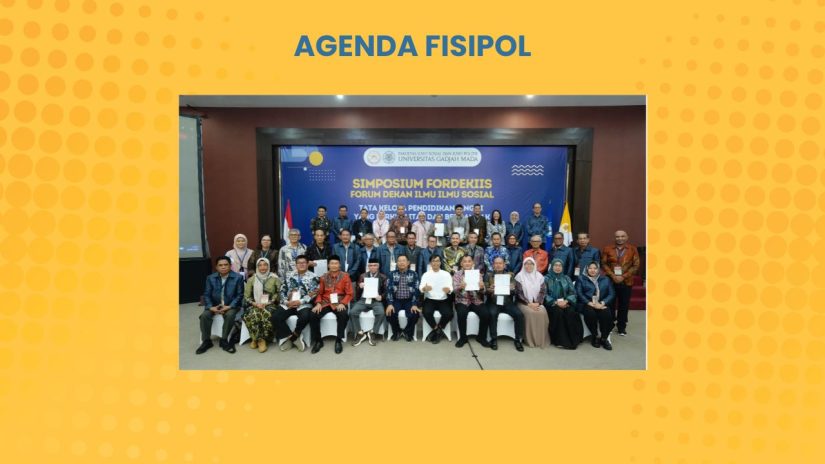
The Faculty of Social and Political Sciences at Universitas Gadjah Mada (FISIPOL UGM) hosted the 2026 National Symposium of the Forum of Deans of Social Sciences (FORDEKIIS) on Friday, June 12, 2026, at the FISIPOL UGM Jakarta Campus. The symposium was organized in response to the evolving landscape of higher education governance in Indonesia and the increasingly complex challenges facing social sciences in a rapidly changing global environment.
Carrying the theme “High-Quality and Impactful Higher Education Governance,” the symposium served as a strategic platform for deans and faculty leaders from social science faculties across Indonesia to exchange ideas, share institutional experiences, and develop collaborative strategies for strengthening the future of higher education.
Throughout the symposium, participants engaged in discussions on a range of pressing issues shaping Indonesia’s higher education sector. Key topics included the future direction of university governance, strategies for enhancing educational quality and relevance, the implementation of independent accreditation through the Independent Accreditation Agency for Social Sciences, Politics, Public Administration, and Communication (LAMSPAK), and efforts to strengthen FORDEKIIS as a collaborative network for social science faculties nationwide.
The symposium also featured Prof. Dr. Pratikno, M.Soc.Sc., Coordinating Minister for Human Development and Cultural Affairs of the Republic of Indonesia, as the keynote speaker. In his address, he offered strategic insights into Indonesia’s human capital development agenda and emphasized the critical role of universities in generating knowledge, innovation, and evidence-based public policy to address the nation’s evolving development challenges.
By convening this national forum, FORDEKIIS seeks to reinforce collaboration among social science faculties in responding to the rapid social, political, economic, and technological transformations shaping higher education today. The symposium is also expected to generate policy recommendations that contribute to building a higher education system in Indonesia that is more inclusive, adaptive, accountable, and impactful.
Hosting the symposium underscores FISIPOL UGM’s commitment to fostering academic collaboration and advancing higher education that remains responsive to societal needs. It also reaffirms the faculty’s dedication to strengthening the contribution of the social sciences in supporting sustainable national development through research, education, and policy engagement.
The symposium reflects FISIPOL UGM’s continued commitment to advancing the Sustainable Development Goals (SDGs), particularly SDG 4 (Quality Education) by promoting excellence and effective governance in higher education; SDG 16 (Peace, Justice, and Strong Institutions) by strengthening accountable, transparent, and responsive educational institutions; and SDG 17 (Partnerships for the Goals) by expanding collaboration and institutional networks among universities to advance higher education and support Indonesia’s long-term development.