
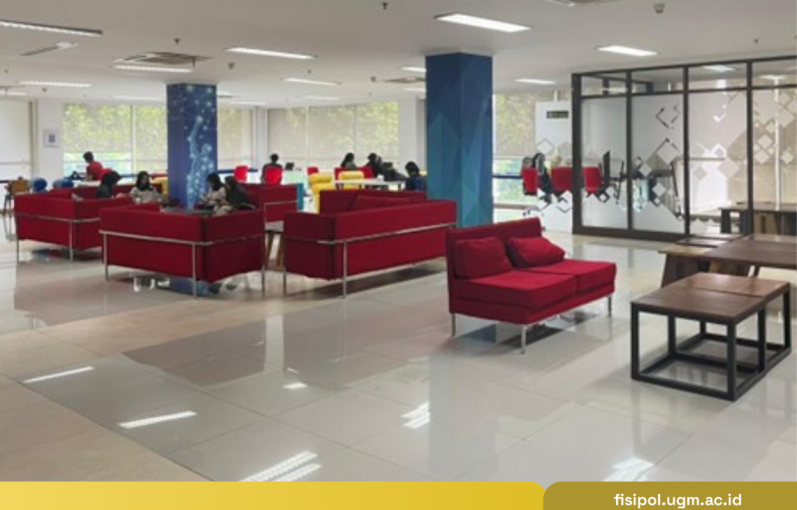
Yogyakarta, April 18, 2026─The Faculty of Social and Political Sciences (FISIPOL) at Gadjah Mada University (UGM) continues to innovate in supporting a collaborative learning ecosystem for its students. One tangible manifestation of this commitment is the optimization of the Digital Library (Digilib) facilities through an online Room Reservation service. Now, academic members can conveniently book discussion rooms or quiet, representative co-working spaces directly through the official website at https://digilib.fisipol.ugm.ac.id/.
The introduction of this online booking system is designed to accommodate the high demand for collaborative spaces among students. There are six room options available for various academic agendas, ranging from research sessions, group work, joint study, to organizational meetings. The facilities include Room 2.1 and 2.2, each with a capacity of 10 people, Room 3.2 for 8 people, Room 3.3 with a capacity of 10 people, and Room 3.4 for 5 people. In addition to conventional discussion rooms, Digilib also caters to students’ multimedia production needs by providing a Green Screen Room.
The reservation process is designed to be highly accessible and informative. In addition to the official website, students can easily check availability and book rooms through the “RSV Room” highlight on the Instagram account @perpusfisipol_ugm. The efficiency of this new system is greatly felt by users of the facilities.
“It’s really convenient to be able to reserve a room online. The process is easy, so there’s no need to fight over who gets to use the room in the Digilib,” said Ayu, a FISIPOL student, during an interview on Friday (April 17).
The digitalization of room booking is a commitment from the faculty that aligns with the Sustainable Development Goals (SDGs). Providing equitable access to educational support resources directly contributes to SDG 4 on Quality Education. At the same time, the utilization of digital technology in collaborative space infrastructure supports SDG 9 regarding Industry, Innovation, and Infrastructure.
Through this service breakthrough, FISIPOL UGM reaffirms its dedication not only to guide students through the academic curriculum but also to provide a responsive, structured, and inclusive environment to support students’ achievements and creativity. The integration of technology in educational facilities is crucial in today’s digital age. By ensuring that students have access to the internet and modern technologies, FISIPOL UGM is paving the way for a more effective learning experience. This initiative not only enhances the academic environment but also prepares students for the challenges of the future workforce.
Moreover, the online reservation system exemplifies how educational institutions can leverage technology to improve operational efficiency. By streamlining the booking process, FISIPOL UGM is setting a standard for other faculties and universities to follow, demonstrating that innovation can lead to better resource management and student satisfaction. In conclusion, the integrated room reservation service at FISIPOL UGM’s Digital Library is a significant step towards enhancing the educational experience for students. It reflects the university’s commitment to providing quality education and fostering an innovative learning environment, ultimately contributing to the broader goals of sustainable development.