

Yogyakarta, June 4, 2026—The Master of Public Policy and Management, Faculty of Social and Political Sciences (FISIPOL), Universitas Gadjah Mada (UGM) organized the Publicness Forum. Held virtually on Thursday (04/06), this public dialogue space carried the theme “Towards Living Space Inclusivity: Rawa Tripa and the Remaining Hope.” This event serves as a critical response to the increasingly alarming ecological and agrarian crisis in Rawa Tripa, one of the most important and historic peat swamp ecosystems in Indonesia.
Rawa Tripa is not merely an ordinary landscape, but an ecological life buffer that is highly vital for environmental stability. However, realities on the ground indicate that this region is facing massive multidimensional pressures. This forum sharply highlighted the various structural challenges threatening the sustainability of Rawa Tripa, ranging from the escalation of environmental damage due to land conversion, entangled governance conflicts, area encroachment practices, to the complex issue of weak law enforcement. The complexity of these problems ultimately not only triggers ecological disasters but also deprives local communities of their living space rights.
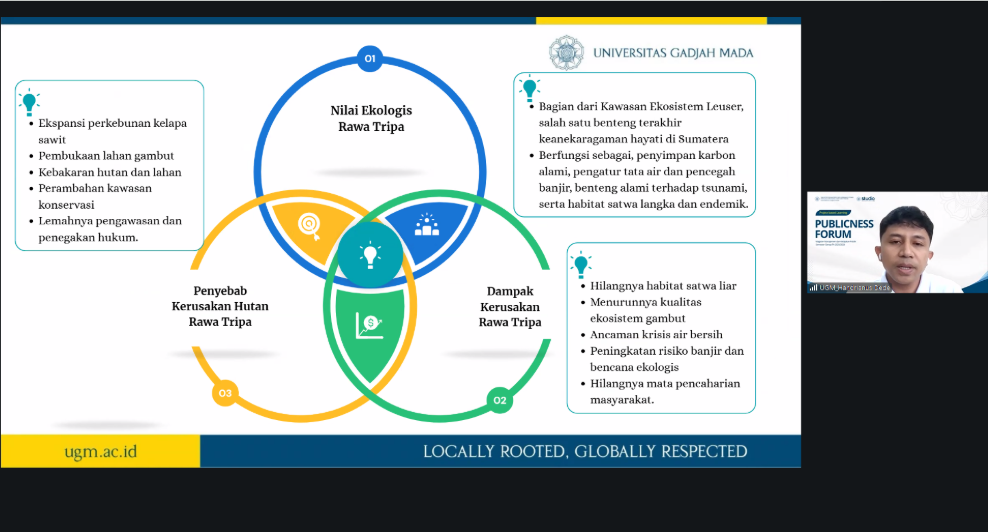
“Now, floods come periodically up to three times because Rawa Tripa can no longer absorb water. Moreover, if a fire breaks out on the peatland, it is not easily extinguished except with high rainfall,” stated Indra Naryani, a community member of Nagan Raya.
Recognizing that the Rawa Tripa crisis cannot be resolved through a sectoral approach alone, the Publicness Forum was specifically initiated to comprehensively bring together diverse perspectives. This discussion involved representatives from government elements, academics, Non-Governmental Organizations (NGOs), and civil society groups. This cross-actor meeting aimed to formulate a problem-solving framework that is not only pro-environment but also inclusive and prioritizes social justice values. Democratic environmental governance necessitates the active involvement of the community as policy subjects.
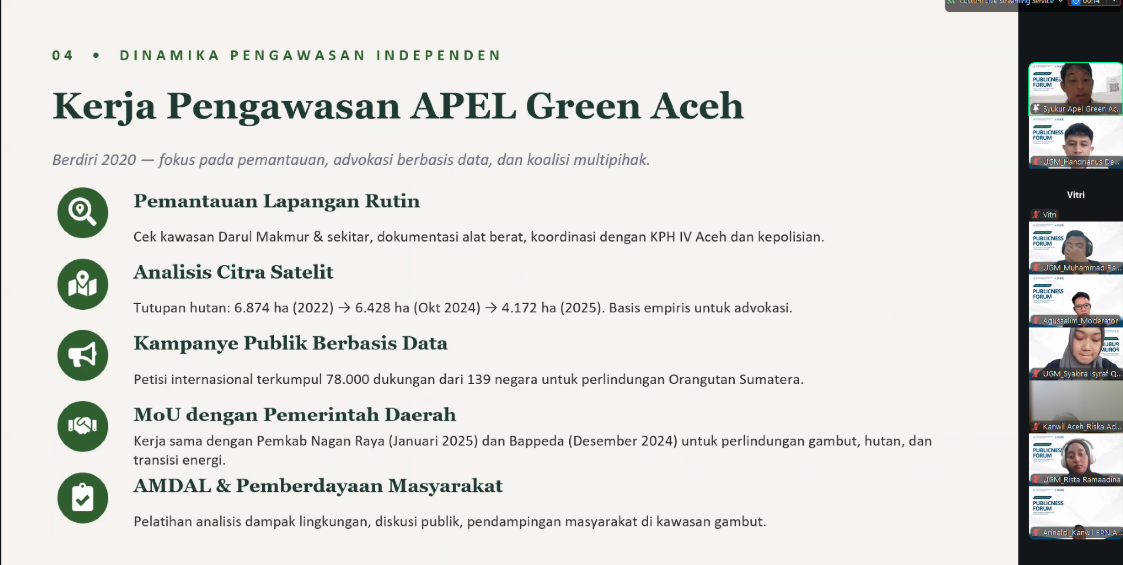
Emphasizing the urgency of collaboration and the absolute responsibility of the state, Rahmad Syukur, as the representative of Apel Green Aceh, delivered a firm statement regarding the dimension of sustainable ecosystem protection.
“We must look at the socio-ecological perspective present there. The ecosystem (Rawa Tripa) supports the climate, water, and wildlife. The government has an obligation to restore their habitat, not relocate them,” concluded Rahmad Syukur before hundreds of forum participants. This statement serves as a starting point that restoring Rawa Tripa is a necessity to ensure the sustainability of life across generations.