
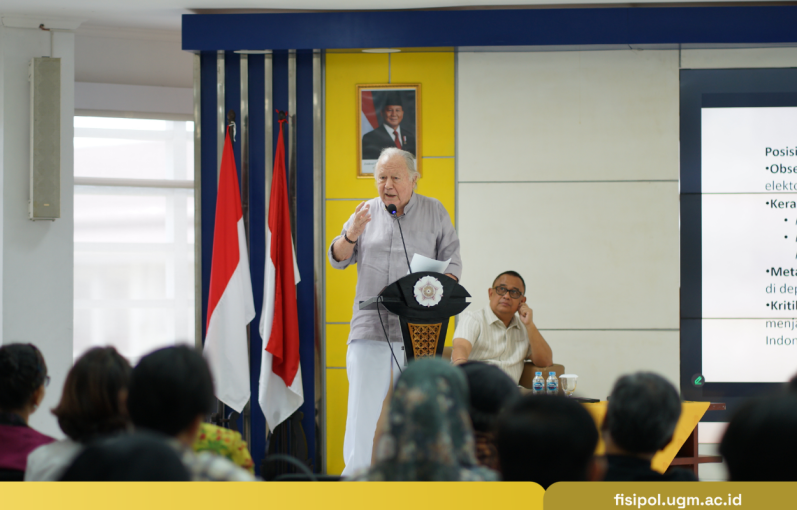
Yogyakarta, June 2, 2026—The Doctoral Program in Political Science at Universitas Gadjah Mada (UGM) hosted a public lecture to discuss the book Understanding Jokowi: Progressive Realism in Indonesian Politics (2014–2024). The event marked the start of a two-day colloquium for doctoral students in Political Science at UGM.
The public lecture was attended by undergraduate, master’s, and doctoral students from UGM’s Department of Political Science. Amid the dominance of political researchers from Australia and the United States in Indonesia, this event offered a new perspective on Indonesian politics from a French academic tradition.
Jean Couteau, the keynote speaker at this event, is a French intellectual, cultural figure, and observer of Indonesia who has dedicated most of his life to understanding Indonesian society, culture, and political dynamics. In his book, Couteau offers an in-depth analysis of President Joko Widodo’s leadership through a perspective he calls “progressive realism.” Couteau seeks to understand Indonesian politics by re-adopting a historical-structural approach to analyze Jokowi’s leadership and how Jokowi expands the space for negotiation regarding Indonesia’s economic and political legacy.
“Jokowi has succeeded in significantly expanding the economic foundation and paving the way forward. However, it is also necessary to expose the collusion between political parties, the tax system, security agencies, and moral authorities that lies behind this economic expansion,” he said. This critical perspective highlights the complexity of Jokowi’s leadership and the challenges that remain in Indonesian politics.
The event is significant as it contributes to the growing body of intellectual literature on the figure and leadership of Joko Widodo. This public lecture aims to shed light on one of the most critical periods in Indonesia’s post-Reform political history. By incorporating diverse perspectives, the event aligns with the Sustainable Development Goals (SDGs), particularly in promoting quality education and fostering global partnerships.
Couteau’s insights encourage students and academics to think critically about the implications of Jokowi’s policies and the broader socio-political context in which these policies operate. The event also serves as a platform to foster collaboration among academics from developing nations, emphasizing the importance of inclusive dialogue in addressing global challenges.
In conclusion, the public lecture and subsequent colloquium represent significant steps toward enriching the academic landscape in Indonesia. By integrating international perspectives, UGM’s PhD Program in Political Science not only enhances the quality of education but also builds global partnerships that are essential for addressing the complexities of contemporary political issues.