Arsip:

SDGs 9: Innovation and Infrastructure

Raising Environmental Issues, the Gadjah Mada Youth Team from the Faculty of Social and Political Sciences (FISIPOL) Successfully Completes Expedition and Community Service in the IKN

Yogyakarta, March 5, 2026─The Gadjah Mada Youth Team from the Faculty of Social and Political Sciences (FISIPOL) completed a 14-day expedition, social project, and research program in the Indonesian Capital City (IKN). The team consisted of 12 students from the Faculty Student Activity Unit (UKMF) of the Nature and Environment Lovers Group (KPALH) of the FISIPOL Secretariat.

The activity, titled the Environmental Conservation Mission, ran from January 26 to February 10, 2026, and focused on mapping environmental governance, specifically waste management, while also providing concrete contributions to the communities in the buffer zone of the IKN, including Bumi Harapan Village, Pemaluan Subdistrict, and SMPN 27 Penajam Paser Utara (PPU). read more

CfDS FISIPOL UGM and Pulitzer Center Strengthen the Role of Advocates in Addressing Algorithmic Inequality in Online Motorcycle Taxi Platforms

Jakarta, February 3, 2026—The use of artificial intelligence (AI) in online motorcycle taxi platforms has become a system that actively regulates, assesses, and disciplines drivers. Amidst the lack of algorithmic transparency and weak legal protection for platform workers, the Center for Digital Society (CfDS) of Universitas Gadjah Mada (UGM) and the Pulitzer Center held an offline workshop at the Faculty of Social and Political Sciences (FISIPOL) of Universitas Gadjah Mada (UGM) Jakarta Campus on Tuesday (February 3). The workshop, titled “Strengthening the Role of Advocates in Addressing Algorithmic Inequality in Online Motorcycle Taxi Platforms in Indonesia,” aimed to bridge empirical research findings and investigative reporting with legal practice by strengthening the capacity of advocates and digital rights advocates to understand, critique, and challenge the algorithmic systems that shape working conditions in the platform economy. This event brought together academics, researchers, representatives from taxi and motorcycle taxi driver associations, and legal practitioners to discuss litigation pathways, regulatory gaps, and data-driven advocacy strategies. read more

IIS Releases Monthly Review #9: Reading Indonesia and Global Dynamics amid Shifting Geopolitics

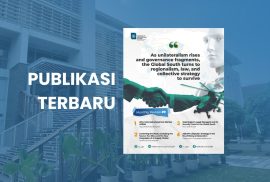
The Institute of International Studies (IIS), Faculty of Social and Political Sciences, Universitas Gadjah Mada, has released IIS Monthly Review #9 (January 2026), addressing key global dynamics shaping Indonesia’s position in international affairs. The publication covers issues ranging from foreign policy direction and AI geopolitics to evolving traditional and non-traditional security challenges amid rising great-power unilateralism.

In the Indonesia and the World section, the review highlights Indonesia’s strategic role in ASEAN amid increasingly transactional foreign policy trends. It emphasizes strengthening regional multilateralism to sustain Indonesia’s position as a de facto leader in Southeast Asia. read more

Faculty of Social and Political Sciences UGM Strengthens Research Ecosystem through Integrated Updates to the 2026 Grant Scheme

Yogyakarta, January 19, 2026—The Faculty of Social and Political Sciences, Universitas Gadjah Mada (FISIPOL UGM), through its commitment to strengthening the research and community service ecosystem, has launched the 2026 Research Grant (HIBAH) Program. Beginning with an online socialization event on Monday (January 19), the Research, Publication, and Community Service Unit (UP3M) presented the latest scheme for the Grant, Facilitation, and Other Funding Program for the 2026 Fiscal Year.

This program, which has been running continuously since 2014, is aimed at lecturers, researchers, and students to encourage the development of quality proposals that contribute to strengthening scientific knowledge and social impact within FISIPOL UGM. FISIPOL UGM continues to evaluate and update its implementation year after year. read more

Rethinking Indonesia’s Electric Vehicle Transition: FISIPOL UGM Scholar Highlights Industrial and Social Justice Dilemmas

Prof. Suharko, a lecturer in the Department of Sociology at the Faculty of Social and Political Sciences, Universitas Gadjah Mada, has published a study examining the challenges of Indonesia’s electric vehicle (EV) transition. The work highlights tensions between industrial downstreaming strategies and emerging risks of delocalization within the broader energy transformation agenda. 

Adopting a sociological perspective, the study critically assesses EV policies framed as part of green development and industrial modernization. It argues that downstreaming—while aimed at increasing resource value—may generate new inequalities if local communities and workers across the supply chain are not adequately protected.  read more

Sovereign AI Fund and Regulatory Challenges, CfDS UGM Holds Discussion on Research Results to Prepare the Foundation for AI Investment in Indonesia

Yogyakarta, October 15th 2025─Artificial Intelligence (AI) is now a hot topic that is not only discussed in academic circles, but also in industry and public policy. Through DIFUSSION (Digital Future Discussion) #128 entitled “Indonesia’s AI Trajectory: From Hype to Investment Challenges,” the Center for Digital Society (CfDS) UGM traces the journey of AI in Indonesia, from technological euphoria to the real challenges in building a sustainable ecosystem that is in line with national interests. read more

CfDS UGM Celebrates a Decade: Driving a Human-Centered & Inclusive Digital Ecosystem Aligned with the Sustainable Development Goals

Yogyakarta, 9 September 2025 – The Center for Digital Society (CfDS) at the Faculty of Social and Political Sciences (FISIPOL) Universitas Gadjah Mada celebrated its tenth anniversary under the theme “A New Era to Rethink Digital.” The celebration also marked the launch of the 2025 Digital Intelligence Course (MKKD), which carries the topic “Building a Human-Centered and Inclusive Digital Ecosystem.”

Since its establishment ten years ago, CfDS has consistently empowered communities through research and advocacy in digital transformation. One of its flagship initiatives is MKKD, a free digital literacy class initiated in collaboration with the Ministry of Communication and Digital Affairs (Komdigi) in 2020. To date, MKKD has reached more than 40,000 participants and features instructors from across sectors, including academia, government, and industry. read more

UGM Social and Political Sciences Expert Speaks at AI Panel Discussion: The Global Humanities Alliance

Yogyakarta, 10 September 2025–The development of Artificial Intelligence (AI) is forcing the world to transform. Since the massive advancement of AI, disruption has emerged in various fields, including education. The Global Humanities Alliance (GHA) held an online seminar on using AI to support the learning process on Wednesday (3/9). The panel discussion, “Digital Transformations: AI and Teaching,” featured experts from the Faculty of Social and Political Sciences, Universitas Gadjah Mada. read more

Driving Just Transitions: Latest Publication by an HI FISIPOL UGM Lecturer in the Annual Review of Environment and Resources

One of the lecturers from the Department of International Relations (DIHI), Faculty of Social and Political Sciences (FISIPOL) UGM, Suci Lestari Yuana, Ph.D., has once again achieved international academic recognition. Together with her collaborators, she has recently published a scholarly article in the prestigious journal Annual Review of Environment and Resources, titled “Transformative Innovation Policy: An Analytical Review of Key Methods and Challenges.”

The article discusses Transformative Innovation Policy (TIP), a new generation of innovation policy designed to address increasingly complex social and environmental challenges—from energy and food crises to mobility systems that remain entrenched in unsustainable modes of production and consumption. The authors emphasize that merely improving technologies or financial instruments is no longer sufficient. Systemic innovations and transformative policies are needed to enable just transitions, ensuring both social justice and planetary health. read more

FISIPOL UGM Lecturers Promote Youth Social Entrepreneurship Ecosystem

Two lecturers from the Faculty of Social and Political Sciences (FISIPOL), Universitas Gadjah Mada, Massageng Widagdhaprasana and Hempri Suyatna, joined as speakers at the online Townhall Muda Yogyakarta forum under the theme “Youth Entrepreneurship Innovation.” On this occasion, both highlighted opportunities, challenges, and innovations in developing a sustainable social entrepreneurship ecosystem.

Director of the Creative Hub (C-Hub) FISIPOL UGM, Massageng Widagdhaprasana, emphasized that FISIPOL’s role through C-Hub is not merely as an incubator but also as a catalyst in building a youth entrepreneurship ecosystem. “We aim to establish a transdisciplinary learning ecosystem that generates new values in social entrepreneurship. Young people must be encouraged to adapt through various cross-sector collaborations,” he explained. read more