Yogyakarta, September 4, 2026—The use of data in the social sciences has become a necessity amid the explosion of digital information. To address this urgent need, the Faculty of Social and Political Sciences (FISIPOL) at Universitas Gadjah Mada (UGM) has optimized the Big Data Analytics Laboratory as a research center that prioritizes a social data science approach to utilize raw data from the digital realm as the primary tool for interpreting, analyzing, and predicting collective social behavior.
SDGs 9: Innovation and Infrastructure
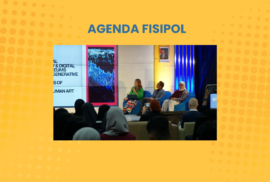
Yogyakarta, 20th July 2026—Australia–Indonesia in Conversation (AIC) 2026 at the Faculty of Social and Political Sciences (FISIPOL) at UGM hosted a panel titled “Sustaining Imagination: Eco-Aesthetics, Creativity, and the Ethics of Intelligent Futures.”
Unlike the previous panel, which discussed the governance of power, this panel focused on the perspectives of human creativity, ethics, and ecological sustainability. In his opening remarks, Wawan Mas’udi, Dean of the Faculty of Social and Political Sciences at UGM, emphasized the importance of discussing the influence of AI on human imagination that is both ethical and ecologically conscious. “This panel invites us to reflect on how technological innovation can support—rather than replace—human imagination, while remaining committed to ethical responsibility and ecological awareness,” he said.
Yogyakarta, July 20, 2026—The focus of the Australia–Indonesia in Conversation (AIC) 2026 event at the Faculty of Social and Political Sciences (FISIPOL) UGM shifted from the politics of knowledge to a fundamental human existential issue: how imagination and aesthetics endure amidst the rapid rise of artificial intelligence (AI). The second panel session, held on Monday afternoon in the Dean’s Meeting Room, was titled “Sustaining Imagination: Eco-Aesthetics, Creativity, and the Ethics of Intelligent Futures.”
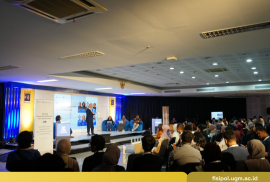
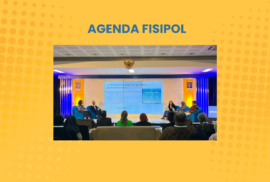
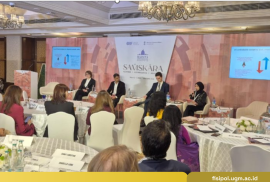
Yogyakarta, July 20, 2026—The advent of Artificial Intelligence (AI) can no longer be perceived merely as a technological marvel; rather, it constitutes a complex instrument with the potential to perpetuate domination and structural inequalities. This discourse emerged during the critical deliberations of The 6th Australia-Indonesia in Conversation (AIC) 2026. The inaugural panel, entitled “Governing Intelligence: Ethics, Power, and the Politics of Knowing,” featured Prof. Robert Hassan and Dr. Silvia Montaña-Niño from the University of Melbourne, alongside Prof. Ridi Ferdiana and Pratiwi Utami, Ph.D. from Universitas Gadjah Mada. Moderated by Dr. Indah Surya Wardhani, the session convened at the 4th Floor Auditorium of FISIPOL UGM on Monday (July 20).
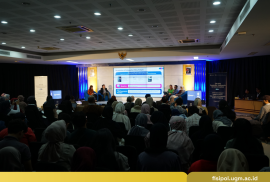
Yogyakarta, July 20, 2026—The 6th Australia-Indonesia in Conversation (AIC) 2026, organized by the Faculty of Social and Political Sciences (FISIPOL) Universitas Gadjah Mada (UGM) in collaboration with the University of Melbourne, continued today, Monday (July 20), with a panel discussion session at the FISIPOL UGM Auditorium.
Centered on the theme “Governing Intelligence: Ethics, Power, and the Politics of Knowing,” Panel 1 highlighted the urgent need for artificial intelligence (AI) governance as it increasingly intersects with the dynamics of ethics and power. The session featured interdisciplinary experts: Prof. Robert Hassan and Dr. Silvia Montaña-Niño from the University of Melbourne, alongside Prof. Ridi Ferdiana and Pratiwi Utami, Ph.D. from Universitas Gadjah Mada. The discussion was moderated by Dr. Indah Surya Wardhani.
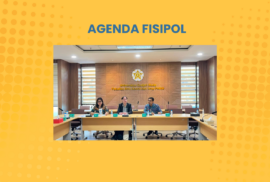
Yogyakarta, July 20, 2026 — The Faculty of Social and Political Sciences (FISIPOL) Universitas Gadjah Mada (UGM), in collaboration with the University of Melbourne, is hosting the annual Australia-Indonesia in Conversation (AIC) 2026 event today, Monday (July 20). Centered on the theme “Is AI the Game-Changer? Intelligence Unbound: Ethics, Power, and the Imagination of Life in the Digital Age,” the event series kicked off with a press conference held in the Dean’s Meeting Room at FISIPOL UGM.
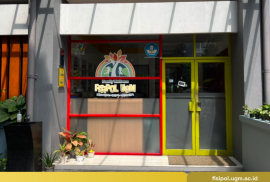
Yogyakarta, June 27, 2026─In order to meet the need for childcare support for the academic community, the Faculty of Social and Political Sciences (Fisipol) of Universitas Gadjah Mada (UGM) established and manages the Family Wellness facility, an integrated daycare service located within the campus environment, precisely on the 1st Floor of the BH Building, FISIPOL UGM.
This facility serves as a concrete solution for lecturers and educational staff who have children. Through Family Wellness, Fisipol UGM is taking tangible steps to institutionalize support for work and personal life balance.
Yogyakarta, May 3, 2026—The 2026 Universitas Gadjah Mada Student Creative Talent Event (Ajisaka) kicked off its series of events with a communication discussion titled “Journalism and Filmmaking” at the Faculty of Social and Political Sciences (FISIPOL) UGM on Wednesday, June 3, 2026. This discussion highlighted the role of alternative media as a tool for advocacy and voicing the public interest, especially amidst the turmoil in traditional mass media.
Featuring two speakers—director and UGM Communication Sciences alumnus Luhki Herwanayogi, and freelance writer and journalist Titah AW—the event not only discussed career opportunities in journalism and filmmaking but also emphasized the importance of leveraging new forms of media to make one’s voice heard.
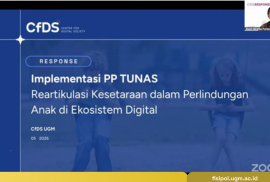
Yogyakarta, May 7, 2026 – The Center for Digital Society (CfDS), Faculty of Social and Political Sciences (FISIPOL) Universitas Gadjah Mada, once again held CfDS Response, carrying the theme “The Enactment of PP TUNAS: Interpreting Equality in Child Protection on Digital Platforms.” This event was held online on Thursday (7/5).
CfDS Researcher and event host, Semeion Bintang Ridho Aunillah, opened the discussion session by highlighting the crucial urgency behind the emergence of this policy, which restricts social media use for children. “The use of digital technology by children is like a double-edged sword. On one hand, digital platforms offer a space for children to learn, express themselves, and develop. But on the other hand, there are numerous negative impacts that arise when children use digital media, such as exposure to harmful content, privacy data exploitation, and, most severely, digital violence against children,” Semeion stated.
Yogyakarta, May 7, 2026─Ernani Dewi Kusumawati, a doctoral student in International Relations at FISIPOL UGM, has achieved a new milestone on the global stage. Joining the Department of International Relations in 2024 as a doctoral student with a concentration in Digital Transformation and Competitiveness (DTC) led her to become Indonesia’s one and only delegate at the Raisina IE-Global Student Challenge 2026, held in New Delhi, India, in March 2026.
This competition is part of the Raisina Dialogue international forum, a strategic gathering that brings together world leaders, government officials, academics, and practitioners to analyze geopolitical and geoeconomic issues. Ernani shared that she initially had doubts because her undergraduate background was in pharmacy. Nevertheless, those doubts transformed into a strong motivation as she delved into the essence of the event. She views an interdisciplinary approach as the key.